Magical Minerals - February Lesson
Geology Topic - What are Rocks?
Last month, we learned all about minerals. This month, we're going to talk about rocks, which are made up of one or more different types of minerals. How do we classify rocks? Basically, rocks are classified by how they formed. That might not seem obvious at first... just looking at a rock, you might not know how it formed. But if you look a little closer, the minerals present and the texture of the rock give you clues as to how it was formed. Let's start off with the three major types of rocks.
Igneous Rocks
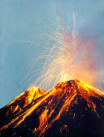 Igneous Rocks - Igneous rocks are formed when molten (melted) rock cools and solidifies. If the molten rock is under the ground, it is called magma, and when it cools, it forms plutonic (also called intrusive) rocks. If the molten rock escapes to the surface of the earth, it is called lava, and when it cools, it forms volcanic (also called extrusive) rocks.
How fast the lava/magma cools will determine what the solid rock looks like. If it cools quickly (for example, if the lava is exposed to the atmosphere or erupts underwater it will solidify within a few minutes to a few days), crystals will not have very much time to form. The result will be what geologists call a fine-grained rock, where the individual mineral crystals are hardly or not visible to the naked eye. If it cools slowly (for example, deep underground, magma may take hundreds, thousands, or even millions of years to cool), the crystals will have lots of time to separate out into their individual minerals and group all together. The result is a coarse-grained rock, where the individual mineral grains may be several millimetres to several metres in size. (Several-metre size crystals are rare. Most common plutonic rocks have crystals several millimetres to several centimetres in size). Igneous rocks with very large grains are called pegmatites.
Volcanic and plutonic rocks are further subdivided depending on their chemistry, and what minerals are present, but I don't want to get into all those gory details here. Common minerals you will find in igneous rocks are quartz, feldspars, biotite (a type of mica), hornblende, pyroxene etc. Igneous rocks (especially plutonic rocks) are good sources of gemstone minerals, such as quartz, olivine, diamond, and many others. Names of some common igneous rocks are granite, basalt, and obsidian. These names are based on chemical composition, texture (fine- or coarse-grained) and origin (volcanic or plutonic). Also considered igneous rocks are the rocks formed from volcanic ash, or combinations of ash and solidified bits of lava that get expelled from a volcano. These are known as tuffs. This name is deceiving, because they are usually not tough at all, but weak rocks very susceptible to erosion.
Basalt: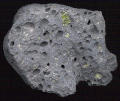 This basalt has holes in it due to gases that were trapped in the lava.
Obsidian: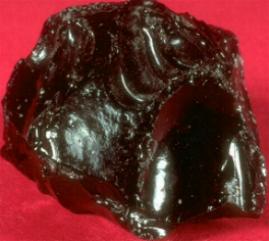 Obsidian is glassy in appearance because it is lava that cooled very quickly, before crystals had a chance to form.
Granite: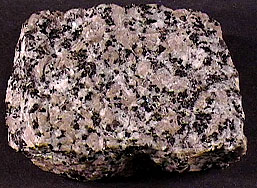 The granite has larger mineral grains because it cooled more slowly... deep underground.
Sedimentary Rocks
Alright, enough about igneous rocks... on to the next rock type! Sedimentary rocks form at or near the surface of the earth, and can either be clastic (which means they are formed from smaller bits of other rocks), or non-clastic (which means they are formed by minerals precipitating out of solution).
Clastic rocks form by weathering or erosion, which means that a solid rock is broken down by water, wind, or ice and the smaller particles are transported to a new location. If you walk along a stream, you may see a lot of gravel or sand being deposited. All of this sand or gravel probably originated as solid rock upstream, was broken off, and then transported by the stream. One rule of thumb is that the smaller, more rounded particles have been transported farther than the larger, angular particles. But how does the loose sand turn into a rock (a sandstone?). There are two main ways that this happens. The first is that the sand is buried by more and more layers of sand or other material, and the pressure starts increasing, causing the grains of sand to fuse together. The other way is that a "cement" material may precipitate out of the fluid in between the sand grains, causing them to stick together. Common cement minerals are calcite and quartz. Often, these two processes occur together.
Clastic rocks are usually classified by grain size. Every discipline in earth sciences (such as geology, engineering, and soil science) has a slightly different way of classifying grain sizes. Generally, the coarsest particles (>5mm in diameter) are called gravel (even larger particles are cobbles and boulders). Rocks that form from gravel-sized particles are called conglomerates if the grains are rounded, and breccias if the grains are angular. The next smallest particles are called sands. They range in size from 0.08mm to 5mm in size, and rocks that form from sand are, quite logically, called sandstones. Finer than sands are silts and clays. At this size, you can't see individual particles without a magnifying glass. Rocks made from these particles are hard to tell apart from very fine-grained volcanic rocks. They are called either siltstones, mudstones or claystones. If they tend to split along parallel planes, they are called shales.
Coarser-grained rocks such as conglomerates and sandstones were likely deposited in high-energy environments, such as rivers, beaches, and deltas. Finer-grained rocks usually form in calmer environments, such as lakes and oceans, far from the shore. This is because it takes a lot of energy to transport large particles. You would not be surprised to see bits of gravel rolling along the bed of a fast-moving stream, but it would be very unusual to see some gravel floating about in the middle of a lake! Very fine sediments, however, are more easily transported in slower-moving water, and take a much longer time to settle to the bottom.
Non-clastic rocks, as mentioned before, form by precipitation of minerals out of solution. This happens a lot in coral reefs, where organisms absorb calcium and carbonates out of the seawater, and precipitate calcite to form their exoskeletons. Over time, the reef builds up, and you end up with a large body of calcite, which is known as limestone. Another type of non-clastic rock is called evaporite. These form when a lake or inland sea dries up, and all of the minerals are left behind. Have you heard of the Dead Sea? It is a very salty body of water, that contains a lot of dissolved minerals. Imagine what would happen if it dried up... all of the salt and other minerals in the water would get left behind as the water evaporated, and you would be left with a thick layer of salty material where the Dead Sea used to be. Although it's not a geologic process this is the reason why your coffee pots and kettles and bathtubs end up with whitish, hard-to-remove deposits, especially if you have hard water. All the minerals get left behind as water evaporates.
Sedimentary rocks generally do not contain valuable mineral deposits (unless the "parent" rock was very rich in a certain mineral), but they are important sources for oil and gas resources. Common minerals in sedimentary rocks are quartz, feldspar, and calcite.
Conglomerate: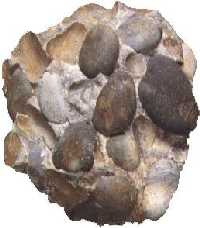 Breccia: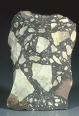
Sandstone: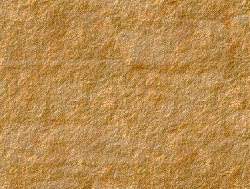
Mudstone: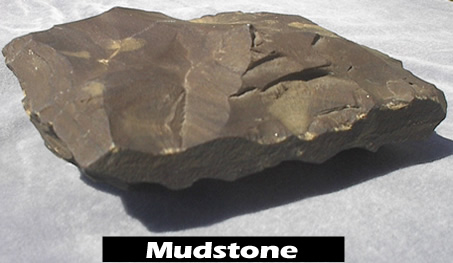
Limestone: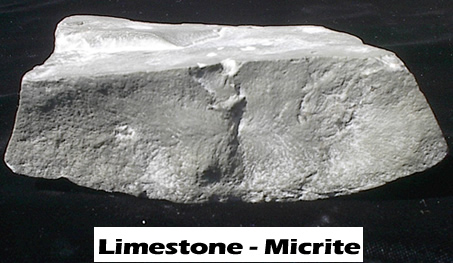
Metamorphic Rocks
The final group of rocks that we will consider are Metamorphic Rocks. Metamorphic rocks are formed when existing rocks are changed due to an increase in temperature and/or pressure. This happens in one of two ways.
Contact metamorphism means that the rock is near to a body of magma. Although it does not get hot enough to melt (rock melts at about 600oC to 1000oC depending on the composition), it is altered by the heat. Different minerals are stable at higher tempertatures, so these minerals may start to replace less stable minerals. Also, natural fluids present in the rock or fluids that escape from the magma body will flow into the surrounding areas and these super-heated fluids will alter the chemistry in the rocks they come in contact with. This is how many vein mineral deposits, such as gold, are formed. The area of rock altered by heat alone usually only extends a few hundred metres away from the magma body. However, if fluids are migrating through the rock, the effects are much more widespread. Contact metamorphism can also happen when lava flows over the ground surface. The heat from the lava will change the top layer of the ground surface, creating metamorphic rock.
The second type of metamorphism is called regional metamorphism, and it involves both pressure and temperature. This usually happens due to plate tectonic effects (which we will talk about next month), although in rare cases it can be due to other events, such as a large meteorite impact. When a large compressional force is applied to a rock, it starts to behave in unusual ways, you could almost say it "flows". Platy minerals, such as micas, tend to line up, with their flat sides perpendicular to the direction of maximum force. (Think of a book... if you stand it on its end, and then press down on the top, it is much less stable than if you lay the book down flat and press on its cover). As the stress increases, the rock, which may have started as an ordinary igneous or sedimentary rock, progressively changes. First, there may be no visible change, but the rock will tend to break along flat planes. It is then called slate. Next, you get a visible alignment of mineral grains. When the rock is in this stage, it is called a schist (don't say this word three times fast!). At very high temperatures and pressures, you end up with bands of minerals of different composition. The rock is then called a gneiss (most people pronounce this as "nice", although I have heard people say "neece"). Metamorphic rocks may have other names, depending on their composition, and the specific pressure and temperature conditions under which they formed (as shown by what minerals are in them).
Common metamorphic minerals are quartz, biotite (mica), hornblende, and calcite (metamorphosed limestone is called marble). There are many gemstone minerals, such as garnet, as well as precious metals, such as gold, that are commonly found in metamorphic rocks.
Schist: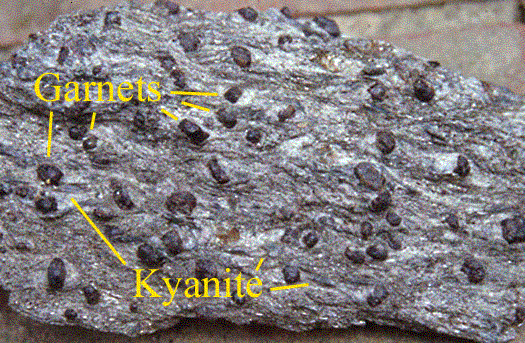 This schist has garnets in it, as well as kyanite (small blue elongated crystals). You can start to see the alignment and "fabric" of the rock developing.
Gneiss: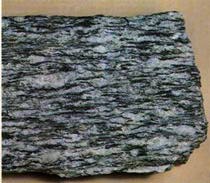 In this rock, you can see the minerals separated out into bands.
As we have seen, the rocks on the earth are always changing! That is part of what makes this planet a very exciting place! Sometimes the changes happen quickly, such as a volcanic eruption, but most of the time, the change occurs slowly... so slowly that we humans have a hard time imagining it. Sedimentary rocks can melt, solidify, and turn into igneous rocks, which are then eroded away by wind and water and become sedimentary rocks again. Igneous rocks can be altered into metamorphic rocks, and then broken up by ice to become sedimentary rocks. Unravelling the geologic history of a single rock, or a whole continent, is a fascinating and challenging endeavour.
Magical Minerals of the Month: Gold and Pyrite (Fool's Gold)
Gold
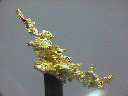
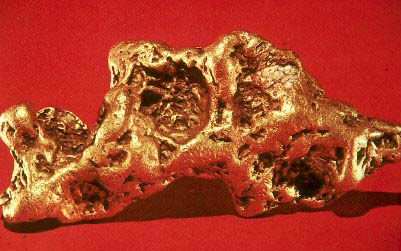
Physical Properties:
Chemical symbol: Au. Gold is a very dense, but soft and malleable mineral, usually found as a native element with some silver, copper, or iron content. It is yellowish-gold in colour, and has a specific gravity of 15.6 to 19.3(pure) (ie. about 15 to 20 times denser than water). It rarely exists as crystals in nature, and is most often found in veins, leaves, or filaments. It has a hardness of only 2.5-3. Gold is originally deposited either in igneous rocks or as veins due to heated fluids in the rocks due to metamorphism. However, as these rocks weather, the gold can be found in sand and mud along river banks. This is how people panned for gold - they took a scoop of sand or mud from the river bank, and gradually washed out the lighter minerals grains. Since the gold is so dense, it stays at the bottom of the pan. Even small flakes of gold would be retained once all the other material had been washed away. The world's leading gold producers are South Africa, Russia, China, Canada, USA, and Brazil (in that order). As we discussed last month, most of the world's gold is used in international trade. It is also used in jewellery, scientific instruments, electrical equipment, and dental appliances.
Magical Properties:
Throughout history, gold has been used by numerous cultures as a sign of wealth, power, and beauty. It was often used as currency, or made into spiritual objects or buried with the dead. When gold deposits were discovered in Australia, the United States, and Canada - people literally became crazed with desire to find a gold nugget and become rich. Gold is said to amplify solar energies, and to increase the power of other gemstones that are set in it. White gold is said to combine the energies of the sun and the moon. It can be used to invoke wealth, although it can lead to greed if used too often.
Pyrite (Fool's Gold)
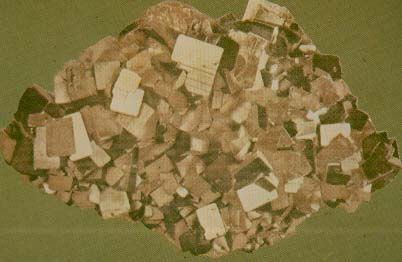
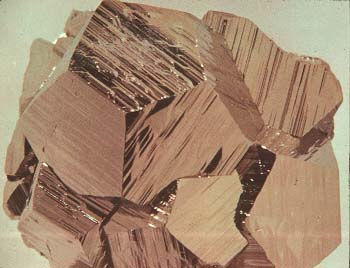
Physical Properties:
Chemical formula: FeS2. Pyrite has a similar colour to gold, which is why it was often mistaken for that element (hence the name... fool's gold). However, once you have looked a little closer, it is very hard to confuse pyrite and gold. Pyrite tends to have a more brassy colour rather than the "warm" gold colour of real gold. It has a specific gravity of only 5.02, much less than that of gold. It is also has a hardness of 6-6.5, much harder than gold. Finally, it very commonly exists in crystalline form (usually cubes, octahedrons, or other many-sided shapes). The faces of pyrite crystals will often have striations, or lines on them. Pyrite is a very common mineral in many parts of the world, and its value is fairly low, except as an ore of sulphur.
Magical Properties
Like gold, pyrite also amplifies solar energies. It is also believed to improve the intellect, memory, and concentration, and it removes negativity. The word pyrite comes from the Greek word for fire "pyr". The ancient Incas used polished mirrors of pyrite for divination purposes. Pyrite was also worn as an amulet by some North American aboriginal cultures.
The Real World: The World Below Us - What's holding up your house?
What is below the building you are in right now? Have you ever considered why a tall office building doesn't sink into the ground? Why does the Leaning Tower of Pisa lean? Why are there cracks in your basement floor? Most people never even think about these things, probably because we never see what's actually under the basement floor, or under the tall office building. Yet, it is very important!
Generally, most buildings either rest on soil or rock. Yes, you could follow the advice of the proverb and build only on solid rock, but that's not always possible. And even rock can be unstable when it is fractured, or has planes of weakness (this is especially problematic when building on rock slopes). In this discussion, I will mostly talk about building things on soils, since that is more common.
Have you ever been to a sandy beach? If you walk along the dry sand, you leave little indentations behind, and generally, you don't even sink in much past your ankles. But walk out a little ways into the wet sand, and you leave much deeper footprints. If you so desire, you can even work your feet in deeper, maybe even up to your knees. The only difference is the fact that the sand is dry in the first case, and wet in the second case. You can also see this if you walk along a dirt path. When it is dry... no problem. But after a heavy rain, there is mud everywhere, and you get filthy. Again, the only difference is the amount of water in the soil. Now imagine you want to put a building on that same soil. All well and good if the soil is dry, but what will happen if it gets wet? Thus we can see that water in the ground is one of the most challenging aspects of designing a foundation for a building or other structure, especially if the water is moving.
Generally, engineers like to classify things, and so they divide soils up into two main types, based on their behaviour. Granular or cohesionless soils are things like sand and gravel, where the individual grains don't stick together. Cohesive soils are things like clay, which sticks together. You can see the difference by considering a small pile of sand, and a small lump of modelling clay. Even if you got the sand wet, you would have a very difficult time getting it to stick together nicely in a ball. With the clay however, it would be no problem - roll it up, form it into any crazy shape you want. Now consider that you want to build a house on one of these materials - obviously, the way you go about doing that will be very different for each different soil type.
Usually, cohesionless soils are pretty good for building things on, especially if they are dense. However, very wet sands and silts don't have as much strength, as we saw with the beach example. Also, in earthquake-prone regions, deep layers of loose sands can turn to a fluid when the ground shakes, and whole buildings can sink into the ground. (This is called liquefaction). You can also run into problems with groundwater in cohesionless soils too.
Liquefaction after an earthquake in Japan: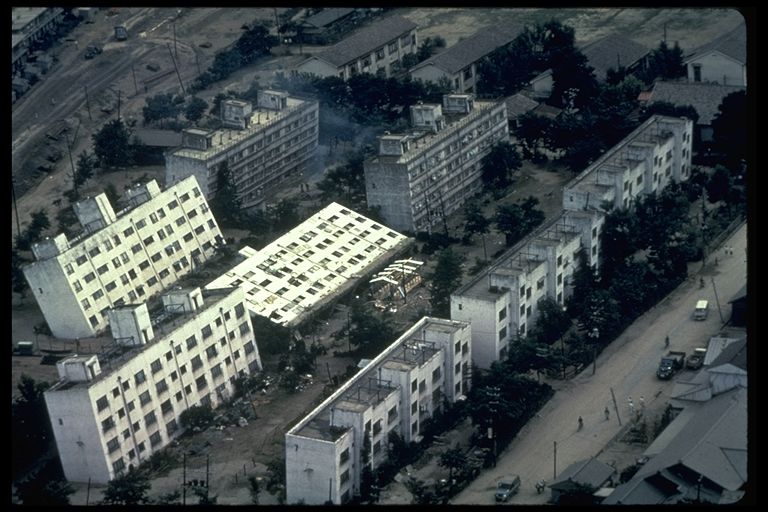
Cohesive soils also have problems - the main one being that they tend to settle when you put a building on them. Settlement is not good - it means the building may crack. Also, some clay soils have a shrinking/swelling behaviour. They shrink when they are dry (think of mud cracking in a dried-up puddle), and they expand when they are wet. One mineral that does this a lot is called "montmorillonite". Clays behave this way because the individual soil particles are so small that they interact with the water molecules around them.
Organic soils are a special type of soil made up partly of minerals and partly of decaying or decayed plant and animal matter. This is the type of soil you want for your garden. However, it is not very good for building things on, since it is very compressible. Usually, this material is removed before anything is built. However, in the case of peat bogs, marshes etc. this is often controversial, because these soils allow growth of specific types of plants and provide habitat for certain animals. The community must then decide what it wants more - the new buildings or the natural land.
So if all these soils have problems, why do we build on them? Fortunately, there are many ways to get around these problems. Generally, there are two different types of foundations for buildings - shallow and deep.
Shallow foundations are things like footings. This uses the concept of spreading out the load over a larger area. Think of walking through some deep snow (those of you in warmer climates may have to imagine this one). If you're just wearing your boots, you'll sink right in. But if you're wearing snowshoes, the weight of your body gets spread out over a larger area and you'll stay on the top. The same thing applies to a building. If you were to just extend the walls down into the soil, they might sink in. But if you put a wider "foot" at the base of the walls, it spreads out the load and your house will stay put.
Deep foundations are things like piles. Basically these are just long poles that are either driven into the ground with a huge hammer, or else a deep hole is drilled and then filled with concrete. These piles make use of the friction between the soil and the pile, as well as the support at the base of the pile in order to hold up the building. Piles can be metal, wood, or concrete. A really thick pile, sometimes used in bridges and piers that support heavy loads is called a caisson. Piles can also be used if you have really weak soils near the surface, but stronger soils (or rock) deeper down. If you put the piles into the strong soil below, they will hold up the weight of the building, which the soft soils above may not have been able to support, even with footings.
One way to get around the problem of settlement in clays is to "preload" the soil. This means that you put a big pile of soil on the site, wait for it to settle, then get rid of the soil and build your building. Then, hopefully, all the settlement will have already occurred, and your building won't crack.
But how do you know what type of foundation to use? This really depends on the types of soils present. Before any building is constructed (even a house), engineers will go to the site and use drills to collect soil samples from deep below the ground surface. They will also look at maps and try to understand the geology of the area, and they will monitor the groundwater levels. They may do testing in the lab and at the site to help them determine the strength of the soils, and other things that they need to design the foundations.
Designing foundations for buildings or anything else where earth materials such as soil or rock are involved, is very challenging. For one thing, you only get to see a very small amount of the actual material that is down there, so you are working with very limited data. Also, natural deposits are usually highly variable, so you can easily miss something important. Whereas with structural materials, such as concrete and steel, you can specify the strength and other properties that you want, do lots of quality control testing, and discard anything that doesn't meet the specifications. With soil, however, you have to work with what is there. (If it is really bad, you can remove it and replace it with better fill material, but this is extremely expensive).
So next time you care to think about it, consider the work that did (or didn't!) go into the design and construction of the foundations of your house, office, or school.
Since I am encouraging you to list your sources of information for the research question, I will do the same for the lessons from now on. Material for this lesson was taken from:
Kehew, Alan E. 1995. "Geology for Engineers & Environmental Scientists, 2nd Ed." Prentice Hall Inc. USA.
Klein, C., and C. Hurlbut. 1993. "Manual of Mineralogy, 21st Ed." John Wiley & Sons Inc.
Raymond, Loren A. 1995. "Petrology". Wm. C. Brown Communications Inc.
Chesterman, Charles W. "National Audubon Society Field Guide to North American Rocks and Minerals".
Craig, R.F. 1997. "Soil Mechanics, 6th Ed." Chapman & Hall.
Proceed to Assignment
Return to Homepage