Astrophysics Problem
Two fast protons in the Sun are approaching each other. According to nuclear
physics, if they are to fuse they must get close enough so that the strong
nuclear force kicks in. This means that they must get within

 of
each other. The only force preventing this is the electric force created by
their like electric charges. Stellar structure models suggest the temperature
in the core of the Sun is some
of
each other. The only force preventing this is the electric force created by
their like electric charges. Stellar structure models suggest the temperature
in the core of the Sun is some
 .
If we consider the gas in the Sun an ideal gas,
.
If we consider the gas in the Sun an ideal gas,
a) Can the two protons fuse together from a classical point of view? What
temperature should the Sun's interior be to allow (classical) proton fusion?
b) What is the probability that quantum-tunneling will take place through the
electric potential?
a) We
first need to estimate the energy of the protons. Since we consider the
interior of the Sun as an ideal gas, the average speed of a proton in the Sun
is given by the Maxwell Speed Distribution as:
We
first need to estimate the energy of the protons. Since we consider the
interior of the Sun as an ideal gas, the average speed of a proton in the Sun
is given by the Maxwell Speed Distribution as:
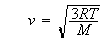
where
 is the temperature (in Kelvins),
 the molecular mass of the gas and
 is the universal gas constant. (We chose here the root mean squared speed,
which is usually used for estimation purposes).
is the universal gas constant. (We chose here the root mean squared speed,
which is usually used for estimation purposes).
We will consider one of the protons at rest, and assume the other proton's
speed is the calculated average speed, which gives it a net kinetic energy of:
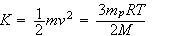
where
 is the mass of a singular proton, but the molar mass is related to the single
proton mass and Avogadro's number through:
is the mass of a singular proton, but the molar mass is related to the single
proton mass and Avogadro's number through:

so that the kinetic energy of the proton is:

which can be rewritten (since Boltzman's constant
 is
is
 ):
):

On the other hand, the electric potential energy is given by:

or, in this case:

where
 is Coulomb's constant and
 is the proton charge (ie, the positive electron charge).
We only need the protons to get within certain distance
 (the strong force range), so:
Now that we have calculated both energetic values, we can estimate the
physical result. For the protons to reach at least the
strong force range, we need:

so it must hold that:

By plugging in the numbers in these expressions, we obtain:

and

By comparing the values, we realize that the average kinetic energy of the
protons in the Sun is about 1000 times smaller than the required energy to
break the electric potential barrier, therefore making it impossible them to
fuse. The temperature needed is:
 or
or
 Kelvins !!
This conclusion is not entirely correct, because by chosing the average speed
given by the Maxwell speed distribution we are only considering fusion
reactions fuelled by average-energy protons (which
should be the most numerous). However, it is entirely possible that the
high-energy protons in the tail of the Maxwellian distribution are significant
in such thermonuclear process. The extreme density of the Sun's core make it
likely that these less numerous protons can sustain a thermonuclear chain
reaction. A much more complex calculation would be needed to correctly account
for this. Mainly, this implies calculating statistical parameters such as the
mean free path of particles in order to estimate the frequency of collisions,
and from here calculate the rate of proton interactions with sufficient energy
for fusion to occur (and if the energy transport mechanisms in the Sun are
known to a certain extent, one can calculate what the Solar luminosity should
be).
Fortunately for us, such calculations have already been done, and the result
is similar to ours: the Sun's estimated core temperature it still not enough
to fully sustain the nuclear reactions needed to justify the Sun's luminosity.
b) The probability of protons quantum-tunneling through the electric potential
barrier is easily calculated if we know the dimensions of the barrier.
However, the formula assumes a rectangular barrier, while the more realistic
barrier is a function which behaves like
 .
The (rectangular) barrier height must be what we calculated for the electric
potential; otherwise, it would not be in agreement with classical mechanics.
The width of the barrier is more difficult to determine. A first guess could
be to make it as wide as the region that is classically forbidden for a given
kinetic energy, ie, from the strong force range to the distance where the
electric potential drops to the proton kinetic energy (as shown on the
following diagram).
.
The (rectangular) barrier height must be what we calculated for the electric
potential; otherwise, it would not be in agreement with classical mechanics.
The width of the barrier is more difficult to determine. A first guess could
be to make it as wide as the region that is classically forbidden for a given
kinetic energy, ie, from the strong force range to the distance where the
electric potential drops to the proton kinetic energy (as shown on the
following diagram).
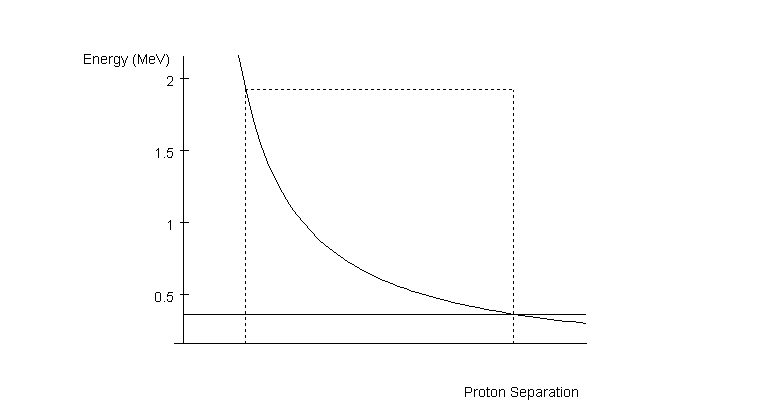
The distance where the electric potential energy drops to the calculated
kinetic energy of the proton is:

which gives a barried width of:

As we calculated, the barrier height is:

The probability of the proton quantum-tunneling through this barrier is given
by:

where
 is the width of the barrier, and
 is the wave number, given by:
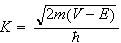
where
 is the mass of the object,
 is the height of the potential barrier,
 is the energy of the object (usually, kinetic) and
 is Planck's constant over
 .
Plugging in the numbers:
.
Plugging in the numbers:

which gives a probability of:
Note that, as before, this calculated number is severely underestimated, since
we are considering the average-energy protons, and this creates an extremely
wide barrier.
This document created by Scientific WorkPlace 4.0.


