
Temel donanım bilgileri
© Copyright Brian Brown, 1992-2001. All rights reserved.


DATA COMMUNICATIONS, Part 1
The objective of this section is to
At the end of this section you should be able to
 Data Transmission
Signals
Data Transmission
Signals
Analogue Signals
Analogue signals are what we encounter every day of our life.
Speech is an analogue signal, and varies in amplitude (volume)
and frequency (pitch).
The main characteristics of analogue signals are,
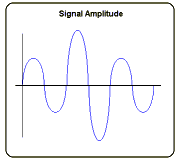
Fig 7.1: Signal Amplitude
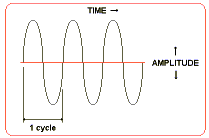
Fig 7.2: Signal Frequency
One cycle is defined as a point on the wave to the next identical point. The number of cycles there are per second determine the frequency of the signal.
Digital Signals
Digital signals are the language of modern day computers. Digital
signals normally comprise only two states. These are expressed as
ON or OFF, 1 or 0 respectively.
The following diagram shows a digital signal.
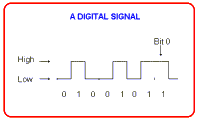
Fig 7.3: Digital Signal showing two states, 0 and 1
Data Transmission
Circuits
The following is a discussion on the THREE main types of
transmission circuits, simplex, half duplex and full duplex.
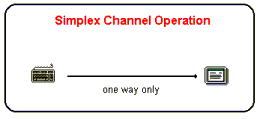
Fig 7.4: Simplex (one-way) channel
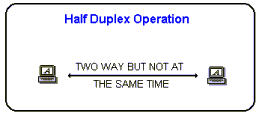
Fig 7.5: Half-Duplex channel
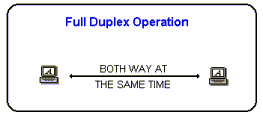
Fig 7.6: Full-Duplex channel
PARALLEL AND SERIAL
DATA
Data may be transmitted between two points in two different ways.
Lets consider sending 8 bits of digital data (1 byte).
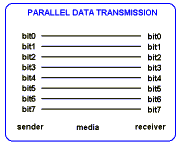
Fig 7.7: Parallel Interface
To transfer data on a parallel link, a separate line is used as a clock signal. This serves to inform the receiver when data is available. In addition, another line may be used by the receiver to inform the sender that the data has been used, and its ready for the next data.
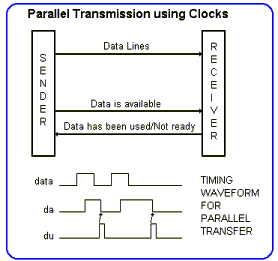
Fig 7.8: Parallel Interface timing
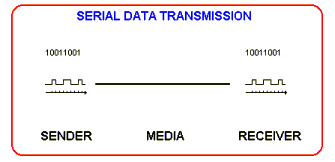
Fig 7.9: Serial Interface
No signal lines are used to convey clock (timing information). There are two ways in which timing information is encoded with the signal so that the sender and receiver are synchronised (working on the same data at the same time).
If no clock information was sent, the receiver would misinterpret the arriving data (due to bits being lost, going too slow).
Parallel transmission is obviously faster, in that all bits are sent at the same time, whereas serial transmission is slower, because only one bit can be sent at a time. Parallel transmission is very costly for anything except short links.
Data transmission
protocols
There are TWO main methods of sending data, asynchronous
and synchronous.
The purpose of the start and stop bits was introduced for the old electromechanical tele-typewriters. These used motors driving cams which actuated solenoids which sampled the signal at specific time intervals. The motors took a while to get up to speed, thus by prefixing the first bit with a start bit, this gave time for the motors to get up to speed, and thus acted as a reference point for the start of the first bit.
At the end of the character sequence, a stop bit was used to allow the motors/cams etc to get back to normal, in addition, it was also need to fill in time in case the character was an end of line, when the tele-type-writer would need to go to the beginning of a new-line. Without the stop character, the machine could not complete this before the next character arrived.
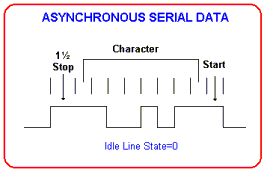
Fig 7.10: Asynchronous signal showing start and stop bits
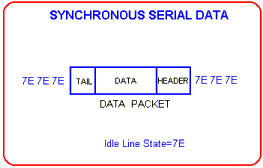
Fig 7.11: Synchronous data
The header field is used to convey address information (sender and receiver), packet type and control data.
The data field contains the users data (if it can't fit in a single packet, then use multiple packets and number them) or control data. Generally, it has a fixed size.
The tail field contains checksum information which the receiver uses to check whether the packet was corrupted during transmission.
Data Communications
Terminology
The following is an explanation of common terms applicable to
data communications.
Channel
A channel is a portion of the communications medium allocated to
the sender and receiver for conveying information between them.
The communications medium is often subdivided into a number of
separate paths, each of which is used by a sender and receiver
for communication purposes.
Baud Rate
Baud rate is the reciprocal of the shortest signal element (a
measure of the number of line changes which occur every second).
For a binary signal of 20Hz, this is equivalent to 20 baud (there
are 20 changes per second).
Bits Per Second
This is an expression of the number of bits per second. Where a
binary signal is being used, this is the same as the baud rate.
When the signal is changed to another form, it will not be equal
to the baud rate, as each line change can represent more than one
bit (either two or four bits).
Bandwidth
Bandwidth is the frequency range of a channel, measured as the
difference between the highest and lowest frequencies that the
channel supports. The maximum transmission speed is dependant
upon the available bandwidth. The larger the bandwidth, the
higher the transmission speed.
Home | Other Courses | Notes
| Tests | Videos
© Copyright Brian Brown, 1992-2001. All rights reserved.