City University of Hong Kong
Final Year Project 2003/04
Product design - Automatic Scrambled Egg Machine

 Theory
 Newton


It is the basic concept on this project, especially with the rolling ball system. It consists of three different laws, which relate to inertia, action and reaction, and the force.
Newton's first law: Inertia
The definitions of the Newton’s first law by Newton are:
An object at rest will remain at rest unless some unbalanced force causes it to do otherwise.
An object in motion will continue in motion in a straight line with constant velocity unless some unbalanced force causes it to do otherwise.
It is no doubt that if I place an object on somewhere and there is no exact force acting on it, the material will remain at rest anytime. However, if I act a force on it, it will move at once and remain moving. As there will be friction between the air and the object and at the touching point or surface, the movement will decrease and finally stop. But ignore these frictions, the first law is correct to explain this physical observation.
Newton’s second law: F = ma
If we want to make something move faster or slower, we have to apply a force on it. By the explanation of Newton, there is a relation between the force F acting on the object and the acceleration a of the object. When F increase, a increase. We can write this as:
a ~ F
Moreover, there is another thing that will affect this relation – mass m. The larger the mass of the object, the higher the force needed. Therefore, we can rewrite the equation as below:
F = ma
Newton’s third law: Action and reaction
There is a description on this law:
If object A exerts a force on object B, then object B exerts on oppositely directed force of equal magnitude on object A.
The meaning of the above statement is that two object will have the same magnitude of force when there approach to each other. However, the direction of the force is in opposite. If one force points to the left, the other one will point to the right.

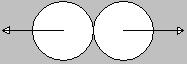
Newton’s third law


They are two different things. Although they are related, they have different meanings.
Weight of an object is defined as a force. It is related to the gravity that how much it is pulled down by the gravity. We can also say that it is the force of gravity. Commonly we use W to represent weight.
Mass of an object is defined as its inertia. When the object has larger mass, it needs to apply larger force on stopping or moving it. We use m to represent mass.
Everything in the earth will be pulled down due to the gravity. So when we calculate the force acting on it to pull it down, we can apply the Newton’s second law:
F = ma
And becomes
W = mg
Where g = 9.8m/s2
Below shows that the surface of many object are not perfectly smooth and they have tiny bumps.
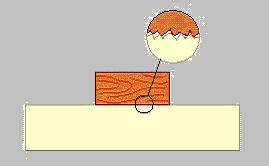
When an object slides on another object, the tiny bumps at the surfaces catch each other and cause friction. Friction acts in a direction that opposes motion.
We define the friction as
F = μR
Where μ is the coefficient of friction
Conservation of energy states that energy can be changed from one form to another and it can be transferred between objects, but it cannot be created or destroyed. In this project, there are many chances to change the energy from gravitational potential energy to kinetic energy. For the term, we always call gravitational potential energy as PE and kinetic energy as KE. The equation of the conservation of energy is as below:
PE = KE
And
ΔPE + ΔKE = work done on object
Also, we have the elastic potential energy for the spring.
Gravitational potential energy (PE)
Gravitational potential energy (PE) is the energy that an object possesses because of its position above the ground. The unit of gravitational potential energy is J. The equation is
PE = mgh
Where h is the difference of height
Kinetic energy (KE)
Kinetic energy exists when it is moving. The faster it moves, the more kinetic energy it has. Also, when the temperature of the object increases, the KE of particles in the body also increases. Its unit is also J. it can be defined as

Where m is the mass
v is the velocity of the object
Elastic potential energy
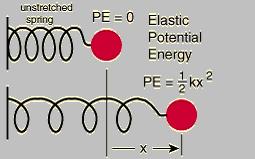
It is another form of potential energy. It is the energy stored by an elastic object when the object is stretched, compressed or bent. We can use U(x) or PE to represent it. Its unit is J. Its equation is
U(x) = 1/2kx2
Where U(x) is the elastic potential energy
Conservation of momentum means that the total momentum of the colliding objects before and after collision is remaining the same as before, that is no force will be produced or destroyed during the collision. The equation is shown below:
mAu1i + mBu2i = mAv1f + mBv2f
We can see below the object A and B are the colliding objects. In the absence of external force, conservation of momentum will follow the equation.

This can be applied on the rolling ball system. When the ball is rolling, the velocity of the ball is
v = ωR
Where ω is the angular speed
R is the radius
The kinetic energy of rolling is
K = 1/2IPω2
And
IP = ICOM + MR2
Therefore, it should be
K = 1/2ICOMω2 + 1/2Mv2

Produced by
WAN Ho Ting 50318419
LEUNG Yu Ching 50340205
Last update: 19th April, 2004