Republic of
Lebanon
National name: Al-Joumhouriya al-Lubnaniya
President: Emile Lahoud (1998)
Premier: Selim al-Hoss (1998)
Area: 4,015 sq mi. (10,452 sq km)
Population (1999 est.): 3,562,699 (average annual rate of natural
increase: 1.61%); birth rate: 22.5/1000; infant mortality rate: 30.5/1000; density per sq
mi.: 887
Capital and largest city (1991 est.): Beirut, 1,100,000
Other large cities: Tripoli, 240,000; Sidon, 100,000
Monetary unit: Lebanese pound
Languages: Arabic (official), French, English
Ethnicity/Race: Arab 95%, Armenian 4%, other 1%
Religions: Islam, 60%; Christian, 40% (17 recognized sects);
Judaism negl. (1 sect)
Literacy rate: 80%
Economic summary: GDP/PPP (1997 est.): $15.2 billion; $4,400 per capita. Real growth rate: 4%. Inflation: 9%.
Unemployment: 18%. Arable land:
21%. Agriculture: citrus, vegetables, potatoes, olives, tobacco,
hemp (hashish); sheep, goats. Labor
force: 1 million, plus as many as
1 million foreign workers; services, 62%; industry, 31%; agriculture, 7% (1997 est.). Industry: banking; food processing; jewelry; cement; textiles; mineral and
chemical products; wood and furniture products; oil refining; metal fabricating. Exports: $1.018 billion (f.o.b., 1996): paper and paper products, food
stuffs, textiles and textile products, jewelry, metals and metal products, electrical
equipment and products, chemical products, transport vehicles. Imports: $7.559
billion (c.i.f., 1996): machinery and transport equipment, foodstuffs, consumer goods,
chemicals, textiles, metals, fuels. Major
trading partners: U.A.E., Saudi
Arabia, Kuwait, Syria, Jordan France, Italy, U.S., Germany, U.K., Japan. |
 |
Geography
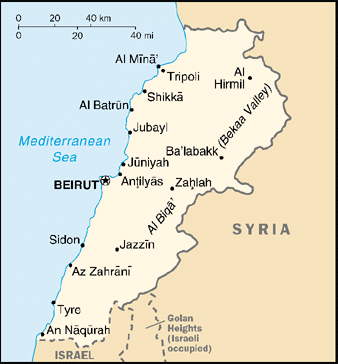
Lebanon lies at the eastern end of the
Mediterranean Sea north of Israel and west of Syria. It is four-fifths the size of
Connecticut.
The Lebanon Mountains, which parallel the
coast on the west, cover most of the country, while on the eastern border is the
Anti-Lebanon range. Between the two lies the Bekaa Valley, the principal agricultural
area.
People
Although the modern state of Lebanon is a
creation of the 20th century, the people of Lebanon have had a long and
distinctive history.
The coastal plain was the home of Phoenician merchants whose ships sailed throughout the
Mediterranean world more than a millennium before Christ. The Lebanese of today emphasize
their uniqueness as a people and stress their "Phoenician heritage."
Government
Lebanon is governed by a president, elected
by parliament for a six-year term, and a cabinet of ministers appointed by the president
but responsible to parliament.
The unicameral parliament has 108 members
elected for a four-year term by universal suffrage and chosen by proportional division of
religious groups. Traditionally, the president has always been a Maronite Christian.
Lebanon’s Historical Background
THE PHOENICIANS
The area now known as Lebanon first emerged in
recorded history around 3000 BC as a group of coastal cities and a heavily forested
hinterland. It was inhabited by the Canaanites, a Semitic people, whom the Greeks called
"Phoenicians" because of the purple (phoinikies) dye they sold.
The early populace referred to themselves as "men of SIDON" or the like,
according to their city of origin, and called the country "Lebanon."
Because of the nature of the country and its location, the Phoenicians turned to the sea,
where they engaged in trade and navigation. Each of the coastal cities was an independent
kingdom noted for the special activities of its inhabitants.
TYRE and SIDON were important maritime and trade centers; GUBLA (later known as BYBLOS and
now as JBEIL) and BERYTUS (present-day BEIRUT) were trade and religious centers.
GUBLA was the first Phoenician city to trade actively with Egypt and the pharaohs of the
Old Kingdom (2686-2181 BC), exporting cedar, olive oil, and wine, while importing gold and
other products from the Nile Valley.
Toward the end of the 14th century BC, the Egyptian Empire weakened, and
Lebanon was able to reacquire its independence by the beginning of the 12th
century BC.
The subsequent three centuries were a period of prosperity and freedom from foreign
control during which the earlier Phoenician invention of the alphabet facilitated
communications and trade.
The Phoenicians excelled not only in producing textiles but also in carving ivory, in
working with metal, and above all in making glass. Masters of the art of navigation, they
founded colonies wherever they went in the Mediterranean Sea (specifically in Cyprus,
Rhodes, Crete, and Carthage) and established trade routes to Europe and western Asia.
Furthermore, their ships circumnavigated Africa a thousand years before those of the
Portuguese. These colonies and trade routes flourished until the invasion of the coastal
areas by the ASSYRIANS.
ASSYRIAN RULE
Assyrian rule (875-608 BC) deprived the Phoenician
cities of their independence and prosperity and brought repeated, unsuccessful rebellions.
In the middle of the 8th century BC, TYRE and BYBLOS rebelled, but the Assyrian
ruler, Tiglath-Pileser, subdued the rebels and imposed heavy tributes on them. Oppression
continued unabated, and TYRE rebelled again, this time against SARGON II (722-OS BC), who
successfully besieged the city in 721 BC and punished its population.During the 7th
century BC, SIDON rebelled; it was completely destroyed by Esarhaddon (681-68 BC), and its
inhabitants were enslaved.
Esarhaddon built a new city on Sidon's ruins. By the end of the 7th century BC,
Babylonia, a new Mesopotamian power, had destroyed the Assyrian Empire, weakened by the
successive revolts.
BABYLONIAN RULE AND THE PERSIAN
EMPIRE
Revolts in the Phoenician cities became more
frequent under Babylonian rule (685-36 BC).
TYRE rebelled again and for 13 years resisted a siege by the troops of
"Nebuchadnezzar" (587-74 BC). After this long siege, the city capitulated; its
king was dethroned, and its citizens were enslaved.
The "Achaemenids" ended Babylonian rule when Cyprus, founder of the Persian
Empire, captured Babylon in 539-38 BC and Phoenicia and its neighbors passed into Persian
hands. Cambyses (529 - 522 BC), Cyprus’s son and successor, continued his father's
policy of conquest and in 529 BC became suzerain of Syria, Lebanon, and Egypt. The
Phoenician navy supported Persia during the Greco-Persian War (490-49 BC). But when the
Phoenicians were overburdened with heavy tributes imposed by the successors of Darius I
(521-485 BC), revolts and rebellions resumed in the Lebanese coastal cities.
RULE OF ALEXANDER THE GREAT
The Persian Empire eventually fell to Alexander the
Great, king of Macedonia. He attacked Asia Minor, defeated the Persian troops in 333 BC,
and advanced toward the Lebanese coast. Initially the Phoenician cities made no attempt to
resist, and they recognized his suzerainty. However, when Alexander tried to offer a
sacrifice to Melkart, Tyre's god, the city resisted. Alexander besieged Tyre in
retaliation in early 332 BC.
Following six months of resistance, the city fell, and its people were sold into slavery.
Despite his early death in 323 BC, Alexander's conquest of the eastern Mediterranean Basin
left a Greek imprint in the area. The Phoenicians, being a cosmopolitan people amenable to
outside influences, adopted aspects of Greek civilization with ease.
THE SELEUCID DYNASTY
After Alexander's death, his empire was divided among
his Macedonian generals. The eastern part--Phoenicia, Asia Minor, northern Syria, and
Mesopotamia--fell to Seleucus I, founder of the Seleucid dynasty. The southern part of
Syria and Egypt fell to Ptolemy, and the European part, including Macedonia, to Antigonus
IThis settlement, however, failed to bring peace because Seleucus I and Ptolemy clashed
repeatedly in the course of their ambitious efforts to share in Phoenician prosperity.
A final victory of the Seleucids ended a forty-year period of conflict. Disorder and
dynastic struggles marked the last century of Seleucid rule which ended in 64 BC, when the
Roman general Pompey added Syria and Lebanon to the Roman Empire. Economic and
intellectual activities flourished in Lebanon during the Pax Romana. The inhabitants of
the principal Phoenician cities of Byblos, Sidon, and Tyre were granted Roman citizenship.
These cities were centers of the pottery, glass, and purple dye industries; their harbor
also served as warehouses for products imported from Syria, Persia, and India. They
exported cedar, perfume, jewelry, wine, and fruit to Rome.
Economic prosperity led to a revival in construction and urban development; temples and
palaces were built throughout the country, as well as paved roads that linked the cities.
Upon the death of Theodosius I in AD 395, the empire was divided in two: the eastern or
Byzantine part with its capital in Constantinople, and the western part with its capital
in Rome.
Under the Byzantine Empire, intellectual and economic activities in Beirut, Tyre, and
Sidon continued to flourish for more than a century. However, in the 6th
century a series of earthquakes demolished the temples of Baalbeck and destroyed the city
of Beirut, leveling its famous law school and killing nearly 30,000 inhabitants.
To these natural disasters were added the abuses and corruption prevailing in the empire
at that time. Heavy tributes and religious dissension produced disorder and confusion.
Furthermore, the ecumenical councils of the fifth and sixth centuries AD were unsuccessful
in settling religious disagreements.
This turbulent period weakened the empire rendering it easy prey to the newly converted
Muslim Arabs of the Arabian Peninsula.
THE ARAB CONQUEST, 634 - 636 AD
The followers of the Prophet Muhammad, the founder of
Islam, embarked on a movement to establish their religious and civil control throughout
the eastern Mediterranean from their base in the Arabian Peninsula. Their determination to
conquer other lands resulted both from economic necessity and from religious beliefs,
which imbued them with contempt for death. Calling for a jihad (holy war) against
non-Muslims, the Prophet's successor, Caliph Abu Bakr (632 - 634), brought Islam to the
area surrounding Lebanon. Dividing his forces into three groups, he ordered one to move in
the direction of Palestine, one toward Damascus, and one toward the Jordan River.
THE UMAYYADS, 660 - 750 AD
After the Battle of Yarmuk, Caliph Umar appointed the
Arab Muawiyah, founder of the Umayyad dynasty, as governor of Syria, an area that included
present-day Lebanon. Muawiyah garrisoned troops on the Lebanese coast and had the Lebanese
shipbuilders help him construct a navy to resist any potential Byzantine attack. He also
stopped raids by the Marada, a powerful people who had settled in the Lebanese Mountains
and who were used by the Byzantine rulers to prevent any Arab invasion that would threaten
the Byzantine Empire. Concerned with consolidating his authority in Arabia and Iraq,
Muawiyah negotiated an agreement in 667 AD with Constantine IV, the Byzantine emperor,
whereby he agreed to pay Constantine an annual tribute in return for the cessation of
Marada incursions. During this period a number of Arab tribes settled in the Lebanese and
Syrian coastal areas.
THE ABBASIDS, 750 - 1258 AD
The Abbasids, founded by the Arab Abul Abbas,
replaced the Umayyads in early 750 AD. They treated Lebanon and Syria as conquered
countries, and their harshness led to several revolts, including an abortive rebellion of
Lebanese mountaineers in 759 AD. By the end of the 10th century, the emir of
TYRE proclaimed his independence from the Abbasids and coined money in his own name.
However, the Fatimids of Egypt, an independent Arab Muslim dynasty, terminated his rule.
THE IMPACT OF ARAB RULE
Arab rule under the Umayyads and Abbasids had a
profound impact on the Eastern Mediterranean area and, to a great degree, was responsible
for the composition of modern Lebanese society. It was during this period that Lebanon
became a refuge for various ethnic and religious groups.
The presence of these diverse, cohesive groups led to the eventual emergence of the
Lebanese confessional state, whereby different religious communities were represented in
the government according to their numerical strength.
The ancestors of the present-day, Maronites, were among the Christian communities that
settled in Lebanon during this period. To avoid feuds with other Christian sects in the
area, the followers of Saint John Maroun moved from the upper valley of the Orontes River
and settled in the picturesque Qadisha Valley, located in the northern Lebanon Mountains,
about twenty-five kilometers southeast of Tripoli.
Lebanon also became a refuge for a small Christian group called Melchites living in
northern and central Lebanon. Influenced by the Greek Christian theology of
Constantinople, they accepted the controversial decrees of the Council of Chalcedon, the
fourth ecumenical council of the church held in 451.
As a result of missionary activity by the Roman Catholic Church, some were later drawn
away from this creed and became known as Greek Catholics because Greek is the language of
their liturgy. They lived mainly in the central part of the Bekaa Valley (Zahleh).
During the Arab era, still another religious faith found sanctuary in Lebanon.
When the Fatimid caliph of Egypt AI Hakim (996-1421 AD), proclaimed himself an incarnation
of God, two of his followers, Hamza and Darazi, formulated the dogmas for his cult. Darazi
left Egypt and continued to preach these tenets after settling in southern Lebanon.
His followers became known as the Druze who, along with Christians and Muslims,
constitutes one of the major communities of modern Lebanon.
Under the Abbasids, philosophy, literature, and the sciences received great attention,
especially during the caliphate of Harun al Rashid and that of his son, AI Ma’mun.
Lebanon made a notable contribution to this intellectual renaissance. The physician Rashid
ad Din, the jurist AI Awazi, and the philosopher Qusta ibn Luqa were leaders in their
respective disciplines.
The country also enjoyed an economic boom in which the Lebanese harbors of TYRE and
TRIPOLI were busy with shipping as the textile, ceramic, and glass industries prospered.
Lebanese products were sought after not only in Arab countries but also throughout the
Mediterranean basin. In general, Arab rulers were tolerant of Christians and Jews, both of
whom were assigned special taxes and were exempted from military service.
Later, under the Ottoman Empire, the practice of administering non-Muslim groups as
separate communities called millets was developed. This system whereby each religious
community is organized under its own head and observes its own laws pertaining to matters
such as family law still prevails.
THE CRUSADES 1095 - 1291 AD
The occupation of the Christian holy places in Palestine and the destruction of the Holy
Sepulcher by Caliph AI Hakim led to a series of eight campaigns. Known as the Crusades,
these wars were undertaken by Christians of Western Europe to recover the Holy Land from
the Muslims. Pope Urban II proclaimed the first Crusade in 1095 at the Council of
Clermont-Ferrand in France. After taking Jerusalem, the Crusaders turned their attention
to the Lebanese coast. Tripoli capitulated in 1109; BEIRUT and SIDON, in 1110. TYRE
stubbornly resisted but, after a long siege, finally capitulated in 1124. Although they
failed to establish a permanent presence, the Crusaders left their imprint on Lebanon.
Among the conspicuous results of the Crusades, which ended with the fall of Acre in 1291,
are the remains of many towers along the coast, ruins of castles on hills and mountain
slopes, and numerous churches.
Of all the contacts established by the Crusaders with the peoples of the Middle East,
those with the Maronites of Lebanon were among the most enduring. They acquainted the
Maronites with European influences and made them more receptive to friendly approaches
from Westerners. During this period the Maronites were brought into a union with the Holy
See, a union that survives until today. FRANCE was a major participant in the Crusades,
and French interest in the region and its Christian population dates back to this period.
Bitter conflicts among the various regional and ethnic groups in Lebanon and Syria
characterized the 13th century. The Crusaders, who came from Europe, the
Mongols, who came from the steppes of Central Asia, and the Mamluks, who came from Egypt,
all sought to be masters in the area.
In this hard and confused struggle for supremacy, the Mamlukes emerged victorious.
THE MAMLUKS, 1282 - 1516
The Mamluks were a combination of Turkoman slaves from the area east of the Caspian Sea
and Circassian slaves from the Caucasus Mountains between the Black Sea and Caspian Sea.
They were brought in by the Muslim Ayyubid sultans of Egypt to serve as their
bodyguards.One of these slaves, Muez-Aibak, assassinated the Ayyubid sultan, AI Ashraf
Musa, in 1252 and founded The Mamluk sultanate, which ruled Egypt and Syria for more than
two centuries. From the 11th to the 13th century, the Shiite Muslims
migrated from Syria, Iraq, and the Arabian Peninsula to the northern part of the Bekaa
Valley and the Kesrouan region near Jounieh in the mountains northeast of Beirut. Together
with the Druzes they rebelled in 1291 while the Mamluks were busy fighting European
Crusaders and Mongols, but after repelling the invaders, the Mamluks crushed the rebellion
in 1308. To escape from repression and massacres by the Mamluks, the Shiites abandoned
Kesrouan and moved to southern Lebanon.
OTTOMAN RULE
In 1516 AD, the Ottomans defeated the Mamluks in
northern Syria, establishing Ottoman control over the Arab Levant. The Ottomans dominated
this area for the next four centuries. The Ottomans continued the Mamluk policy of
recognizing the status quo of semiautonomous rulers. Two great dynasties, the Druze and
the Shihabs, reigned in the mountains of Lebanon until 1843. The Druze house of Ma'an was
paramount until 1697, reaching its zenith under Fakhr al-Din II (15861635). His efforts to
obtain total independence for Lebanon led ultimately to his defeat and
execution.Nevertheless, this Druze leader did much for Lebanon by reopening the country to
the West, as it had not been since the time of the Crusades. During his exile in Tuscany,
Fakhr al-Din II allied himself with the rulers of that Italian State.
These ties extended beyond the political realm. The Druze leader emulated his allies in
attempting to create a modern army. He also imported engineers and agricultural experts to
promote better land use. These efforts however, had only a minimal long-term impact on
Lebanon. Of greater significance was Fakhr al-Din's encouragement of the Maronite
peasantry to move south.Over the subsequent centuries, the Maronites spread from their
northern Lebanese strongholds and slowly expanded their numbers and influence throughout
the Lebanon Mountains. In 1697 the Ma'an family was replaced by the Shihabs as emirs
(princes) of Mount Lebanon. Under Bashir (1788 -1840), the Shihabs pressed for full
independence. The early 19th century was a time when the Ottoman state was
being torn apart by local rulers who, playing upon the weakness of the central government,
strove to break away from the authorities in Istanbul.
Bashir however, made an unfortunate miscalculation by supporting Muhammad Ali of Egypt
against the Ottomans, who, in turn, were supported by the British. As a result, when the
Egyptian leader was obliged to give up his claims to sovereignty in the Levant, his ally
Bashir was forced into exile in 1840.
Strife and turmoil marked the next twenty years. Ottoman weakness and European
intervention exacerbated internal Lebanese rivalries. During the preceding two centuries,
the fundamental economic and political balance of Mount Lebanon had been upset by the
rapid growth of the Maronite population and their gradual migration southward from
traditional strongholds in North Lebanon. Druze preponderance had been seriously eroded.
In 1843 The Ottomans attempted to ward off potential inter-communal difficulties, by
dividing Lebanon into two districts (qaim maqamyyah): a northern district was placed under
a Christian vice-governor and a southern district in the hands of a Druze.
This system proved unsatisfactory. The Druze and Christian populations were already too
intermingled and antagonistic to accept such a simple solution. Despite Ottoman efforts,
tensions between the communities increased with French protection of the Maronites and
British protection of the Druze only serving to aggravate the situation. Moreover, the
Ottomans were not satisfied with the status quo. Istanbul desired to limit the traditional
autonomous status of the inhabitants of Mount Lebanon and resented European interference
in Ottoman internal affairs. Another problem was the growing resentment of the industrious
Maronite peasantry toward their oppressive feudal aristocracy. In 1858 a peasant revolt
broke out. !n the northern district, the Maronite peasantry turned against Maronite
shaykhs; in the southern district, the Maronite peasantry rose against the Druze
aristocracy.
Because the Druze peasantry in the south felt closer bonds with their coreligionists than
with the Maronite peasants, the hostilities south and east of Beirut became more of a
religious war than a peasant revolt. Druze and other Muslims massacred thousands of
Maronites. Following direct European intervention, Mount Lebanon was reunited and made a
semiautonomous governorship (mutasarrifyyah).
The governor was a non-Lebanese Ottoman Christian who was appointed by the Ottoman sultan
with the consent of the five great European powers. He was aided by an elected
administrative council, which ensured representation of each of the major sects, and a
locally recruited police force.
This system remained in force until World War I. The period from 1860 to 1914 was marked
by increasing contacts between the Lebanese and the West. Intellectual activity increased,
encouraged by the influence of foreign missionaries. Presbyterians from the United States
founded the American University of Beirut in 1866, and French missionaries founded Saint
Joseph University in 1875.
LEBANON DURING THE WORLD
WARS
The outbreak of World War 1 in August 1914 badly
affected Lebanon. As Turkey allied itself with Germany and Austria-Hungary, the Turkish
government abolished Lebanon's semiautonomous status and appointed Jamal Pasha, then
minister of the navy, commander in chief of the Turkish forces in Syria.
Having occupied Lebanon he replaced the Armenian mutasarrif, Ohannes Pasha, with a Turk,
Munif Pasha. In February 1915, frustrated by his unsuccessful attack on the British forces
protecting the Suez Canal, Jamal Pasha initiated a blockade of the entire eastern
Mediterranean coast to prevent supplies from reaching his enemies and indirectly causing
thousands of deaths from widespread famine and plagues.
Lebanon suffered as much as, if not more than, any other Ottoman province. The blockade
deprived the country of its tourists and summer visitors while remittances from relatives
and friends were lost or delayed for months. The Turkish Army cut down trees for wood
either to fuel trains or for military purposes. In 1916 Turkish authorities publicly
executed twenty-one Syrians and Lebanese in Damascus and Beirut, respectively, for alleged
anti-Turkish activities.
The date, May 6, is commemorated annually in both countries as Martyrs' Day, and the
exectution site in Beirut has come to be known as Martyrs' Square. Four centuries of
Ottoman rule came to an end in Lebanon with World War 1. The Sykes - Picot agreement
ensured that Lebanon was mandated to the French, who created Greater Lebanon; this area
included not only Mount Lebanon but also Beirut, Sidon, Tyre, southern Lebanon, the Bekaa
valley and the Akkar plain in the north. The French hoped that a larger Lebanon would
benefit Lebanon economically and would thus benefit them.
In 1926 a constitution was promulgated. The Lebanese nationalists were not satisfied with
this document however, for the French high commissioner retained his ultimate authority.
For example, in 1932 and again in 1939 the French suspended the constitution. Despite
French control, the Lebanese were permitted to choose their first Presidents and to assume
greater responsibility for their own political destiny. Differences with the French led
many Lebanese to examine alternate political philosophies, including Arab and Syrian
nationalism and socialism.Nevertheless, the French continued to receive significant
support from large numbers of Lebanese, particularly the Maronites.
FROM INDEPENDENCE TO CIVIL WAR
Flushed from its independence in 1943, the commercial
instincts and joie de vivre of the Lebanese swiftly elevated the country to the pinnacle
of business and tourism in the region over the next two decades. The geographical location
of Lebanon, natural beauty, culture, and easy going populace led Beirut to become the
commercial and tourist site of the Middle East, enjoyed by both westerners and Arab oil
tycoons. It was during this period of prosperity that Lebanon became known as the
"Paris of the Middle East," and "the Pearl of the Orient" and became a
favorite destination for movie stars, politicians, millionaires and royalty.
However, the storm clouds gathered on the horizon following the 1967 Arab-Israeli war,
which heralded the rise of Palestinian militancy.The arrival of thousands of Palestinian
refugees from Jordan in 1970, heightened sectarian tensions in the country which spilled
over into civil war five years later. The Palestinian guerrillas allied with Lebanese
leftist Muslims battled for supremacy with Christian militias between 1975 and 1976
leading to the intervention of the Syrian army to stem the bloodshed. But Lebanon's
strategic geo-political position ensured that violence was to continue for a further 15
years, during which Israel invaded the country twice and two presidents were assassinated.
Instead of being left alone to resolve their differences, the underlying social tensions
in Lebanon were often stroked by the intervention of foreign powers ensuring that the
country's quest for peace would be long and arduous.
he economy plummeted and thousands of Lebanese left the country to seek sanctuary abroad.
Those remaining behinds had to endure daily horrors. The most devastating impact of the
war was the 1982 Israeli invasion in which Beirut was placed under siege for three months
and over 20,000 people, mainly civilians were killed. The repercussions of the invasion
are still felt today with Israel occupying the southern portion of the country.
POST CIVIL WAR
In 1989, Lebanon's rival leaders gathered in the city
of Taif in Saudi Arabia to forge an agreement that would bring an end to the civil war.
The subsequent Taif accord resulted in the Maronite Christian president having some of his
powers reduced in favor of a balanced sectarian cabinet that would exercise executive
powers. President Elias Hrawi was elected to office; he appointed Nabih Berri as
parliamentary speaker and Omar Karami as prime minister.
The Lebanese militias were disbanded allowing Lebanon to face the daunting task of
rebuilding its economy and infrastructure. In 1992, Rafik Hariri was appointed Prime
Minister, a move that launched the beginning of the ambitious reconstruction program. Mr.
Hariri, a construction tycoon, spearheaded the recovery by revealing plans for a
multi-billion dollar project designed to rebuild the war-shattered central district of
Beirut while at the same time encouraging foreign investments and the repatriation of
Lebanese capital.
The scheme was designed to return Beirut to its pre-war role as the commercial and
financial hub of the Middle East. The appointment of Mr. Hariri alone helped lift the
Lebanese Lira from nearly LL 3,000 to the dollar to around LL 1,800 to the dollar almost
overnight. The "jewel" of the program was the reconstruction of downtown Beirut
through a specially established private company called SOLIDERE.
Foreign companies began returning to Beirut, as did thousands of Lebanese.
Yet difficulties remained. Israel still occupies south Lebanon and continues to ignore the
20-year-old United Nations Resolution 425 which calls for immediate and unconditional
withdrawal.Since the end of the civil war, Israel has staged two devastating assaults on
Lebanon, in 1993 and 1996. The latter caused damage estimated at $500 million and killed
160 Lebanese, 107 of them in a single incident in which Israeli artillery shelled a United
Nations base in Qana.
Hizbullah was the only organization allowed to continue bearing arms following the war and
is officially sanctioned by the government to spearhead the resistance against the Israel
occupation.
Hizbullah, which was the "b�te noire" of the West in the 1980s, has now
softened its tone and is a powerful force in parliament. Some 35,000 Syrian troops
remained in Lebanon to help achieve stability and calm in the postwar climate, although
that number has since been reduced to 25,000.
Lebanon and Syria remain linked in the regional peace negotiations with Israel in which
Syria is demanding the return of the Golan Heights, captured by Israel in 1967 and Lebanon
is seeking an end to the occupation of the south. Despite the difficulties of the post-war
transition to peace, tourists are visiting the country in ever-increasing numbers each
year and the infrastructure continues to improve.
The election of the army commander, General Emile Lahoud, as the next president, and the
appointment of Prime Minister Salim el Hoss, is expected to herald a new era for Lebanon.
The final vestiges of the civil war are completely eradicated paving the way for the
country to look forward to the 21st century with optimism. |