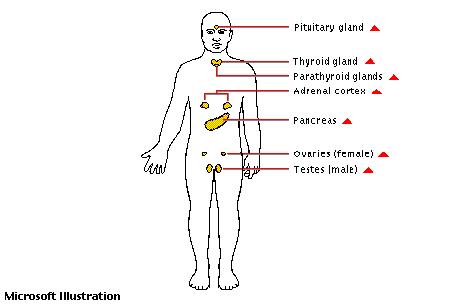
Endocrine System
Endocrine System, associated organs and tissues of the body that collectively release substances known as hormones. Endocrine organs are known also as ductless glands because their secretions are released directly into the bloodstream, in contrast to exocrine glands, which discharge their secretions on such external or internal surface tissues as those of the skin, the lining of the stomach, or of the lining of the pancreatic ducts. The endocrine glands and their hormones regulate the growth, development, and function of certain tissues and coordinate many of the metabolic processes within the body. Endocrinology is the study of the endocrine glands, the hormonal substances produced by these glands, their physiological effects, and the disorders and diseases that involve their malfunction.
Hormone-producing tissues may be classified into three groups: purely endocrine glands, which function solely in hormone production; endo-exocrine glands, those that produce other types of secretions as well as hormones; and certain nonglandular tissues, such as the autonomic nerves, which produce hormonelike substances.
Pituitary Gland
The pituitary gland, or hypophysis, consists of three lobes, the anterior lobe, the intermediate lobe, which in primates is present for only a short part of the life span, and the posterior lobe. It is situated at the base of the brain and has been called the master controlling gland of the body. The anterior and the posterior lobes of the pituitary secrete different hormones. The anterior lobe secretes various hormones that stimulate the function of other endocrine glands, for example, adrenocorticotropic hormone, or ACTH, which stimulates the adrenal cortex; thyroid-stimulating hormone, or thyrotropin, known as TSH; follicle-stimulating hormone (FSH) and luteinizing hormone (LH), which stimulate the sex glands; and prolactin, which, with other special hormones, influences milk production of the mammary gland. In addition, the anterior pituitary is the source of growth hormone, also called somatotropin, which promotes the development of body tissues, particularly of bone matrix and muscle, and influences carbohydrate metabolism. The anterior pituitary also secretes a hormone called melanocyte-stimulating hormone, which regulates the intensity of pigmentation in pigmented cells. In the 1970s scientists found that the anterior pituitary also produces substances called endorphins. These are peptides that act on the peripheral and central nervous systems to reduce sensitivity to pain.
The hypothalamus, that part of the brain from which the pituitary gland arises, secretes an antidiuretic hormone (one that controls the excretion of water) named vasopressin, which is stored in the posterior lobe of the pituitary gland. Vasopressin controls the amount of water secreted by the kidneys and raises blood pressure. The posterior lobe of the pituitary also stores another hormone secreted by the hypothalamus. This hormone, known as oxytocin, stimulates muscular contractions, especially of the uterus, and ejection of milk from lactating mammary glands.
Not long ago it was found that secretion of three anterior pituitary hormones is under regulation of the hypothalamus: thyrotropin secretion is stimulated by thyrotropin-releasing factor (TRF), and luteinizing-hormone secretion by luteinizing-hormone releasing hormone (LHRH). Release of growth hormone is inhibited by somatostatin, which is also made by the pancreas. This discovery, for which the American physiologists Roger Guillemin (1924-) and Andrew Schally (1926-) earned the 1977 Nobel Prize in physiology or medicine, means that the brain also functions as a gland.
Adrenal Glands
Each adrenal gland consists of an inner part called the medulla and an outer part called the cortex. The two glands are situated above the kidney. The adrenal medulla is the source of epinephrine, also called adrenaline, and norepinephrine, which affect a number of body functions; for example, they stimulate cardiac action, increase the blood pressure, and affect constriction and dilation of blood vessels and musculature. Epinephrine (but not norepinephrine) raises the blood-sugar level. All these actions help the organism deal with acute emergencies more effectively and efficiently. The adrenal cortex elaborates a group of hormones known as glucocorticoids, which include cortisone and hydrocortisone, and the mineralocorticoids, which include aldosterone and other hormonal substances that are essential to the maintenance of life and to adaptation to stress. Adrenal secretions regulate the salt and water balance of the body, influence the blood pressure, affect lymphatic tissue, influence the mechanisms of the immune system, and regulate carbohydrate and protein metabolism. In addition to these functions, the adrenal glands also elaborate male and female hormones.
Thyroid Gland
The thyroid is a two-lobed gland situated in the neck. The thyroid hormones thyroxine and triiodothyronine increase oxygen consumption and stimulate the rate of metabolism, regulating the growth and maturation of body tissues and affecting physical and mental alertness. The thyroid also secretes a hormone known as calcitonin, which lowers the levels of calcium and phosphate in the blood and inhibits bone resorption.
Parathyroid Glands
The parathyroids are found near or embedded in the thyroid gland. The parathyroid hormone regulates blood levels of calcium and phosphorus and stimulates bone resorption.
Ovaries
The ovaries are the female gonads, which are paired, almond-shaped bodies situated on either side of the uterus. The ovarian follicles produce the ova, or eggs, and also secrete a group of hormones called estrogens, which are necessary for the development of the reproductive organs and of such secondary sex characteristics as the distribution of fat, widening of the pelvis, mammary growth, and pubic and axillary hair.
Progesterone, another hormone produced by the ovaries, has as its principal function the maintenance of pregnancy, which it accomplishes primarily by its effects on the lining of the uterus. Progesterone also acts in conjunction with estrogens in promoting the growth and elasticity of the female genital tract. The ovaries also elaborate a hormone called relaxin, which acts to relax the cervix during childbirth, thus making delivery easier.
Testes
The male gonads, the testes, are paired, ellipsoid bodies suspended in the scrotum. The Leydig cells of the testes produce one or more male hormones called the androgens. The androgens, the most important of which is testosterone, stimulate the development of secondary sex characteristics, influence the growth of the prostate and seminal vesicles, and promote secretory activity of these structures. The testes also contain cells that produce sperm.
Pancreas
The bulk of the pancreas consists of exocrine tissue that releases digestive juices into the duodenum. Distributed throughout this tissue are clusters of endocrine cells called the islets of Langerhans, which secrete insulin and another hormone known as glucagon. Insulin affects carbohydrate, protein, and fat metabolism, increasing the rate of sugar utilization and promoting formation of protein and storage of fat. Glucagon temporarily raises blood-sugar levels, apparently by releasing glucose from the liver.
Placenta
The placenta, an organ formed during pregnancy from the membrane surrounding the fetus and the uterine lining, assumes certain endocrine functions of the pituitary gland and the ovaries that are important in the maintenance of pregnancy. It secretes the hormone called chorionic gonadotropin, a substance found in the urine during pregnancy and constituting the basis for pregnancy tests. The placenta produces the sex hormones progesterone and the estrogens, a protein hormone with some of the characteristics of growth hormone, and lactogenic hormones (placental lactogen).
Other Organs
Hormones and hormonelike substances are also produced by certain other body tissues. The kidneys secrete an agent called renin, which activates the hormone angiotension produced in the liver; this hormone in turn raises blood pressure, probably in part by stimulating the release of aldosterone by the adrenal glands. The kidneys also elaborate a hormone called erythropoietin, which stimulates the bone marrow to produce red blood cells. The gastrointestinal tract elaborates a number of substances that regulate the functions of the digestive system; these include gastrin from the stomach, which stimulates gastric acid secretion, and secretin and cholecystokinin from the upper intestine, which stimulate secretion of digestive juices and hormones from the pancreas. Cholecystokinin also causes the gallbladder to contract. In the 1980s the heart was also found to secrete a hormone, called atrial natriuretic factor, which is involved in the regulation of blood pressure and of the body's salt and water balance.
The functional definition of the endocrine system has been blurred by the finding that many typical hormones are found in sites where they do not act in an endocrine fashion. Noradrenaline is present in nerve endings, where it transmits nervous impulses. Components of the renin-angiotension system have been found in the brain, where their function is unknown. The intestinal peptides gastrin, cholecystokinin, vasointestinal peptide (VIP), and gastric inhibitory peptide (GIP) are found in the brain. Endorphin is present in the intestine, and growth hormone is found in cells of the islets of Langerhans. In the pancreas, growth hormones appear to act locally by inhibiting release of insulin and glucagon from endocrine cells.
Hormone Metabolism
The known hormones belong to three chemical groups, proteins, steroids, and amines. Those in the protein, or polypeptide, group include the hormones produced by the anterior pituitary, parathyroid, placenta, and pancreas. In the steroid group are the hormones of the adrenal cortex and gonads. The amines are produced by the adrenal medulla and thyroid. The synthesis of hormones occurs intracellularly, and in most instances the product is retained within the cell until its release into the blood. The thyroid and the ovaries, however, contain special sacs for hormone storage.
Release of hormones depends on the levels in the blood of other hormones and of certain metabolic products under hormone influence, and also on nervous stimulation. The production of the anterior pituitary hormone is inhibited when the hormones produced by the particular target gland, the adrenal cortex, the thyroid, or the gonads, are circulating in the blood. For example, when a certain amount of thyroid hormone is present in the bloodstream, the pituitary ceases production of thyroid-stimulating hormone until the level of thyroid hormone is reduced. Thus, the levels of circulating hormones are kept constantly in balance. This mechanism, known as negative feedback, is analogous to the system by which a thermostat is activated by room temperature to switch a furnace on or off.
Long-term administration from outside sources of adrenocortical, thyroid, or sex hormones causes virtual cessation of the corresponding stimulating hormone from the pituitary and, consequently, the eventual atrophy of the target gland. Conversely, if the output of a target gland is consistently subnormal, the constant production of the stimulating hormone from the pituitary causes an overgrowth of the gland, as in an iodine-deficiency goiter.
Hormone release is also regulated by the amount of certain substances in the bloodstream, the presence or utilization of which is under hormonal control. High levels of glucose in the blood stimulate the production and release of insulin, whereas low blood-sugar levels stimulate the adrenal glands to produce epinephrine and glucagon, maintaining an equilibrium in this aspect of carbohydrate metabolism. Similarly, a deficiency in blood calcium stimulates secretion of the parathyroid hormone, and a high blood-calcium level stimulates release of calcitonin from the thyroid.
Endocrine function is regulated also by the nervous system, as demonstrated by the adrenal responses to stress. The different endocrine organs are brought under nervous control in a variety of ways. The adrenal medulla and the posterior pituitary are richly innervated glands directly controlled by the nervous system. The adrenal cortex, thyroid, and gonads, however, although responding to various nervous stimuli, have no apparent nerve supply and continue to function when transplanted to other parts of the body. The anterior pituitary has a scanty nerve supply but cannot function if transplanted.
The way in which hormones exert their numerous metabolic and morphologic effects is not known. The effects on cell function, however, are thought to be caused either by action on cell membranes or on enzymes, by regulation of gene expression, or by control of the release of ions or other small molecules. Although apparently not consumed or changed in the metabolic process, hormones may be partly destroyed by chemical degradation. Hormonal end products are excreted rapidly and are found largely in the urine and also in feces and perspiration.
Endocrine Cycles
The endocrine system exerts a regulatory action on the reproductive cycles, including the development of the gonads, their period of functional maturity, and their subsequent senescence, as well as the menstrual cycle and the gestation period. The cyclic pattern of estrus, the period during which fertile mating is possible in lower animals, also is regulated by hormones.
Puberty, the time of sexual maturation, is marked by an increase in the secretion of pituitary gonad-stimulating hormones or gonadotropins, which cause maturation of the testes or ovaries and increased secretion of sex hormones. The sex hormones, in turn, affect the accessory sex organs and general somatic and psychic development.
Puberty in the female is associated with the onset of menstruation and ovulation. Ovulation, the release of an ovum from an ovarian follicle, occurs approximately every 28 days at about the 10th to 14th day of the menstrual cycle in human beings. The first part of the cycle is marked by the actual menstrual period, averaging about three to five days, and by the maturation of the ovarian follicle under the influence of the follicle-stimulating hormone of the pituitary. After ovulation, the vacated follicle, under the influence of another pituitary hormone, forms an endocrine body known as the corpus luteum that secretes progesterone, estrogen, and, probably during pregnancy, relaxin. Progesterone prepares the uterine lining for pregnancy; if it does not occur, the corpus luteum regresses, and the uterine lining, deprived of hormonal support, breaks down, resulting in menstrual bleeding. The rhythmic pattern of menstruation is explained by the reciprocal inhibitory-stimulative relationship between the estrogens and the pituitary gonad-stimulating hormones.
If pregnancy occurs, the placental secretion of gonadotropins, progesterones, and estrogens maintains the corpus luteum and the uterine lining and prepares the mammary glands for milk production, or lactation. Secretion of estrogens and progesterone is high during pregnancy, reaching a peak just before childbirth. Lactation begins shortly after the delivery, presumably as a result of changes in hormone balance following separation of the placenta.
With progressive senescence of the ovaries and decrease in ovarian estrogen production, menopause occurs. Secretion of gonadotropins increases at this time, apparently as a result of lack of estrogen inhibition. In the male the corresponding period is marked by a gradual reduction in androgen secretion.
Disturbances of Endocrine Function
Disturbances in function of endocrine production may be classed as either hyperfunction (excess activity) or hypofunction (insufficient activity). Hyperfunction of a gland may be caused by a hormone-secreting tumor that is benign or, less often, malignant. Hypofunction may result from congenital defects, cancer, inflammatory lesions, degeneration, anterior pituitary disorders affecting the target glands, trauma, or, in the case of thyroid disease, iodine deficiency. Hypofunction may also result from surgical removal of a gland or destruction from radiation therapy.
Hyperfunction of the anterior pituitary gland with overproduction of the growth hormone may result in gigantism or acromegaly, or, when excess adrenal-stimulating hormone is produced, in a group of symptoms known as Cushing's disease, including hypertension, weakness, plethora, bruising, and a curious type of obesity. Deficiency in anterior pituitary function leads to dwarfism (if onset is early in life), sexual underdevelopment, weakness, and occasionally, severe emaciation. Subnormal adrenal-cortical activity results in Addison's disease, whereas excessive activity may produce Cushing's syndrome or cause virilism in women or children. Disturbances in gonadal function affect mainly the development of primary and secondary sex characteristics. Thyroid deficiency produces cretinism and dwarfism in the infant, and myxedema, marked by coarsening of the features and slowing of mental and physical reactions, in the adult. Excessive thyroid function (Graves' disease, toxic goiter) is characterized by protrusion of the eyes, tremor and sweating, increased pulse rate, cardiac palpitations, and nervous irritability. Diabetes insipidus results from deficiency of the antidiuretic hormone, and diabetes mellitus from a defect in the production of the pancreatic hormone insulin, or in the body's response to it.