Blood:
Blood, fluid substance that circulates in the arteries and veins of the body. Blood is bright red or scarlet when it has been oxygenated in the lungs and passes into the arteries; it becomes bluish-red when it has given up its oxygen to nourish the tissues of the body and is returning to the lungs through the veins and the tiny vessels called capillaries. In the lungs, the blood gives up the carbon dioxide wastes it has taken from the tissues, receives a new supply of oxygen, and begins a new cycle. This movement of blood is brought about by the coordinate activity of the heart, lungs, and blood vessels.
Blood is composed of a yellowish fluid, plasma, in which are suspended the millions of cells that constitute about 45 percent by volume of whole blood. It has a characteristic odor and a specific gravity between 1.056 and 1.066. In an average healthy adult, the volume of blood is one-eleventh of the body weight, or between 4.5 and 6 liters (5 and 6 qt).
Composition of Blood:
A great portion of the blood is composed of water, a medium that facilitates the circulation of the many indispensable factors of which blood is composed. A cubic millimeter of human blood contains about 5 million red corpuscles called erythrocytes; 5000 to 10,000 white corpuscles called leukocytes; and 200,000 to 300,000 platelets called thrombocytes. The blood also carries many salts and organic substances that are in solution.
Erythrocytes:
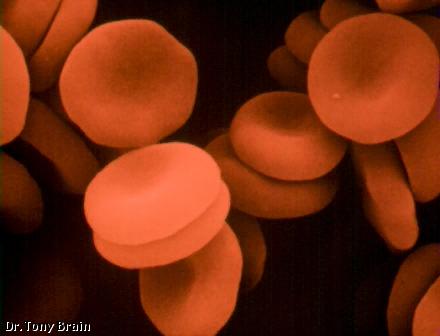
The red corpuscles, or red blood cells, are round disks, concave on two sides, and approximately 7.5 thousandths of a millimeter in diameter. In humans, and most other mammals, the mature red blood cell contains no nucleus; in some vertebrates, it is oval and nucleated. Hemoglobin, a blue-red, iron- containing compound in the red blood cells, combines with oxygen as blood passes through the lungs to form oxyhemoglobin and releases the oxygen in the capillaries of tissues. Oxyhemoglobin is bright red and gives this color to the erythrocytes.
Leukocytes:
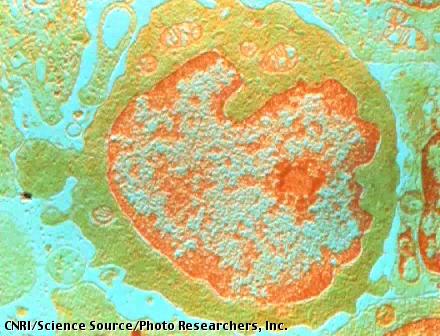
The white blood cells are of two principal types: the granular, which have multilobed nuclei, and the nongranular, which have rounded nuclei. The granular leukocytes include neutrophils, which ingest and destroy bacteria; eosinophils, which increase and become active in the presence of certain infections and allergies; and basophils, which secrete the anticoagulant heparin and the substance histamine, which stimulates inflammation. The nongranular leukocytes are the lymphocytes, which are associated with immune phenomena, since they not only elaborate antibodies, but are also concerned with cellular immunity.
Thrombocytes:
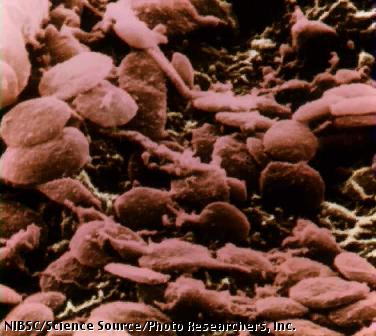
Blood platelets are small, round, nonnucleated bodies with a diameter about one-third that of red blood cells. Thrombocytes adhere to the walls of blood vessels at the site of an injury and thus plug the defect in the vascular wall. As they disintegrate, they release coagulating agents that lead to the local formation of thromboplastin, which helps to form a clot, the first step in the healing of an injury.
Blood Count:
A laboratory technique known as complete blood count (CBC) is a useful indicator of disease and health. A precisely measured sample of blood is automatically diluted and the cells are usually counted by an electronic or optical scanner. Different settings or diluents permit the counting of red blood cells, white blood cells, or platelets. A CBC may include a sorting of white blood cells into categories (granulocytes, eosinophiles, monocytes, lymphocytes, etc.), which may be done visually from a stained sample on a microscope slide or automatically using one of several techniques.
Plasma:
Plasma is a complex substance; its principal component is water. It also contains plasma proteins; such inorganic constituents as sodium, potassium, calcium chloride, carbonate, and bicarbonate; sugar, hormones, enzymes, fats, amino acids, and such waste products as urea and creatinine. All these substances occur in minute quantities.
Among the component plasma proteins are albumin, the principal agent in maintaining the osmotic pressure of the blood and therefore in controlling its tendency to diffuse through the walls of blood vessels; a dozen or more proteins, including fibrinogen and prothrombin, which participate in clotting; agglutinins, which cause the agglutination reaction between samples of blood of different types and the reaction known as anaphylaxis, a form of allergic shock; and globulins of many types, which include the antibodies that provide immunity against many diseases. Other significant plasma proteins function as carriers of such essential tissue nutrients as copper, iron, other metals, and a variety of hormones.
Separation of plasma proteins for individual study was first accomplished in the 1920s; large- scale fractionation, allowing use of the individual fractions, was accomplished during World War II by the American biochemist Edwin Joseph Cohn (1892-1953) and his associates. Some of the results of this work include the use of serum albumin as a substitute for blood or plasma for transfusion; the use of gamma globulin for short-term protection against such diseases as measles and hepatitis; and the use of antihemophilic globulin for the treatment of hemophilia.
Blood Formation and Reactions:
The red cells are formed in the bone marrow. After an average life of 120 days, during which they incur substantial damage, they are broken down and removed by the spleen. Of the white cells, the granular leukocytes or granulocytes are formed in the bone marrow; the lymphocytes are formed in the thymus, in the lymph glands, and in other lymphatic tissue. Platelets are formed in the marrow. All these constituents of the blood are continuously worn out or consumed and must be continuously replaced. The components of plasma are formed in various organs of the body, including the liver, which makes albumin and fibrinogen, stores blood sugar, and releases such important elements as sodium, potassium, and calcium. Endocrine glands make the hormones that are transported in the plasma; the lymphocytes and plasma cells make some of the proteins; and other constituents are derived by absorption from the intestinal tract.
Coagulation:
One of the most remarkable properties of blood is its ability to clot, or coagulate, when it is withdrawn from the body. Inside the body, a clot is formed in response to tissue injury, such as a muscle tear, a cut, or a sharp blow. In the blood vessels, the blood remains in a fluid condition; shortly after being withdrawn, it becomes viscid and gelatinous and sets into a firm, jellylike mass. This mass then separates into two portions: a firm red clot floating free in a transparent, straw-colored fluid called serum.
A clot consists almost entirely of red corpuscles entangled in a network of fine fibrils or threads, composed of a substance called fibrin. This substance does not exist as such in blood but is created by the action of thrombin, an enzyme that promotes the conversion of fibrinogen, one of the plasma proteins, to fibrin in the clotting process. Thrombin is not present in circulating blood; it is formed from prothrombin, another of the plasma proteins, by a complex process involving blood platelets, certain calcium salts, substances produced by injured tissue, and contact with rough surfaces. If any of these factors is deficient, clot formation is defective. The addition of sodium citrate removes calcium ions from the blood and thus prevents a clot from forming. Lack of vitamin K makes impossible the maintenance of the proper amount of prothrombin in the blood. Certain diseases may lower the concentration of the various clotting proteins or of the platelets of the blood.
Homeostatic Reactions:
Certain blood characteristics are kept within narrow limits by precisely regulated processes. For example, the alkalinity of the blood is so nearly constant that if the pH falls to 7.0 (the same as that of pure water), the individual lapses into an acidotic coma that may be fatal; on the other hand, if the pH rises above 7.5 (the same as that of a solution containing 1 part of caustic soda in 50 million of water), the individual lapses into an alkalosis tetany and will probably die. Similarly, a fall in blood sugar concentration, normally about 0.1 percent, to less than 0.05 percent brings on convulsions. Persistently high concentrations of blood sugar, when accompanied by a variety of important metabolic changes, often bring about diabetic coma. The temperature of the blood in a normal individual does not vary more than 1� from a normal average of 98.6� F. A rise in blood temperature of 6� is usually an indication of serious illness, while a rise of 10� generally causes death.
Blood Diseases:
Disorders of the blood arise from abnormal changes in its composition. An abnormal reduction in the hemoglobin content or in the number of red blood cells is known as anemia, which is regarded as a symptom rather than a disease and has a number of causes. Probably the most common cause is blood loss or hemorrhage. Excessive destruction of the red blood cells, a condition known as hemolytic anemia, may be caused by a variety of toxins or by an antibody to the red blood cells. One type that occurs in the infant at or shortly before birth is erythroblastosis fetalis.
Anemia also results from decreased production of red cells, attributable to a loss of iron, to a deficiency of vitamin B12, or to a failure in the function of bone marrow. Finally, one group of anemias is caused by inherited defects in the production of red cells or hemoglobin. These anemias include a number of hereditary disorders in which the red cells lack any one of several enzymes needed if the cell is properly to utilize glucose.
Formation of abnormal hemoglobin is responsible for the hereditary defects called sickle-cell anemia and thalassemia major. Both are severe diseases that can be fatal in childhood.
An increase in the number of circulating red blood cells is called polycythemia, which can be a primary condition or one that follows decreased oxygenation of the blood, or hypoxia. Extreme hypoxia occurs most commonly in advanced lung disease, in certain types of congenital heart disease, and at high altitudes.
Leukemia is accompanied by a disordered proliferation of white blood cells. Several types of leukemia exist, each characterized by the cells involved.
A deficiency in any of the factors necessary for blood coagulation leads to excessive bleeding. A decrease in platelets is known as thrombocytopenia; a decrease in clotting factor VIII results in hemophilia A (classic hemophilia); a decrease in clotting factor IX results in hemophilia B, commonly known as Christmas disease. Several of the hemorrhagic diseases, such as hemophilia, are hereditary. Preparations are available that contain some of the clotting factors in concentrated form for treating some of these disorders. In 1984 researchers developed a genetic engineering technique for making Factor VIII, a blood-clotting factor of vital importance for victims of the most common form of hemophilia.
Although clot formation is a normal process, it sometimes occurs inappropriately and constitutes a threat to life. In patients hospitalized for a long time, for example, clots sometimes form in the large veins of the legs. If these clots, or thrombi, travel to the lungs, they can cause death. Such venous thrombi are dissolved in many cases with a combination of drugs that prevent coagulation and break down clots. Anticoagulants include the natural compound heparin, prepared from the lungs and livers of animals, and the synthetic chemicals dicumarol and warfarin. Clot-dissolving drugs, called thrombolytics, include two enzymes, urokinase and streptokinase, approved for medical use in 1979, and tissue plasminogen activator (TPA), a product of genetic engineering.
Interaction of thrombocytes with the fatty deposits found in atherosclerotic heart disease is thought to contribute to heart attacks. Compounds such as aspirin and sulfinpyrazone, which inhibit platelet activity, may decrease heart attacks in persons with atherosclerotic disease.