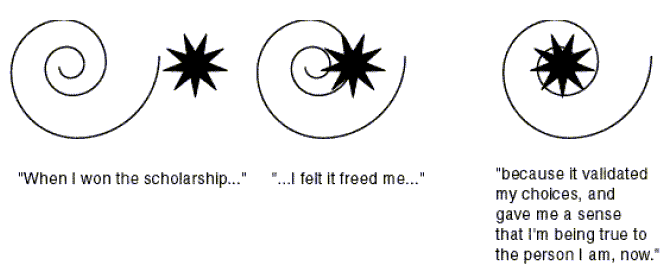
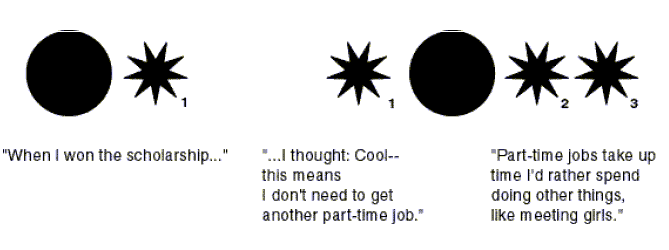
IX. A Clarification The last chapter was pretty complex, so let’s consider it from a different angle, so that what we’re getting at is perfectly clear. Men relate to primary experiences—whether a chair is physically comfortable, whether a deal makes a certain amount of money, whether something looks good or not. Women relate most to evaluations of and feelings about experiences, and feelings about their feelings. For a woman, the important thing is not whether a chair is soft or in good condition or squeaky—the important thing is how she feels about the chair being soft or in good condition or squeaky. What’s even more important is how the way she feels about the chair’s physical attributes relates to feelings about things which are even more general—the way she feels about her life, and what the chair suggests to her about herself. Is she being authentic? Is she challenging herself? Is she feeling connected with herself or those around her? Is she following her destiny? With women, the important thing is less the sensation than the value or the emotion. Women easily and instinctively connect real-world, physical experiences—things that can be seen and felt and heard and touched— with concepts about what those experiences “mean”. She makes connections between real-world things and emotions and abstract concepts, and the emotions and abstractions are much more important than the real-world things that led to them. Why is this important? Because you can choose any emotion or experience, and add the phrase, “this gives you a feeling of X.” X, for our purposes, should be something pleasant, because it’s what she’ll start to experience as you talk about it. Women naturally think in, and experience, chains of emotion. X leads to Y leads to Z. For example, you might tell her that a feeling of comfort leads to a feeling of serenity and this leads to a feeling of being open to new experiences. Being open to new experiences, you might continue, leads to a feeling of knowing that you are growing and developing and in touch with your path. None of these things has any necessary connection—but if you present one emotional state as leading to another, women will follow along and experience what you are talking about. Women’s emotions cascade— one leads to another, and the more abstract the emotion, the more meaningful and powerful it is for her. You can move her from one emotion to the next even more easily by putting pleasant metaphors between them. Bridge the gap with imagery. Say when you feel X really powerfully, it’s just like walking on the beach and feeling the waves caress the sand; and when you really feel that powerfully, it gives you a feeling of Y, which is just like when you gaze into the eyes of someone you are falling in love with, and that can really lead to a feeling of Z, which is just like feeling wings on your back, and knowing you are meant to fly….etc. The metafeelings, the emotions, you induce should become increasingly close to her values. In a seductive context, if you haven’t elicited her values yet—if you haven’t learned why she does what she does and what things she looks for and thinks about when making choices—you can usually rely on generic feminine values. We’ll cover this more later, but they include things like connecting emotionally to someone special, a sense that emotional relationships drive everything else, believing that somewhere, there is Mr. Right, The One guy meant for her; believing that there are certain emotional experiences she needs and does not need at a given time; believing that life has phases during which some things are appropriate and other things aren’t, and that there are few things more destructive than doing something, especially sexually or romantically, which isn’t right for her, during this phase, or in the “emotional place” she’s in; and believing that emotions and irrational, unexpected things like fate tend to overpower, and so must take precedence over, things like plans and beliefs and wishes. For women, emotions are what makes things possible or impossible—of course that’s pretty much true for everyone, but women have that in the forefront of their minds. Pleasure and success for a woman come in part from realizing and remembering that she can experience more emotions, and more complex and more intense emotions, than she’s felt thus far. To evoke strong emotional states in a woman, presuppose that any emotion she feels leads to a deeper one, which she can be reminded or encouraged to notice. As you describe it in overwrought sensory-rich language ("a bright blue flower spreading wide inside you, its soft moist petals glittering with dew, deep inside your heart"), she will begin to feel the emotion you describe.Any emotion X (example: "joy") can lead to emotion X+1 (example: "true joy") or emotionY ("surrender"). Remember, the labels for emotional experience are arbitrary. X. You Say Tomato, I Say Delicious, Glistening, Nutritious Meal That Makes Me Feel Renewed and Alive: Emulating the Direction of a Woman’s Thoughts for Rapport and Arousal The direction of a man’s thoughts is forward; the direction of a woman’s thoughts is inward. That is, men reason from one event in the world of senses to the next event in the world of the senses, and the meaning of the first event is the impact it has on that second event. For example, buying a new fire-red sports car, for a man, might “mean” impressing more women and therefore having sex with more women. Women, by contrast, reason inward—that is, they relate a physical event, or an emotion, to their emotions and their values. The meaning of an event is the emotional response it produces. And a given event will often set off a chain of emotional responses, each emotion able to lead to a “deeper,” more abstract emotion. For example, buying a new fire-red sports car, for a woman, might “mean” finally coming to accept and celebrate her sexual desires and desirability. Accepting and celebrating her sexuality might “mean” feeling a sense of freedom. Feeling freedom might “mean” the opportunity to discover more about herself. Discovering more about herself might “mean” feeling more connected to who she truly is. Et Cetera. Note that the “meanings” in the female list were abstract—that is, they were beliefs, ideas, emotional states, as opposed to physical events (such as having sex with women who are irresistibly attracted to your car). An abstract emotion is one that doesn’t include descriptions of things you can see with your eyes, touch with your hand, or hear with your ear— something abstract is something without sensory detail. And the “deeper” the emotion—that is, the more abstract the emotion, and the more that emotion relates to such subtleties as a woman’s sense of “self,” sense of “destiny,” sense of “emotional growth,” and so forth—the more important that emotional response becomes in determining a woman’s choices and actions. How is any of this relevant to getting laid? You can make a woman feel emotionally connected and sexually attracted to you by saying things that match her thought pattern. Why will matching her thought pattern arouse her? Matching her thought pattern will arouse her because sex, for women, is above all a form of communication, and communicating really well generates rapport; communicating really really well creates strong rapport and also sexual excitement. This is not the same thing as matching her thoughts. Matching her thoughts, too, can be potent, but doing this well requires that you know her thoughts. Matching her thought pattern, by contrast, requires only that you know one simple pattern, whatever her particular thoughts at a particular moment might be. By verbally emulating the way a woman thinks and feels, you make it easy for her to feel the emotions you describe. How do you emulate a woman’s thought patterns? You emulate a woman’s thought patterns by verbally suggesting that every physical event and every emotion leads to another, “deeper,” more abstract, more powerful emotion. A pleasurable physical stimulus—the warm feeling in your legs that come from bicycling, for example—you can say leads to a sense of “comfort,” which in turn leads to “peace,” which in turn leads to “connection with yourself,” which in turn leads to a sense of “knowing who you are.” This sort of chain tends to seem preposterous to men—it started, after all, with warm legs—but this is the kind of emotional chain which seems eminently reasonable to women. It’s the way women experience things. And if you describe experiences in this way, you make women feel good and make it easy for them to feel the emotions you describe. To describe things in a way that’s compelling for women, end every description with “…and this gave me a feeling of X,” where X is whatever emotion you wish to induce: serenity, self-discovery, passion, a feeling of destiny, or what have you. Women’s emotions tend to cascade; one emotion leads to another emotion, and the further along the chain a given emotion is, the more meaning and impact that emotion will have on her perceptions and experiences. In the example diagram above, connection to her real self will have more influence on her than tension or stress. For a woman, every physical experience or emotion implies the existence of a “deeper,” more powerful emotion to which the first emotion can lead. A woman won’t necessarily feel the next emotion in the chain automatically, but can easily be led to feel it by your description. Emotion1 àEmotion2àEmotion3àEmotion nAs n increases, the emotions tend to become more abstract and more subjectively powerful. A woman’s emotions spiral into the depths of the Hidden and Unknown Self, becoming progressively more abstract as they do. Women’s emotions are primed to cascade into further, more intense emotions, and the further they cascade in a given moment, the more a woman feels as if she’s “learning” and “growing” and “getting in touch” with herself—that is, doing what she’s supposed to do. This can be contrasted with the male thought pattern, which is based on bodily reaction to physical stimulus. action àphysical pleasure/painà choose new actionExample: packing up house, preparing to moveàtensionàstart hauling boxes When you describe an extremely long chain of emotions to a woman, such a long chain will tend to match her experience, and induce strong rapport. Note how simple the typical male pattern is, by contrast— this is part of the reason why women think men are out of touch with their emotions, and men think women get wrapped up in ridiculously complex concerns. Men tend not to have the kinds of emotional experiences women do; women think men do, or should, and men have no idea what women are talking about.
Women internalize external events and experiences. They take them “inside,” and process them on ever-deeper emotional levels. An external event seems to exist to teach them about what they want, what they believe, what is good for them, and “who they are”. When you speak in emotional abstractions, you encourage them to go “inside” themselves and have strong emotional responses. Men, by contrast, tend to move their attention from one external event to another, rarely internalizing any one event very deeply.
|