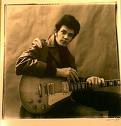
| Michael Bloomfield is middle-aged, gifted, and white. Probably he is the foremost blues guitarist of his generation. From Bob Dylan. Paul Butterfield and the Electric Flag in the Sixties to his own bands. records, and film soundtracks in the Seventies music has felt his influence as performer, writer. arranger. and producer. In short, he has done a lot.
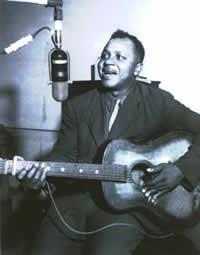
This is a story of his early days in Chicago, when he had done very little. I met JOE LEE WILLIAMS in the early Sixties in a Chicago nightclub called the Blind Pig. He was a short and stout and heavy-chested man, and he was old even then. He wore cowboy boots and cowboy hat and pleated pants pulled way up high, almost to his armpits. Just visible above the pants was a clean white shirt and a tiny blue bow tie dotted his bullish neck He played a nine-string Silvertone guitar, and to keep others from copying his style he�d put it up in a very strange tuning I was familiar with all stringed instruments and I think eventually I worked that guitar every way possible, but I never learned to play it really well, and to this day don�t know the tuning he used. Big Joe, as he was often called, had been a well-known artist in the Thirties and Forties, and wrote one of the real standards in the blues field, Baby Please Don�t Go, a song later cut by, among others, MOSE ALLISON and MUDDY WATERS. At the time I met Joe Lee I was trying to meet as many blues artists as were alive in America, because music was the field I most wanted to pursue. And blues was the music I most wanted to learn. So between sets I talked with Joe, or at least I tried to. He lacked teeth and had a thick Pineywoods accent, and at first I found him nearly indecipherable. I had to ask him to repeat himself over and over, but he didn�t seem to mind, and after a while I caught on somewhat to his speech. He told me Crawford, Mississippi, was his birthplace, and that since the early Thirties he�d done nothing but hobo around the country with his guitar. Now, most bluesmen I�d met had two jobs�they�d play and sing nighttimes, but during the day they kept up a straight gig of one kind or another. But Joe never did that�he played and traveled, and that was it. Joe and I got along well that night, and as he packed his guitar away after his last set he invited me to visit him sometime. He was living in the basement of a record store on Chicago�s Near North Side, and I dropped in to see him often. The store specialized in blues and was run by a very odd guy named Kaercher. Along with the store he owned a record company, and though I was never sure he knew a good record from a bad one, he was straight with the musicians he recorded and had a real reverence for their art and skill. But Joe and he would have many fights, sometimes due to Kaercher�s obtuse nature, and at other times to Joe�s drinking. Joe would get a few beers or a little hard liquor in him (peppermint Schnapps and Gordon�s gin were his choices) and suddenly you wouldn�t be dealing with a normal man�he couldn�t talk coherently and nothing would make sense to him. Behind larger amounts of alcohol he could get physically violent. But as nasty as he could get when he was drunk, that�s how compassionate and big-hearted he could be when he was sober, and often his ways were a real Southern gentleman�s. His manner could be touching�very sweet, gallant, courtly. As I got to know Joe better we became more and more friendly, and soon he began to carry me to see old friends of his. I�d say, �Listen, Joe, d�you know where TAMPA RED�s living?� And Joe�d say, �Sure I know where Tampa�s at�I�ll take you by right now .� And we�d go. Tampa Red was a singer whose career had begun in the twentIes and who�d become very popular in the Thirties and Forties. I knew his records well. He�d had a big hit called Tight Like That. and he recorded with the man who is now the king of all gospel publishing, THOMAS G. DORSEY. But Tampa, by the time I met him, was just a frail, wizened little man whose hands shook uncontrollably. He had an expensive old Gibson in a case beneath his bed, but all he could do was show it to us�his hands wouldn�t let him plav. Another singer Joe took me to see was KOKOMO ARNOLD, who had also recorded in the Thirties and Forties. His big hit was Kokomo Blues, a song about that bright city, that seven-light city, that sweet old Kokomo. He told me I was the first one to ask about his music since the early Fifties when some people from a jazz magazine in Belgium had come to see him. But the next time I saw him was in a hospital, where I�d gone to visit him with Charlie Musselwhite. Kokomo�d had to have much of his insides cut out, and he was just a shadow of the man I�d seen with Joe. -CONTINUED ON NEXT PAGE- |
 |
 |
| ME AND BIG JOE by michael bloomfield and s. summerville c.1980 by S.E. Summerville/Michael Bloomfield |

|