Ribosomes
 Ribosomes
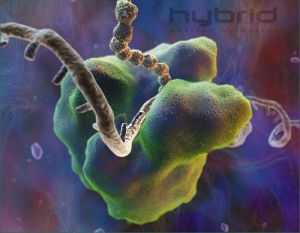
are where proteins are made. Cells that need to produce more proteins
have a high ribosome count, such as a human liver cell, which may
have a few million ribosomes. Ribosomes can either be free, such as
the one in the illustration at right, or bound to endoplasmic
reticulum or the nucleus. Some also exist within the mitochondria.
Most of the proteins produced by free ribosomes function in the
cytosol, such as enzymes that catalyze metabolic processes. Bound
ribosomes typically create proteins to be included into membranes,
for packaging within certain organelles, or to be sent out from the
cell. Cells, such as pancreatic cells, that specialize in secretion
generally have many bound proteins. Bound and free ribosomes are
structurally identical and interchangeable, and cells can adjust the
numbers of each type when necessary.
Ribosomes
are where proteins are made. Cells that need to produce more proteins
have a high ribosome count, such as a human liver cell, which may
have a few million ribosomes. Ribosomes can either be free, such as
the one in the illustration at right, or bound to endoplasmic
reticulum or the nucleus. Some also exist within the mitochondria.
Most of the proteins produced by free ribosomes function in the
cytosol, such as enzymes that catalyze metabolic processes. Bound
ribosomes typically create proteins to be included into membranes,
for packaging within certain organelles, or to be sent out from the
cell. Cells, such as pancreatic cells, that specialize in secretion
generally have many bound proteins. Bound and free ribosomes are
structurally identical and interchangeable, and cells can adjust the
numbers of each type when necessary.
Structurally, ribosomes appear
to have three creases on their surface: one holds mRNA (messenger)
and two hold tRNA (transfer). Enzymes bound to the ribosome attach
amino acids, in the appropriate sequence, to the protein that is
being created by the ribosome.