Mitosis: An
Overview
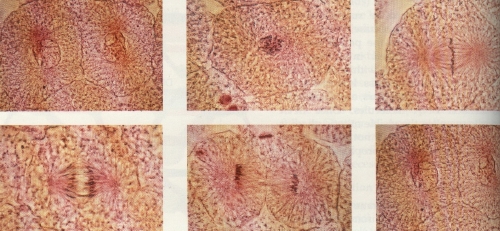 During
interphase (not shown), the genetic material in the nucleus
replicates. In prophase (first box), the nuclear membrane dissolves
and the chromatin of the nucleus becomes distinct threads
("mitos" from the Greek for "thread"). These
threads--chromosomes--condense and thicken. At prophase, the cell
contains twice the normal number of chromosomes (46 pairs). During
metaphase, the 46 pairs line up on the cell equator, with the
centrioles at either end of the cell. From each centriole extends a
fiber to the chromosomes. These spindles consist of microtubules and
are responsible for the subsequent separation and movement of the the
pairs. Each chromosome pair consists of a pair of identical
chromatids, joined at a point called a centromere. In anaphase, the
pairs separate and retract toward the ends of the cell along the
spindle fibers, as if being pulled in. In telophase, the chromosomes
disappear into chromatin, and the two masses of it are surrounded by
new membranes. The spindles fibers dissolves and the cytoplasm
divides along the equator, forming two new daughter cells.
During
interphase (not shown), the genetic material in the nucleus
replicates. In prophase (first box), the nuclear membrane dissolves
and the chromatin of the nucleus becomes distinct threads
("mitos" from the Greek for "thread"). These
threads--chromosomes--condense and thicken. At prophase, the cell
contains twice the normal number of chromosomes (46 pairs). During
metaphase, the 46 pairs line up on the cell equator, with the
centrioles at either end of the cell. From each centriole extends a
fiber to the chromosomes. These spindles consist of microtubules and
are responsible for the subsequent separation and movement of the the
pairs. Each chromosome pair consists of a pair of identical
chromatids, joined at a point called a centromere. In anaphase, the
pairs separate and retract toward the ends of the cell along the
spindle fibers, as if being pulled in. In telophase, the chromosomes
disappear into chromatin, and the two masses of it are surrounded by
new membranes. The spindles fibers dissolves and the cytoplasm
divides along the equator, forming two new daughter cells.