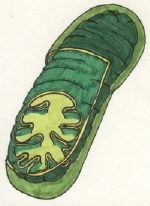
 The
mitochondria converts energy into forms the cell can use for work.
They are sites for cellular respiration, the process that generates
ATP by extracting energy from sugars, fats, and other fuels, with the
aid of oxygen.
The
mitochondria converts energy into forms the cell can use for work.
They are sites for cellular respiration, the process that generates
ATP by extracting energy from sugars, fats, and other fuels, with the
aid of oxygen.The
mitochondria converts energy into forms the cell can use for work.
They are sites for cellular respiration, the process that generates
ATP by extracting energy from sugars, fats, and other fuels, with the
aid of oxygen.
Mitochondria are not a part of the endomembrane system, and their membrane proteins are not made by ER, but instead by free ribosomes or ribosomes within the mitochondria. In addition to having their own ribosomes, mitochondria also have their own DNA which programs the synthesis of the proteins made by the ribosomes.
These organelles are
semiautonomous and are found in nearly all eukaryotic cells.
Sometimes, a cell will have a singular, large mitochondrion, but most
have hundreds or thousands of little ones. They range from 1-10
micrometers long and can move around, change their shape, and divide.
Mitochondria have two membranes, each a phospholipid bilayer with
embedded p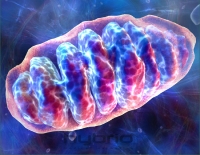 roteins.
The outer membrane is smooth, but the inner membrane has infoldings
call cristae which increase the surface area, enhancing the
productivity of cellular respiration. The inner membrane separates
the mitochondrion into two internal compartments. The first in the
intermembrane space, a narrow region between the inner and outer
membranes. The second compartment is the mitochondrial matrix,
enclosed by the inner membrane. Here, some of the metabolic steps of
cellular respiration take place, and the enzyme that makes ATP is
built into the membrane.
roteins.
The outer membrane is smooth, but the inner membrane has infoldings
call cristae which increase the surface area, enhancing the
productivity of cellular respiration. The inner membrane separates
the mitochondrion into two internal compartments. The first in the
intermembrane space, a narrow region between the inner and outer
membranes. The second compartment is the mitochondrial matrix,
enclosed by the inner membrane. Here, some of the metabolic steps of
cellular respiration take place, and the enzyme that makes ATP is
built into the membrane.