Lysosomes
 Lysosomes
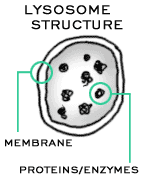
are essentially a membrane-bound sac of hydrolytic enzymes, but they
have various vital functions. Lysosomal enzymes are used to digest
macromolecules, hydrolyzing proteins, polysaccharides, fats, and
nucleic acids. Since the enzymes are most effective in an acidic
environment, lysosomes keep their pH at approximately 5 by pumping
hydrogen ions in from the cytosol. The leaking or bursting of a
single lysosome will have little effect in the vast and neutral
cytosol, but if several lysosomes open, the cell can be destroyed
through autodigestion.
Lysosomes
are essentially a membrane-bound sac of hydrolytic enzymes, but they
have various vital functions. Lysosomal enzymes are used to digest
macromolecules, hydrolyzing proteins, polysaccharides, fats, and
nucleic acids. Since the enzymes are most effective in an acidic
environment, lysosomes keep their pH at approximately 5 by pumping
hydrogen ions in from the cytosol. The leaking or bursting of a
single lysosome will have little effect in the vast and neutral
cytosol, but if several lysosomes open, the cell can be destroyed
through autodigestion.
The membrane of the lysosome
and the enzymes it contains are made in the rough ER and transferred
by the Golgi to be tweaked. Some lysosomes are simply budded straight
out from the trans face of the Golgi. The proteins of the
inner membrane surface are spared from being digested by have three
dimensional conformations which protect their bonds from
enzymes.
One function of a lysosome is
phagocytosis (from the Greek "phagein", "to eat", and
"kytos", "vessel"), the process of engulfing smaller organisms
or food particles. In human, macrophages (cells that move through
tissue fibers) defend the body by "eating" bacteria and other
invaders.
Lysosomes also engulf the
cell's own material in autophagy. Cellular material is recycled
when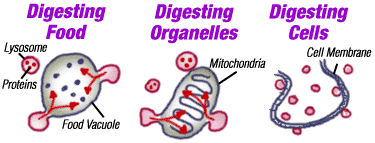 an older organelle or portion of cytosol needs to be dismantled. The
organic monomers that remain are returned to the cytosol to bee
reuse. The lysosome allows the cell to constant renew itself. A good
example of this is the human liver cell which recycles half its
macromolecules a week.
an older organelle or portion of cytosol needs to be dismantled. The
organic monomers that remain are returned to the cytosol to bee
reuse. The lysosome allows the cell to constant renew itself. A good
example of this is the human liver cell which recycles half its
macromolecules a week.
Lysosomes can even be
programmed to destroy their entire cell. When cells are no longer
necessary, such as the cells that make up a tadpole's tail or the
webbing between a human fetus's fingers, their lysosomes dismantle
them
There are many lysosomal
storage diseases that can be inherited. Someone with a storage
disease would lack one of the active hydrolytic enzymes normally
present in a lysosome, leaving the organelle to become overfilled
with indigestible substrates and unable to perform other necessary
functions. In Pompe's Disease, the liver is damaged when glycogen
accumulates because it cannot be broken down. In Tay-Sachs Disease,
it is a lipid-digesting enzyme that is missing or inactive, allowing
lipids to accumulate and impair the brain. Fortunately, storage
diseases are rare.