Golgi
Apparatus
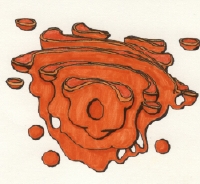 The
Golgi apparatus manufactures, stores, sorts, and ships. Many
transport vesicles fresh from the ER move next to the Golgi to be
modified or stored, then sent on to new destinations. Cells that
specialize in secretion have extensive Golgi. The organelle consists
of flattened membrane sacs--cisternae. Vesicles in the area are
involves in the transfer of material between the Golgi and other
structures.
The
Golgi apparatus manufactures, stores, sorts, and ships. Many
transport vesicles fresh from the ER move next to the Golgi to be
modified or stored, then sent on to new destinations. Cells that
specialize in secretion have extensive Golgi. The organelle consists
of flattened membrane sacs--cisternae. Vesicles in the area are
involves in the transfer of material between the Golgi and other
structures.
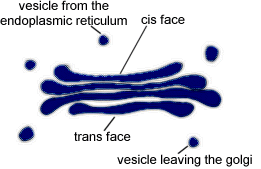
There is distinct polarity
between the membranes at either end of the stack. The ends differ in
thickness and molecular composition. They are called the cis
face and the trans face. The cis face receives material
and the trans face ships it. The cis face usually is
near ER. Transport vesicles that bud from ER move material from their
maker to the Golgi's cis face. The trans face creates
more vesicles, filled with material that has been processed and is
ready to move to another location.
 The
Golgi manufactures, by itself, certain macromolecules, such as many
polysaccharides. One such Golgi product is hyaluronic acid, a sticky
substance that works as glue between animal cells. Golgi products
destined for secretion exit from the trans face in vesicles
that will fuse with the plasma membrane to allow their contents to
pass through.
The
Golgi manufactures, by itself, certain macromolecules, such as many
polysaccharides. One such Golgi product is hyaluronic acid, a sticky
substance that works as glue between animal cells. Golgi products
destined for secretion exit from the trans face in vesicles
that will fuse with the plasma membrane to allow their contents to
pass through.
Substances are manufactured
and/or refined in stages within different cisternae containing
various groups of enzymes and seem to be transported from cisternae
to cisternae by vesicles. Before sending products out, the Golgi
sorts them, aiming them for certain areas of the cell. Adding a
molecular ID tag, such as a phosphate group, aid in the sorting
process. Also, transport vesicles may have external membrane
molecules to recognize a "docking site" on an organelle
surface.