Endoplasmic
Reticulum (ER)
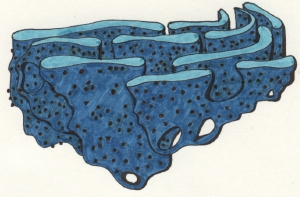 The
endoplasmic reticulum is part of the endomembrane system and accounts
for over half of the total membrane in many eukaryotic cells.
"Endoplasmic" means "within the cytoplasm" and
"reticulum" is from the Latin term for "network". ER is
indeed a network, one composed of membranous tubules and sacs called
cisternae (Latin: "cisterna" means "box" or "chest"). The
membrane separates the ER material compartment--the cisternal
space--from the cytosol.
The
endoplasmic reticulum is part of the endomembrane system and accounts
for over half of the total membrane in many eukaryotic cells.
"Endoplasmic" means "within the cytoplasm" and
"reticulum" is from the Latin term for "network". ER is
indeed a network, one composed of membranous tubules and sacs called
cisternae (Latin: "cisterna" means "box" or "chest"). The
membrane separates the ER material compartment--the cisternal
space--from the cytosol.
There are two different and
distinct types of ER that have individual forms and functions: smooth
ER and rough ER (shown in the illustration above at left). Smooth ER
does not have attached ribosomes, whereas rough ER does--hence the
name and appearance.
SMOOTH ER
This form of endoplasmic
reticulum functions in diverse metabolic processes, including the
synthe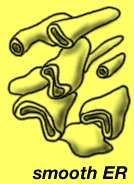 sis
of lipids, metabolism of carbohydrates, and detoxification of drugs
and poisons. Smooth ER also produces steroids, such as sex hormones
and steroid hormones secreted by adrenal glands. Ovary and testicle
cells have a large quantity of smooth ER. Liver cells store
carbohydrate as glycogen, which is hydrolyzed to release glucose from
the cell to regulate sugar concentration in the blood. When it is
hydrolyzed, its glucose phosphate (an ionic sugar that cannot enter
the blood) is removed by smooth ER. Smooth ER detoxifies drugs in the
liver, usually by adding a hydroxyl group or groups to make the
substance more soluble and therefore easier to be expelled from the
body. Barbiturates, alcohol, and many other drugs lead to the need
and creation of more smooth ER and its detoxification enzymes. While
this may seem like a good thing, what is happen is the body is
increase its tolerance to the drugs, meaning higher "doses" are
necessary to achieve the drug's intended effect. While the liver is
working to detoxify excessive amounts of alcohol, it could also be
detoxifying helpful drugs, such as antibiotics.
sis
of lipids, metabolism of carbohydrates, and detoxification of drugs
and poisons. Smooth ER also produces steroids, such as sex hormones
and steroid hormones secreted by adrenal glands. Ovary and testicle
cells have a large quantity of smooth ER. Liver cells store
carbohydrate as glycogen, which is hydrolyzed to release glucose from
the cell to regulate sugar concentration in the blood. When it is
hydrolyzed, its glucose phosphate (an ionic sugar that cannot enter
the blood) is removed by smooth ER. Smooth ER detoxifies drugs in the
liver, usually by adding a hydroxyl group or groups to make the
substance more soluble and therefore easier to be expelled from the
body. Barbiturates, alcohol, and many other drugs lead to the need
and creation of more smooth ER and its detoxification enzymes. While
this may seem like a good thing, what is happen is the body is
increase its tolerance to the drugs, meaning higher "doses" are
necessary to achieve the drug's intended effect. While the liver is
working to detoxify excessive amounts of alcohol, it could also be
detoxifying helpful drugs, such as antibiotics.
In muscle cells, the smooth ER
membrane pumps calcium ions from the cytosol into the cisternal
space. When a nerve impulse stimulates the muscle cell, the calcium
moves back across the ER membrane into the cytosol quickly,
triggering the contraction of the muscle cell.
ROUGH ER
As a polypeptide chain is
forming from a bound ribosome, it moves into the cisternal space and
folds into its protein conformation. Most secretory proteins are
glycoproteins, which are bonded covalently to carbohydrates, attached
to the protein when in the ER. The ER membrane keeps secretory
proteins separate from proteins that will remain in the cytosol
(those produced by free ribosomes). A specialized region in the ER
called transitional ER buds out vesicles of secretory proteins to
transport them away.
Rough ER is a membrane
factory, building itself by adding on proteins and phospholipids.
Polypeptides growing from ribosomes are inserted into the ER
membrane. Enzymes in the ER membrane build phospholipids as well,
piecing together snippets from the cytosol. ER membrane expands and
can be transported to other parts of the endomembrane system via
transport vesicles.