
Welcome

     <<Home

<< Back      


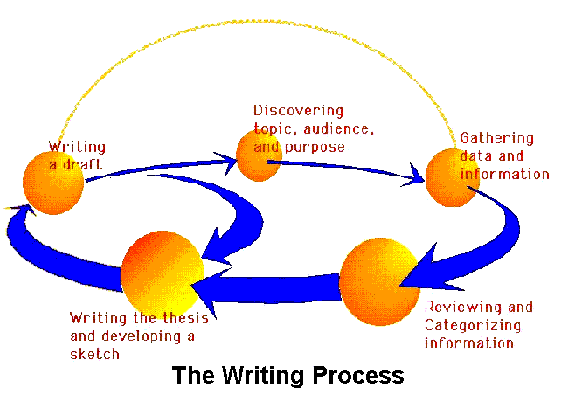
The Writing Process: An Insight in to Research Paper Writing

Compiled by                           NOMAN AHMED JUNEJO

Post Graduate Student

Institute of Information Technology, Mehran University of Engineering and Technology. Jamshoro, Pakistan

Email: [email protected]

Mob 0333-2608556


Invention,

The Child Of Necessity: Getting Papers Started

Getting a paper started is tough for every writer; it's especially hard for a student writer who doesn't get to pick her own subjects: first she must learn about a broad subject area; then, she must find some topic within that broad area to write about, always with limited space and time. And if all this isn't enough, writers also have to develop their own ideas about their topic and explain those ideas with concrete support.

Does this sound familiar? Does it sound impossible? There are many ways to go about "inventing" a short paper; what follows is one very practical process that gets results:

  1. Locate a subject: Your subject will depend on the kind of writing you are doing; if a subject has been assigned, make sure you know what it is (i.e., read the assignment sheet), and learn something about it (i.e., do your home work). Inventing a paper on a subject about which you know nothing is tough.
  2. Focus on a narrow topic: Use the invention techniques described below to figure out what specific topics are within your subject area; once you have some specific options, commit to a good one. Don't waffle.
  3. Come up with a controlling idea: No one can do this for you! Use invention techniques to help you see what you think about your topic. Again, after you have some options, pick an idea and stick to it.
  4. Generate concrete examples that you can use to develop your paper: Concrete examples and reasoning are the heart of a paper. With your topic and controlling idea in mind, use invention techniques strenuously; push your thoughts beyond generalizations to concrete examples. The clause, "I hate potatoes," is general; "the texture, color, and flavor of potatoes does nothing for me," is a more concrete statement.

Invention Techniques
(We didn't make these up: they're in the third chapter in The Allyn & Bacon Handbook)

  • Reading: use your notes on other people's ideas to jump start your own ideas, but be careful not to plagiarize.
  • Brainstorming: spend five minutes just listing ideas and then sort the list.
  • Freewriting: spend ten minutes writing about your subject or topic, reread your writing, and circle the topics or examples that you find in it.
  • Journalist's Question: consider your subject or topic and answer the questions who, what, when, where, why, and how; sort your answers, and make a list.
  • Journal Writing: keep a journal as you study your topic; reread it and circle the topics and examples that you wrote about.
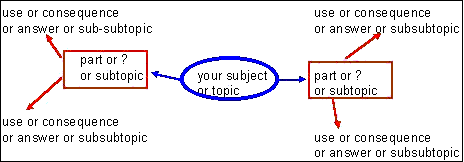
  • The Many Parts Strategy: list out the parts of your subject or topic and ask of each one, "What is the use of this part or what are the consequences of this part?" Sort your answers, and you have a list.
  • Mapping:


Organization

When writers talk about organization, they are talking about arranging thoughts systematically in an orderly, functional way in order to create a harmonious or united action. Your paper should be arranged so that your purpose is clear, your thesis logically stated and developed, and your final conclusion plainly drawn from the preceding material. Of course, different kinds of papers call for different organizations. A paper arguing a political position will be organizationally different from a paper explaining the migratory patterns of African swallows. Two kinds of papers that you will encounter often are the informative paper and the argumentative paper.

Informative paper

The informative paper basically states "This is way things are. This is how they work. This is how to use them." This kind of paper will often be organized in one of the following ways:
Codified order: Present information and ideas in a sequential or other logical order
A potato can be fried, baked, or boiled.
Definition: Arrange the information around a definition.
Good potatoes are the product of planning, preparation, and presentation.
Classification: Arrange examples in varieties
Two types of potatoes are sweet and red.
Comparison: Demonstrate similarities between two or more people or things.
Julienned and sliced potatoes are alike in . . .
Contrast: Demonstrate differences between two or more people or things
Julienned and sliced potatoes differ in . . .

Argumentative/Persuasive paper

The argumentative paper states a premise and then gives support for that premise. This kind of paper will often be organized in one of the following ways:
Induction: Infer a general principle from a group of examples
Potatoes with the skin on are more flavorful than skinned potatoes.
Deduction: Infer a group of effects given a general principle (i.e. Cause/Effect).
Leaving the skin on the potatoes produces more flavorful results.
Sign: Establish that one thing indicates the presence or action of another
Over-seasoned potatoes is a sign of bad potatoes or an incompetent cook.
Analogy: Compare one topic to another seemingly unrelated topic to illuminate a relationship
In the same way that a good blueprint is the foundation of success in building a bridge, thorough planning is the foundation of a successful potato torte.

THE THESIS IS YOUR FRIEND!

One of the most common problems of organization is including extraneous material. As you are composing the body of your paper--perhaps following the structures illustrated above--make sure that every paragraph you write puts forward the idea of thesis. If a paragraph does not clearly support or further the argument of the thesis, it does not belong in the paper. Following this rule will prevent you from discussing unrelated material. Remember, always keep the thesis in mind:
Tape it to the wall in front of your desk
Write it on top of every page that you write
Write it on your arm

Once you have organized your thoughts, you should begin to think about crafting paragraphs and introducing and concluding your paper.

Crafting Paragraphs

Just what exactly are we talking about here?

A paragraph is a group of sentences that are related to each other because they all refer to a controlling idea; this idea is often expressed in a topic sentence, a sentence that functions in a paragraph much like a thesis statement functions in a paper. Paragraphs work together to develop the controlling idea established by the thesis. Consider the following example:

Thesis statement People in the past spent a great deal of effort protecting themselves from evil potatoes.
Topic sentence for a typical paragraph Anti-evil-potato devices were understandably numerous since every bad thing that happened could be blamed on the power of an evil potato.
Subject of paragraph Anti-evil-potato devices
Relation to controlling idea People's fear of evil potatoes forced them to devise equipment to keep evil potatoes away.

O.K. So, why do I want one?

The paragraph is a unit of organization and development. This structure is used to fully explore set of sub-topics that a thesis statement suggests. Each paragraph develops a specific idea that supports the thesis statement; it also connects that idea to the other ideas presented in the paper. Paragraphs can develop and unify a set of ideas in many different ways: writers must simply make sure that their reader understands how all the paragraphs in a paper work together to achieve the writer's purpose.

Where am I supposed to put this thing when I get one?

Hopefully, you will collect several of these items into a paper of some kind. How you store your paragraphs is very important. Each paragraph must be separated from the others by means of indentation. Remember that each paragraph must also relate its distinct idea about the thesis to the ideas developed in other paragraphs. (No paragraphs about Han Solo and Princess Leia in a paper about the soil conditions of Ireland during the famine.)

Where can I get some?

Unfortunately, you still have to produce these things yourself. What follows is largely based on information from The Allyn & Bacon Handbook; often, writers go through this "process" after they have completed a draft.
Decide what the paragraph will deal with:
Since each paragraph begins with a specific purpose (to explore a distinct sub-topic of the thesis), each topic sentence should be specific and clear. The organizational pattern of your paper (based mainly upon the type of paper you are writing) will help you decide what issues you should deal with and in what order to deal with them.
Think about all the issues that this paragraph should deal with:
Each sentence within a specific paragraph must support the idea posited by the topic sentence. As you reflect on a particular paragraph, ask yourself, "What are the issues involved in this topic? How does this relate to my overall controlling idea? Do my sentences adequately explore this topic sentence?"
Think about the purpose and tone of your paragraph:
Each paragraph must provide a thorough analysis of its topic. If a paragraph provides information that is not directly related to the thesis, revise or eliminate the extraneous information. Ask yourself whether each paragraph contributes to the focus and tone of the entire paper and follows the map laid out in your thesis.
Be efficient with your sentence development in your paragraph:
A paragraph is not a paper. Each paragraph represents a separate step towards a general conclusion about your topic. To that end, each paragraph should develop its idea with as many (or as few) sentences as necessary to make its point clear. Many of you have heard that a paragraph can be considered a "miniature essay" in which there is an introduction (topic sentence), some supportive materials (the sentences of the paragraph), and a conclusion (a concluding sentence). This structure works, but keep in mind that regardless of sentence length or number your main goal is efficiently and completely examining individual ideas.
Revise your paragraph organization as you develop your paper:
It may be that your thesis will change as you develop your paper; consequently, topic sentences for your paragraphs must change with it. Don't hesitate to discard vague or tangential ideas in favor of more direct ones. Also, make sure each paragraph moves your paper toward its goal, whether it be informative or persuasive. Finally, make sure each paragraph is part of a logical sequence of ideas that are linked by transitions.

Revision

Revision tends to be divided into two categories, changes that alter the meaning of a text and changes that leave meaning intact. Think of how many changes you can make to a piece of writing.

Since there are so many things a writer can do to a text and, often, so little time, it makes sense to make those changes that will make the meaning of your writing more clear to a reader. There are, of course, lots of ways to figure out how to revise a particular piece of writing; every writer is different. What follows is a method that works, either on a whole paper or on a paragraph.

  1. Finish a draft or at least part of a draft before you consider revising--otherwise you may never get anything finished.
  2. Reread your draft and decide what issues you need to focus on. Always start with the most serious meaning-blocking issues and work down; always make notes on the draft that you read, and consider getting another reader's opinion--maybe even a Writing Center tutor's opinion.
    Levels to consider:
  3. Focus on a single issue.
  4. Maintaining your focus, talk or write through potential solutions to places where communication breaks down; often problems and solutions are easier to find with the help of an objective reader (e.g., another writer, a Writing Center tutor, or your instructor).
  5. Sketch in solutions and write them up.
  6. Repeat steps 1 through 5 as often as necessary.

Revision Checklist

Words like thesis, organization, paragraph, coherence, and comma splice, don't exist just to make your life miserable. All of these terms define the effects of a piece of writing. That is, a paper with a well-defined thesis lets a reader know where it's going; a well-organized paper is one that enables a reader to get from beginning to end without getting lost. Your handbook or a Writing Center tutor can help you describe the effects of your writing (probably using terms like those listed above), but only you can decide to make your writing more meaningful or effective. A revision checklist like the following one can help you write a better paper, but only if you understand what makes effective writing and are willing to make changes.

Check your draft for the following devices:


Subject


Paragraphs

  • topic sentences
  • examples
  • warrants
  • transitional words

Sentences

  • complete sentences
  • sentence variety
  • transitional words

Format

Checking for these devices is one way of making sure that your paper sticks to and develops a single idea. Of course, a list cannot replace your commitment to communicating with an audience. If you are not trying to affect your reader with an idea or two, perfect structure and grammar will only go so far.

Revision Exercise

Look at a piece of writing that you are revising. Work through each of the steps, starting at the top and moving down the list. Make sure that you determine carefully where communication breaks down and how you can go about reestablishing it. Sketch in a solution before setting off on a re-write.


 Teaching Staff              Class Fellows           Announcements             Special Events            

                              Semesters                  Notes                  Research Help                       Research Papers

                                                                                                                                             <<Home

  
Ziauddin Siddiqui, B02ME CSN 07, Mehran University Of Engineering & Technology
Jamshoro, Sindh.
Email. [email protected]

1