 |
 |
|
TCP/IP Protocol Stack Analysis using MENeT |
|
|
|
|
TCP/IP Protocol Stack Analysis using MENeT |
| <<Home | ||||
 |
*Naveed Ahmed, **A Q K Rajput, *Noman Ahmed *Post Graduate Student Institute of Information Technology, Mehran University of Science and Technology **Professor Institute of Information Technology, Mehran University of Science and Technology |
|||
|
ABSTRACT As computing system grow in complexity, the cluster and gird communities require more sophisticated tools to diagnose, debug and analyze such systems. Current network monitoring tools capture network traffic as it appears on the network. These tools are incapable of capturing traffic as it progresses through a running protocol stack. The monitoring tools cannot lend insight the modulating behavior of TCP (Transmission Control Protocol) UDP (User Datagram Protocol) that have been shown to dominant the network traffic and impact network performance. The current generation of tools cannot record true application traffic demands and cannot capture protocol state information with respect to the TCP/IP stack at run time in order to help fine tune network performance. The developed tools focus more on presenting the statistics like IP addresses, Higher Level Protocol, Host and etc. In this paper we introduce MENeT (Monitor for Ethernet Network Traffic). The toolkit is an extension to the earlier developed utility for Traffic Monitoring. The toolkit is operational on the platform of windows NT/2000. The toolkit is developed by programming in Microsoft Visual C++ environment. The MENeT decrypts the packets passing through a system. We first present the design of the toolkit and then demonstrate the implementation with screen shots taken on real time traffic. Next we evaluate the working of the toolkit, its performance and its potential use in application such as protocol tuning a traffic characterization. The protocol analysis demonstrates the effectiveness of MENeT for monitoring. The work on presenting the stats to portray the Network Traffic from every angle is in place. KEYWORDSPacket Capturing, Protocol Analysis, Traffic Monitoring, Transmission Control Protocol, Internet Protocol. EXTENDED SUMMARYThe network community routinely used traffic libraries such as tcplib[1] network traces as those found at the internet traffic archives[2] or the internet traffic data respiratory[3] to test the performance of network based on the parameter like protocol tracing, packet arrival rate, packet byte calculation and etc. The network designers and scientist who study network traffic to spawn models for future high speed networks study mathematical models discussed by V.Pazson and S.Floyd [4], Leland et al [5], Basu et al. [6] and Taqu [7], and Jain et al [8]. However such libraries, traces and models are based on the measurements mode either by host based tools such as tcpdump [9] an coralReef [10] or by global network mapping tools such as NLANR’S Network Analysis Infrastructure [11]. These tools are only capable of capturing traffic on application sends on the network after the traffic has passed through the OS protocol stack such as TCP/IP. Freng et al [12] suggest that application traffic experience significant modulation by protocol stack before it is placed on the network. This implies that current tools can only capture traffic that has already been modulated by the protocol stack; the pre modulation traffic patterns are unknown In order to determine the pre modulation application traffic patterns. We offer our toolkit named Monitor Network Traffic (MENeT). The toolkit is capable of tracing network traffic as they pass through the protocol stack of TCP/IP. The toolkit offers the following benefits over the other utilities.
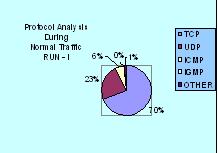
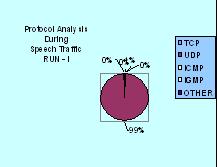
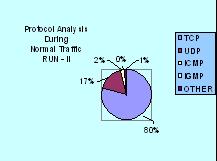
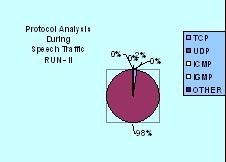
So our utility differs from the existing utilities [13] as it not only captures traffic generated by the network workstations but also network traffic formulated by the applications. The utility traces the network traffic as it progressive its way through the TCP/IP stacks. The header of each layer is truncated from the traffic and analyzed separately. So the trace of TCP/IP stack is another striking feature of our utility. FIGURES In the area of Protocol Analysis the MENeT working capability is demonstrated by the following observations. This is only a glimpse of what MENeT presents while doing the Protocol Analysis. The utility is capable of demonstrating the other Network Stats as well.
REFRENCES[1] P.Danzig and S.Jamin, “tcplib: A library of TCP Internetwork Traffic Characteristics,” http://irl.eecs.umich.edu/jamin/papers/tcplib/tcplibtr.ps.z 1991. [2] “The Internet Traffic Archive, “ http://ita.ee.lbl.gov/html/traces.html. [3] A.Kato, J.Murai and el al. “An Internet Traffic Data Repository: The Architecture and the Design Policy”, in INET 99 Proceedings. [4] V.Pazson and S.Floyd, “Wide Are traffic: the Failure of Poisson Modeling,” IEEE/ACM Transactions on Networking vol 3 no 3 pp 226-244, June 1995. [5] W.E. Leland, M.S. Taqqu, W. Willinger and D.V. Wilson, ’On the Self-Similar Nature of Ethernet Traffic (Extended Version),’ IEEE/ACM Trans. Networking, p1-15, 2 (1), 1994 [6] Basu, A. Mukherjee and S. Klivansky, "Time Series Models for Internet Traffic," p611-620, vol. 2, Proc. IEEE INFOCOM’96, San Francisco, CA., March 1996. [7] M. S. Taqqu, "A Bibliographical Guide to Self-Similar Processes and Long-Range Dependence", in: Dependence in Probability and Statistics, E. Eberlein and M. S. Taqqu (Eds.), Birkhauser, Basel, 137-165, 1985. [8] R. Jain, S. A. Routhier, "Packet Trains: Measurements and a New Model for Computer Network Traffic", IEEE Journal on Selected Areas in Communications 4, 986-995,1986. [9] “tcpdump”, http://www.tcpdump.org. [10]CAIDA,“CoralReefSoftwareSuite”, http://www.caida.org/tools/measurement/coralreef. [11] A.J.McGregor, H-W Braun, and J.A.Brown, “The NLANR Network Analysis Infrastructure,” IEEE Communications, May 2000. [12] W. Feng and et al , “The Failure of TCP in High Performance Computational Grids,” in Proc of SC 2000: High Performance Networking and Computing Conf., November 2000. [13] Ahmed Naveed, et al, “A New Approach to Internet Traffic Monitoring”, Mehran University Research Journal of Engineering and Technology, Vol 22 No 3 March 2003. ISSN 0254-7821. [14] Carpenter B., ed. "Architectural Principles of the Internet," RFC 1958. June 1996.Domain Name FAQ http://www.internic.net/faq.html [15]Tanenbaum A.S. Computer Networks, 3/e. Prentice Hall. 1996. [16] Understanding IP addressing http://www.3com.com/nsc/501302.htm. [17] Postel, Jon, ed. "Transmission Control Protocol," RFC 793. September 1981. --, ed. "User Datagram Protocol," RFC 768. August 1980. --, ed. "Internet Control Message Protocol," RFC 792. September 1981. --, ed. "Internet Protocol," RFC 791. September 1981. [18] Reynolds, Braden, ed. "Internet Official Protocol Standards," RFC 2600. March 2000. Teaching Staff Class Fellows Announcements Special Events |
||||
|
||||||