 |
 |
|
|
|
|
|
|
|
| <<Home | ||||
|
Introduction
Cellular networks got their name because of the way they divide service areas into cells. A cell is a relatively small area that is serviced by a single transmitter/receiver unit (often called a cell site). Mobile phones operating within this area use that cell site to communicate with the rest of the cellular network (and with the public phone network).
Mobile station (MS) Base station (BS) Mobile Services Switching Center (MSC) Public Switched Telephone Network (PSTN)
Basic Network Operations
Traditional mobile phone service has used only terrestrial radio. In other words, it relies on ground-based cell sites, which are usually small towers with three antennae arranged in a triangle. Satellite implementations are possible, although they cannot use radio bandwidth as efficiently. Thus, they are used commercially primarily for pager, broadcast, and some specific site-to-site links. A cellular network is designed to connect to the existing phone system (also called the Public Switched Telephone Network or PSTN) or potentially to a data network (called a Public Data Network or PDN). The connection to the PSTN is not much different than the connection of other telephone switching equipment such as a Public Branch Exchange (PBX). Cellular networks are comprised of terminals and base stations. Terminals are the end-user equipment, usually phones, and are often called Mobile Stations. Everything else in a cellular network is considered to be base station equipment.
Mobile Communication development
Mobile communication become necessary because people need to communicate at any time, any where and any way, and the requirement cannot be full filled by PSTN alone.
Cellular Communication Evolution
Systems-Technical Aspects
Frequency Re-use
The radio frequencies available are allocated according to a regular pattern which repeats over the whole coverage area. In this way, each carrier is used repeatedly throughout the coverage area according to a frequency re-use pattern. Theoretically frequencies may be reused every: 4, 7, 9 , 12 or 21 cells. In practice, 4 or 7 cells patterns are most common.
ScalabilityOne good thing about cellular system is that it could be easily scaled up once there is a greater requirement of communication capacity in a certain area. When such a necessity is discovered some where in certain cells, these cells could be further divided into smaller cells, which allows further frequency reuse in those cells. Thus the capacity of a cellular communication system would be enhanced theoretically infinitely. Cluster and Cell Representation
Cell is the defined area served by a base station. Hexagonal cell shape is assumed during cell planning , although the actual shape depends upon the radiation pattern of the transmitter antenna. Cell size is variable depending upon the traffic density and the grade of service required. Transmitters in adjacent cells operate at different frequencies, therefore they don’t interfere with each other. Each cell is allocated a certain set of frequencies called a Frequency Group.
Cell Size
Cell size depends upon:
Cell Types
Two types of cells are used in cellular systems today.
1) Omni directional Cell, served by an antenna which transmits equally in all directions. 2) Sector Cell, served by a directional antenna which covers an area of 120 degrees.
Fig: Omni direction Cell Fig: Three Cell Cluster
A cluster is a groups of cells. No channels are reused within a cluster. Number of cells belonging to cluster can be different. There is no frequency re-used in a cluster.
Advantages of cellular communication systems
Cellular communication systems have the following advantages: § Can achieve higher capacity § Could be easily scaled up § Less power is necessary when transmitting and receiving § Smaller handset could be built since no need of huge batteries § Less interferences with other wireless communications
|
||||
| <<Home | ||||
|
||||||

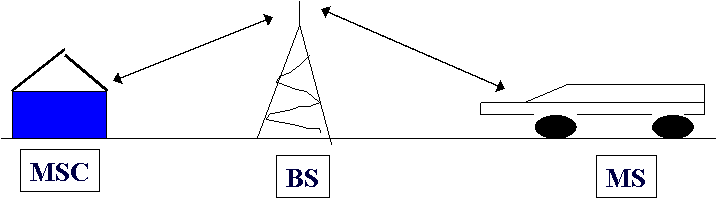

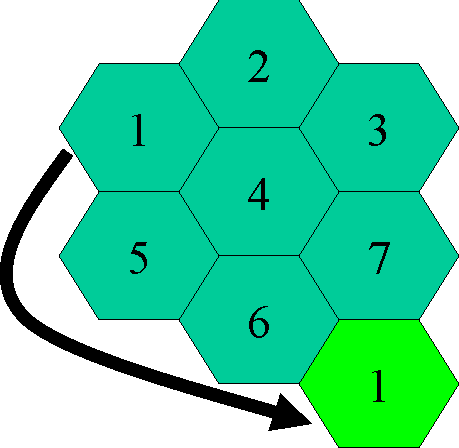
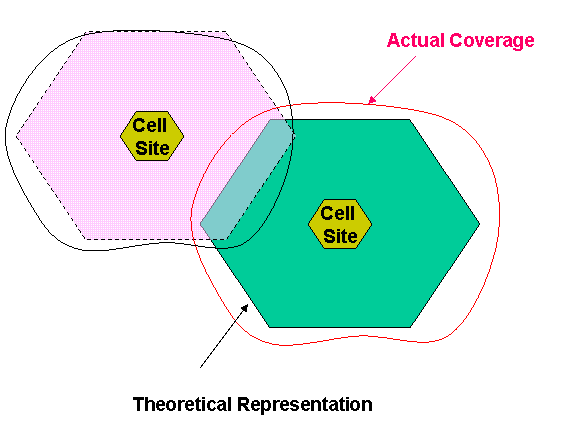
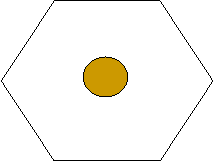
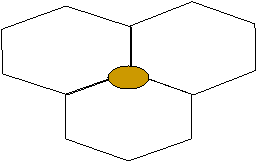
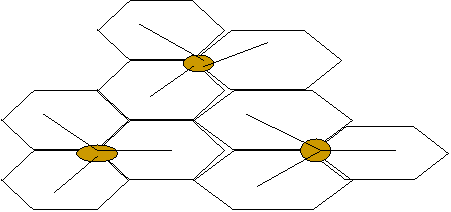 Fig.
Nine Cell Cluster
Fig.
Nine Cell Cluster