LIPIDS
Lipids
· include substances commonly called fats, oils and waxes. Made of carbon, hydrogen, and oxygen. However less oxygen in lipids than in carbohydrates.
· Second source of energy
· Fats under the skin insulate the body (keep you warm)
· Fats covering organs prevent damage
· Oils lubricate the hair and skin
· It is part of the cell membrane (lipid bi-layer)
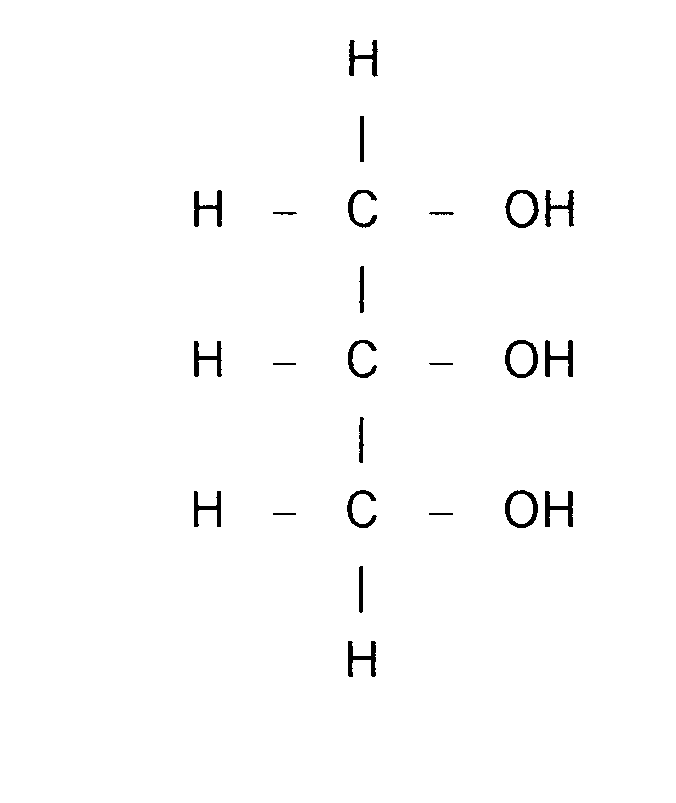
· EACH LIPID MOLECULE IS MADE OF 3 FATTY ACIDS AND 1 GLYCEROL
3 Fatty acids- 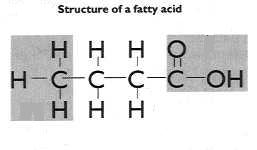
1 Glycerol-
HOW LIPIDS ARE MADE:
Dehydration Synthesis- the combining of small molecules to form a large molecule by the removal of water in the presence of enzymes.
enzymes
3 fatty acids +1
glycerol-----------------------------à Lipid
removal of water
HOW TO BREAK APART A LIPID:
Hydrolysis- the breaking down of large molecules into smaller molecules by adding water and enzymes
enzymes
Lipid --------------------------à3 fatty acids +1 glycerol
Adding
water
TYPES OF FATS:
Saturated Fats- animal fats; there is a single bond between the carbons C-C-C-C-C
(example: butter)
Unsaturated Fats- vegetable fats; there is a double bond between the carbons C-C=C-C
(example: olive oil, corn oil, soya oil)
Unsaturated fats can be changed into saturated fats by adding hydrogen to them. This process is called hydrogenation. Many processed foods contain “partially hydrogenated” fats.
An easy way to tell what kind of fat you’re eating:
Unsaturated fats tend to be oils and liquid at room temperature. Saturated fats are usually solid at room
temperature.