The Cell Membrane (AKA the Plasma Membrane):
The cell has a double layered membrane. If we were to cut a piece of the membrane of the cell and zoom in on it what would it look like?







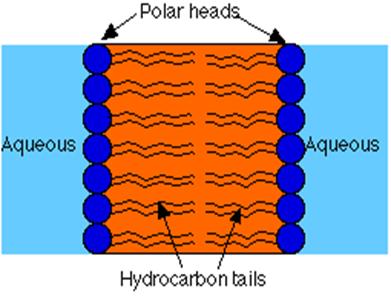
There are polar heads which are “hydrophilic” (meaning they like water) that form the 2 outer faces of the cell membrane. One face has interaction with the external environment and one face has interaction with the inside of the cell.
The nonpolar hydrophobic (meaning they are afraid of water) tails point towards the inside of the membrane.
The plasma membrane separates internal metabolic events (Remember, metabolism is all the chemical and biological reactions occurring in the cells of an organism. Metabolic is just another word for metabolism, see how they look alike?) from the external environment and controls the movement of materials into and out of the cell.
The membrane controls the movement of materials into and out of the cell. This makes the contents of the cell chemically different from the cell’s outside environment. The membrane keeps the internal conditions of the cell constant. The membrane maintains HOMEOSTASIS of the cell.
Not everything can get into the cell. The membrane is selectively permeable. Some small substances can get in without any problem, but the bigger the substance the harder it is for it to get past the membrane into the cell. There are certain factors that depend on whether a molecule can enter a cell:
· Size
· Electrical charge
· Shape
These and other properties determine whether a molecule will be allowed to get through the membrane, bind to a specific transporter molecule on the membrane or be unable to enter the cell at all.
How many layers does the plasma membrane have? Two (2) layers.
The plasma membrane is a double layer (AKA “BILAYER”, “bi” means 2) of fats or lipids, proteins and carbohydrates. The two layers are therefore called a “lipid bilayer.”
The proteins are embedded in the lipids like mosaic tiles.
The accepted model of the structure of the membrane is called the “fluid mosaic model.” This is because the proteins that are embedded in the membrane but still are able to move along the lipid layer of the membrane which is in a fluid state.
Some of the proteins are on the outer surface of the membrane, some are on the inner surface and some are thought to extend through the membrane. There are difference types of proteins that are found on the cell membrane. We will discuss a few:
· Receptor Proteins- proteins that have “binding sites” for specific messenger molecules that signal the cell to begin or to stop some metabolic activity. They are proteins that are sensitive to a certain type of stimulus. They also deal with communication.
· Marker Proteins- these proteins are also known as antigens. They mark a cell so that the body knows that the cell belongs.
· Transport proteins- proteins that only allow specific ions (charged chemical particles) across the membrane and regulate the movement of water and soluble molecules through the membrane.
Other membrane proteins act as enzymes and others help bind the membrane to neighboring cells.
The membrane also has carbohydrates, which are linked chemically to some of the proteins or lipids on the membrane. They branch from the external surface (outside surface) of the membrane.