There are 2 basic cell types: Prokaryotic
and Eukaryotic
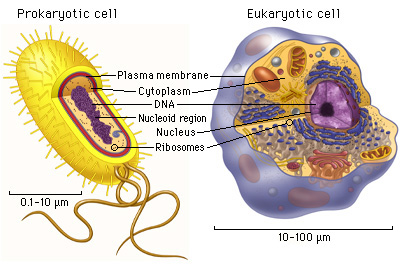
All cells, whether they are prokaryotic or eukaryotic have some common features.
The common features are:
- DNA- genetic material located in a nucleiod region in prokaryotes and in the nucleus in eukaryotes.
- Plasma membrane (cell membrane)- phospholipid bilayer with proteins that separates the cell from the surrounding environment and functions as a selective barrier for the import and export of materials.
- Cytoplasm- the rest of the material of the cell within the plasma membrane, excluding the nucleiod region or nucleus, that consists of a fluid portion and organelles are suspended in it.
- Ribosomes- the organelles that make proteins.
Prokaryotic cells:
· Bacteria are prokaryotes. The simplest cellular organisms
· Do not have a nucleus
· Do not have membranous organelles
· DNA is located in a nucleiod region that has no surrounding membrane
Eukaryotic cells:
· Animals, plants fungi and protests are eukaryotes.
· Contain a membrane bound nucleus
· Contain membrane enclosed organelles (mitochondria, lysosomes, golgi bodies)
· DNA is found in the nucleus