Capacity Allocation
Dynamic Capacity expansion problem
How should the plant capacity be decided? Typically demand for the product plays the deciding role.
Problem:
If a new plant is constructed with a capacity short of the
actual demand, one cannot satisfy the demand and thus looses out on opportunity.
On the other hand, if the plant is built with excess capacity, then besides
under-utilization of capacity, capital also gets blocked. Hence, there is need
for proper planning of capacity.
Goals of Capacity Planning
- Maximize Market Share
- Minimize under-utilization
Demand for a Product
The demand for a product could be ever increasing, as shown in the figure. In order to match demand, plant capacity may be expanded as shown, in discrete units, over time.
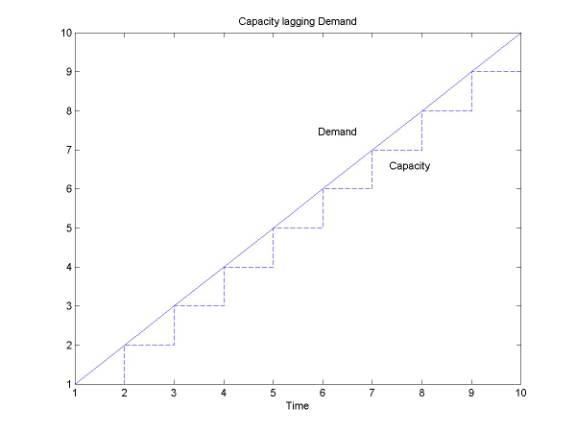
Figure 1 The Capacity Planning Problem
Analysis
Considerations
- The demand for a product has been modeled as ever-increasing.
- The capacity is expanded not continuously, but periodically. Let
 represent the period of
time after which capacity is expanded. Let
represent the period of
time after which capacity is expanded. Let  represent the annual increase in
demand per time unit. Thus, in each time period of length
represent the annual increase in
demand per time unit. Thus, in each time period of length  , the capacity is expanded
by
, the capacity is expanded
by  units per
time period.
units per
time period.
- The principle of Time Value of Money notes that same unit of money
is worth more today than in the future, since money with you today gives you
the freedom to utilize it in a productive activity. Money obtained in the
future is effectively blocked capital. This aspect is represented
mathematically by an exponentially falling 'value' of money. Let
 represents the annual
discount rate. Implication:
represents the annual
discount rate. Implication:  unit of money obtained today is
only worth
unit of money obtained today is
only worth  after
after  years.
- Inflation effects
Inflation is the rise in prices of commodities. Hence, over time the Purchasing Power of a unit of money decreases. Hence, a rupee now is worth less in the future due to inflation. Using a similar model to the above, we can get the actual value of a rupee after years
as
years
as  where
where  represents the Inflation rate. Alternately, the analysis can be
performed for money in real terms. By definition, Real Money is
money adjusted for inflation. For example, if a commodity was sold for Rs 10 a
year earlier, and today costs Rs 11, then inflation rate = 10%. Hence, the
rupee today is worth less than it was a year before due to general price rise.
Thus, in real terms the rupee today (the nominal value) is
worth
represents the Inflation rate. Alternately, the analysis can be
performed for money in real terms. By definition, Real Money is
money adjusted for inflation. For example, if a commodity was sold for Rs 10 a
year earlier, and today costs Rs 11, then inflation rate = 10%. Hence, the
rupee today is worth less than it was a year before due to general price rise.
Thus, in real terms the rupee today (the nominal value) is
worth  (the
real value) where
(the
real value) where  is the inflation rate. Thus, as time passes, a rupee looses
value at a yearly rate of
is the inflation rate. Thus, as time passes, a rupee looses
value at a yearly rate ofwhere
is the annual discount rate and
is the inflation rate. In the rest of this discussion, money is considered to be in real terms, i.e it devalues at a yearly rate of
. Alternately,
can be substituted for
to work with nominal money.
- The Cost of a new Plant
The cost incurred in setting up a plant is regarded as Fixed Cost. Typically, as larger plants - more capacity - are designed, the cost per unit capacity declines. This characteristic yields a decreasing slope curve. Letrepresent the cost in setting up a plant of capacity
. The curve can be represented mathematically by
.
- Parameter Values
How are these parameters estimated?is the cost of setting up a plant of capacity
unit. In order to determine
, consider the following. What is the cost involved in doubling the current capacity of a plant? Typically, this value can be estimated by plant designers. If the above model is correct, the plant with double capacity will cost
as much as the existing one. Interestingly, this ratio is independent of the current capacity. From the estimate provided by the plant designer, the value of
can be estimated.
In order to meet the demand, let us assume that a plant of capacity per year, is added after
every
time
period. This carries a cost of
. Hence, the total cost incurred, now
and in the future is given by Total Cost =
|
|
|
|
|
|
|
|
|
|
|
|
|
|
|
The optimal duration of time can be found from
which yields for optimal
value
Example: and
.
Find the Optimal time period
and the corresponding cost per
period given
units increase per time period as the demand. The annual
discount rate is
. The graph of
can be used to quickly solve for
.
Figure 2 Graph for determining optimum X
Hence, since at , we have
, solve for
using
, which yields
years (since
is the annual
discount rate). Further Plant capacity
units and the cost of setting
up plant is
million.
Learning Curves
As experience is gained with the production of a particular product by an individual or a firm, the production process becomes more efficient.
Factors contributing to learning
- Individual workers' skill improves.
- Improvement in production methods.
- Tools and machines may change with reliability and efficiency improvements.
- Better product design.
- Improved production scheduling and Inventory control.
- Better organization of work place.
Let be the
number of hours required to produce the
unit. From empirical
studies,
can be
characterized as
.
is
simply the time required to produce the first unit. In order to
estimate
consider the time required to produce the
unit compared to the time needed to
produce the
.
This ratio is typically used to characterize the learning
curve. For example, a learning curve implies that the
unit is produced in
of the time it takes to
produce the
unit.
Experience Curves
measure the effect that accumulated experience in the production of a product
or a family has on overall cost and price. Typically, as more experience is
gained, the cost of production per unit decreases. This trend has been witnessed
in nascent industries undergoing major changes like the IC industry -- the cost
per unit is seen to fall exponentially. Hence due consideration must be given to
falling per unit cost in planning for the future.
Forecasting
Characteristics of Forecasts
- They are usually WRONG. Thus, planning systems should be sufficiently robust to react to unanticipated forecasting errors.
- A good forecast is more than a number. It is rather a range with some statistical significance.
- Aggregate forecasts are more accurate, as errors cancel out. Hence it is more likely that the cumulative demand forecast of the entire product range is more accurate than forecasts for individual products.
- The larger the forecast horizon, the less accurate the forecast.