P.P.C.
Lecture Held on 30/10/2002
Auction
Theory
By: Rohan Dayal
Our basic aim is to reach a Stable ‘Nash’ Equilibrium
strategy, a concept borrowed from game theory, in which all players in the game
follow the same strategy, and if and when a player deviates from it, he loses
out.
We restrict our analysis to single object auctions
(i.e. only one object is being sold at a time).
The assumptions:
1.) Private values: The bidders value the commodity
being sold in the auction at a particular price. This value is decided
independently by every individual bidder and does not depend on or change with
the values of other bidders.
2.) Sealed bid: The values are not known to other
bidders. Till the time that the object is sold, nobody knows the valuation of
other bidders.
We look for a Symmetric Nash Equilibrium (Given by
THE John Nash).
(Further reading: refer
http://helios.unive.it/~gottardi/NASH.PDF)
Auction Model:
- Single
object for sale
- N potential buyers
- Bidder i assigns a
random value Xi Î [0,u]
to the commodity with a Cumulative Probability Distribution F( ·
) and a Probability Distribution f(
· ), u being the upper limit to the value of the commodity
- F( ·
), f( · ) and u are the same for all the bidders (hence in our
analysis we search for a symmetric equilibrium strategy)
F and f are obtained using:
- Past
experience
- Intelligent
judgement
Problem:
Knowing the value Xi
for the bidder i
we have to decide the value of our bid b,
such that it maximises our expected value (payoff). This is known as a ‘Risk
Neutral’ strategy, meaning that all the bidders do not take risks, and try to
keep their payoff either positive, otherwise zero, whatever they bid. They do
not bid anything that may result in a negative payoff even if they win. This is
a reasonable assumption in real life auctions.
We look at the problem for the 2 types of auctions
that have been discussed:
- First
price sealed bid
- Second
price sealed bid
Second Price sealed bid:
We first look at this type of auction as the theory
behind the strategy is easier.
Consider a bidding strategy b(X) that gives the bidding value b depending on our value X, and all bidders follow this strategy.
That is, for any bidder i, the bidding value is bi = b(Xi)
Then the payoff is given by:

For Second price auctions, the optimal strategy is
given by:
b(Xi) = Xi
This is a ‘dominant’ strategy, and means that no
matter which strategy other bidders follow (whatever be the probability
distribution of the bidding values of other bidders),
we just need to bid as much as we value the commodity.
Proof of optimality:
Suppose we value the commodity to be X1 and choose to bid a value
of Z1.
Let the second highest bid.
Now we look at the various possibilities:
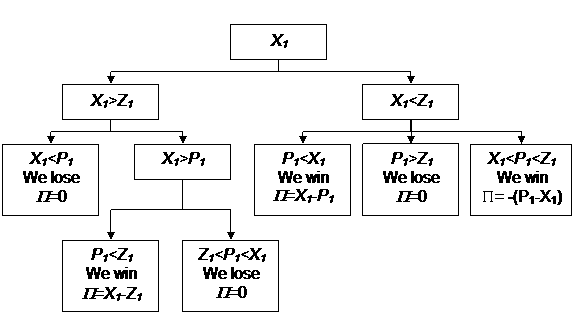
Case 1: X1 > Z1 (i.e. we bid Z1 lower than our valuation X1).
Case 1a: If P1
> X1 (somebody bids
higher than our value) then we lose whatever Z1 we choose (Z1
< X1), so it does not make
a difference, and the payoff is zero.
Case 1b: If P1
< X1, (the second
highest bid is lower than our value) then the payoff is given by,

i.e. if we had bid X1 (instead of Z1)
then the payoff would have been the same (i.e. X1 - P1)
but in certain cases, due to a lower bid value, we would have ended up losing
when we could actually have won.
Therefore, it is better to have bid X1.
Case 2: Z1> X1 (i.e. we
bid Z1 higher than our
valuation X1).
Case 2a: If P1 < X1, (second
highest bid is lower than our value and hence our bid Z1) we win whatever we bid, with a payoff of X1- P1.
Case 2b: If P1> Z1, then we lose with a
payoff of 0.
Case 2c: Z1> P1> X1, (second highest bid lies between our value and our bid)
we do win the auction if we bid Z1,
but the payoff = -(P1 - X1) i.e. a negative payoff. It would have been better
if we had bid X1 as then
we would not have won but would have had a payoff of zero.
The cases are shown in the chart below,
It does not make sense bidding a large value of Z1 with a hope that everyone
will bid a nominal value and you will have to pay a value close to X1, as:
If P1>X1 we end up
paying more than what we value the commodity, and
if P1<X1 we would have
won even if we had bid X1.
\It is best to set b(Xi)
= Xi.
This strategy is known as a ‘Dominate Strategy’ in
game theory.
Hence, the strategy is easy to understand
and implement. Yet second price auctions are not as popular as they should. One
reason is the possibility of a fraud by the seller. The seller knows the values
of all bidders (Xi) and can
make a dummy bid just below the highest bid hence making the highest bidder pay
higher than what he would have paid.
How much does a bidder
pay in Equilibrium?
(or how to find the expected
amount a bidder pays).
Consider an auction with N bidders.
Let Y1=max(X2, X3,…,XN) (the value of the second highest bid).
Let G(y) be the
probability of a bid y being the highest.
\ G(y)= P(Y1£y) (the probability that the second highest
bid is below y)
 = P(max(X2, X3,…,XN)
£ y) the
probability that all the
= P(max(X2, X3,…,XN)
£ y) the
probability that all the
other
bids are lesser than y
= P(X2 £ y
& X3 £ y
& … & XN £ y)
As we have
assumed that the values are independent of each other,
G(y) =
P(X2 £ y) . P(X3 £ y)
… . P(XN £ y)
As we have assumed that the distribution is
identical, the probabilities are equal,
\ G(y)= P(Xi£y)N-1
(Equation 1)
The expected amount a bidder pays is given by the product
of the probability that the bidder wins and the expected value of the second
highest bid.
= P(bidder wins) . E(Y1 | Y1<x)
= G(x) .
E(Y1 | Y1<x)
These can be calculated on
the basis of the probability distribution.
Example:
If Xi
is uniformly distributed in [0,1].

If x is the highest bid, then
all the other (N-1) bids are
at equal intervals between
[0,x] as the distribution is uniform.
The probability distribution is given by, 
Probability that any Xi is lesser than any value y is,
 (Xi can take any value lesser than y)
From Equation 1, G(y) = F(y)N-1 = P(Xi£y)N-1
\
As x lies
between [0,1], u=1
and G(x) = xN-1.
Continuing, the cumulative distribution g(y)
is given by,

From conditional probability,


Therefore, expected value = E(Y1 | Y1<x) = 
Expected amount bidder pays = G(x) . E(Y1 | Y1<x)
= 
Sealed bid first price auctions will be looked at in
the next lecture.