ME
403 N :Production Planning & Control
Author: Abhinav Bhatnagar
INVENTORY THEORY
Thousands of crores worth inventory of goods exists in India, which brings up the question “ Why need inventories??? ”. The answer to this question can be ramified into 3 different categories namely:
- Transaction Motive
- Speculative Motive
- Precautionary Motive
Lets see them in brief
Transaction Motive
Ø Basically ordering or producing large lots may reduce the fixed costs or set up costs associated with them.
Ø The economics of scale may be achieved by ordering large amounts at one time. For instance, sometimes it is better to order a large quantity at a lower price than small quantities at a relatively higher price.

Speculative Motive
Ø If the cost of obtaining or producing an item is going to rise in the near future, it is advantageous to hold inventories in the anticipation of the price rise.
Ø If the demand is expected to increase ( for example, due to seasonality ), it may be more economical to build up large inventories rather than increase production capacity.
Precautionary Motive
Inventories are retained as a hedge / precaution against uncertainty. This uncertainty may be due to
a) Uncertain demand
b) Uncertain supply
c) Uncertainty in lead time ( lead time : time between when order is placed and when it is received )
However it must be noted that often inventory build up is a reflection of poor sales or a poor health of the economy.
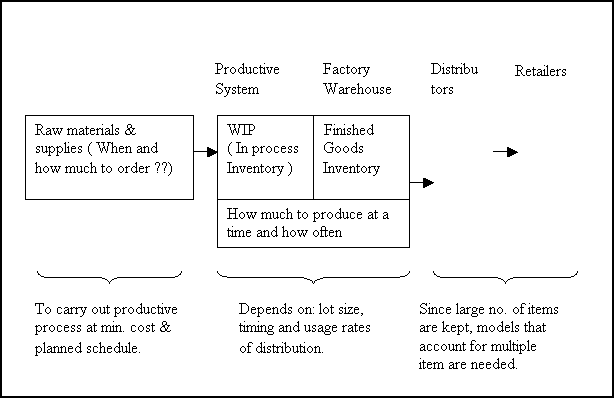
Figure 1 below shows the main inventory stock points in a production distribution system and their need:
Figure
1
After seeing the above model, comes the fundamental question “ When & How much to order ??”.We attempt to answer this by developing a representative mathematical model. For this course primarily the single product at a single location model shall be considered.
The nature of this model depends on 3 key variables namely:
Ø Demand
Ø Costs
Ø Physical aspects of the system
Out of these demand is the most important aspect. Given below is a brief description of these variables.
Demand
Can be mainly of 3 types:
- Deterministic & stationary e.g: that of petrol pumps, shampoo bottles , where the demand more or less is assumed to be constant and known.
- Deterministic & Time varying e.g: demand is known for various seasons differently.
- Uncertain Demand: This basically implies that we know the long term fraction of the outcome but not the outcome itself i.e. the probability distribution is assumed to be known here.
Costs
§ Average & Discounted Cost
For large time horizons, time value of money should be accounted for and discounted cash flow may be considered. This is because a rupee today is much valuable than a rupee next year since it can be invested to give higher returns.
If ‘r’ is the return on investment , let α = 1/ (1+r ) and Ci be the cash flow in period ‘i’.
Then present value of cost = i =1∑∞ αi Ci
If the average costs are considered then:
Avg. Cost = limn→∞ (1/n ) * ( i =1∑∞ Ci )
§ Structure of ordering cost
(Whether cost consists of variable and / or fixed components )
Typically cost = c y + k δ(y)
where δ(y) = 1 if y>0
= 0 otherwise
§ Penalty cost for unfulfilled demand
If the demand is not fulfilled within the stipulated time limit , there can be penalty costs for the same e.g : The company may loose goodwill etc.
Other Distinguishing Physical Aspects
Inventory models also depend on assumptions made regarding timing and logistics issues involved, for example:
§ Lead Time Assumption: May be assumed as constant or even 0.
§ Back Ordering Assumptions : The way system reacts when demand exceeds the supply . Extreme cases are :
1. All excess demand is backordered.
2. All excess demand is lost
- Review Process : We can have a continuous or a periodic review .The advantage of a continuous review is that orders can be placed at any time because there is a continuous monitoring where as in a periodic review inventory is monitored at pre-determined times.
- Changes occurring during storage: Traditional models assume that inventories do not change in character over time in stock. This may not be applicable to items like food stock or volatile liquids. Sometimes the material may become obsolete.
The mathematical aspects of the single product single location model will be analyzed in the next lecture class.