Lecture on Queuing Theory
Held on:
Submitted on:
Submitted by: Sandeep
Arya (1999299, Gp. # 1)
Birth and Death model
The development of a generalized model is based on steady
state behavior of the queuing situation which is achieved after the system has
been in operation for a sufficiently long time.
The generalized model assumes that both arrival and
departure rates are state dependent i.e. they depend on the number of customers
in the service facility.
A state is defined as the number of customers in system.
The rate diagram below shows all states and the rates of
jumping from one state to another.
n = no. of customers in the system
µn = departure rate of customers given n in the system
λn = arrival rate of customers given n in the system
pn = steady state probability of n customers in the system
Rate diagram
From the axioms of Poisson process the probability of more
than one event occurring during a small interval h ends to zero as h -> 0. This means that for n>0 state n can
change to only to two possible states:
n -1 when a departure takes place at the rate of µn and n+1 when an
arrival occurs at the rate of λn. State 0 can only change to
state 1 only when an arrival occurs at a rate λ0. µ0
is undefined because no departure can occur if system is empty.
(Expected rate of flow into state n) = 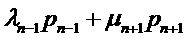
(Expected rate of flow out of state n) = 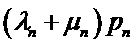
Under steady state condition, the expected rate of flow into
and out of state n must be equal. We
get
= n = 1, 2…
For n = 0 we get
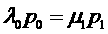
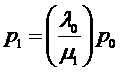
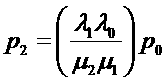
For n = 1 we have
Substituting and simplifying, we
get
by
induction
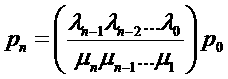 n = 1,2,….
p0 can be calculated from

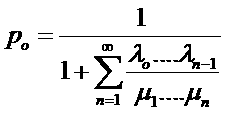
Hence we
find all pi’s
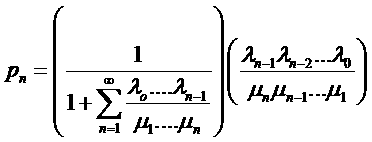
If all λ
are same and all µ are same, and
λ > µ
Then
for n → ∞ p0
≈ 0
i.e. queue
goes on increasing.
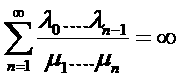
Queue is
unstable.
So this
quantity has to be less than ∞ for stable system.
If
λn =1 for all n
µn=2 for all n
pn = (1/2)n
p0
p0 = ½
→ pn = (1/2)n+1
ð
probability
of having 1 person in queue is 25%
ð
probability
of having 2 person in queue is 12.5%
ð
so
you never see more than 20 people in queue
Steady State Performance Measures
The
commonly used measures of performance in a queuing situation are
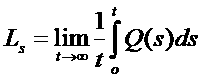
Ls
= Expected No. of customers in system
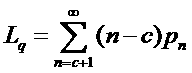
Lq
= Expected No. of customers in queue
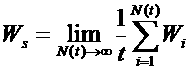
Ws
= Expected waiting time in system
Wq
= Expected number of busy servers
c = No. of
servers
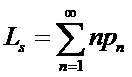
These
measures are derived from the steady state probability of n in the system, pn
Single Server Models
(M / M / 1): (GD / ∞ / ∞)
Customers
are assumed to arrive at a constant rate λ and the service rate is also
constant at µ. Using the generalized model we have,
λn= λ and µn= µ, for all n = 0,1,2,….
Define traffic intensity, 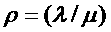
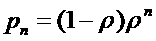
The expression for pn becomes,
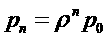 n = 0, 1, 2…
to
determine p0 we use

for
stability we assume ρ < 1
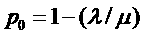

Therefore largest probability is at
state 0
ρ =
1 → heavy traffic condition
Probability of seeing more than k
people = ρk
p(Q ≥ k) = ρk
Expected queue length
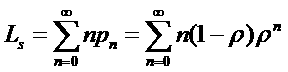
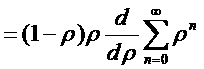
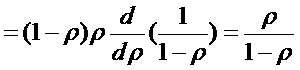
For ρ = 0.50 ,
Ls =1
ρ =
0.80 , Ls =4
ρ =
0.95 , Ls =19
ρ =
0.99 , Ls
=99
at larger
queues even small changes in traffic intensity leads to big problems of
queuing.
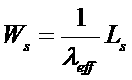
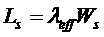
Little’s Law
The
relationship between Ls and Ws is known as Little’s
formula
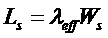
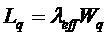
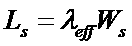
The
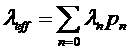
parameter  is the effective
arrival rate at the system. It is equal to λ when all arriving customers
can join the system. If some customers cannot join because the system is full
then λeff < λ.
is the effective
arrival rate at the system. It is equal to λ when all arriving customers
can join the system. If some customers cannot join because the system is full
then λeff < λ.
The figure
below shows the arrivals and departures for FCFS and LCFS queues.
wi
represents the waiting times for ith customers
|
|
|
|
In case of FCFS the first customer gets service before the
second and so on. But in case of LCFS the first customer has to wait till the
others are serviced. And if someone comes when he is being serviced then he has
to wait till the other person gets the service. So his waiting time is greater
than the others as shown in the figure. The waiting time of 3rd, 4th,
and 5th customer is smallest as no other person comes during their
service. This doesn’t happen in case of FCFS and the 1st person does
not have to wait for long.
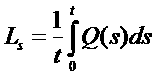
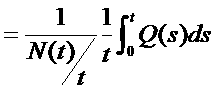
sum of waiting time in a busy cycle
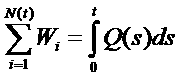
this remains unchanged for FCFS or LCFS.
In the above figure, N(t) = 5.
Dividing both sides by t, we get