PRADEEP
GAUTAM(G-4,99282)
Poisson Process « exponentially distributed inter arrival times
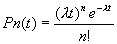
So,

Expected no of arrivals in time t
E (N (t))=lt
(Exponential distribution is the only distribution that has memory less property)
Memory Less Property: if x is the exponentially
distributed, pdf is for x ≥0, l>0,
Then P (x >t+s| x >s)=P (x>t)
eg, given that a bulb that has not failed it’s future life (distribution) is as good as of a new bulb.

e.g In last 5-7 min no person came at bus stand. This fact in won’t effect in any way the probability of a person coming in near future.
PURE BIRTH PROCESS
Probability of n births at time t is
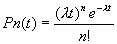 (poisson
process)
(poisson
process)
DEATH PROCESS
(no of items dying are also a poisson process)
Suppose N items and demand is poisson(µ) and n items left after time t
Then Probability of N-n demand
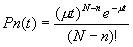
for zero items at time t
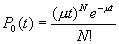 (error in this expression)
Since 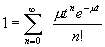
Therefore summation from 0 to infinity is 1 and not 0 to n is 1.If demand is greater than N then we left with zero inventory.
Therefore
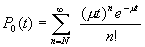
e.g, in queuing customers coming can be taken as births occurring and service completed as deaths occurring.
NOTATION FOR SPECIFYING QUEUE
(a/b/c) (d/e/f)
a: arrival distribution
b: service distribution
if inter arrival time and service time are exponential then
m/m/ (M:memory loss)
D: deterministic
GI/GI/ GI:general independent
C: no of parallel services
e.g checking at airport, photoshop
disadvantage with multi-queue
a person entered late gets priority
server and people both are waiting
GI/GI/5 (5 queues)
d: service disciplines
M/M/1/FCFS
GI/D/1/SIRO
GI/D/1/LCFS
GI/D/1/PS
GI/D/1/TCP (transfer control proceesing)
e: max no allowed in a system
(e.g in phone calls when all available lines are busy then further any call would be simply rejected)
f: size of the calling source
e.g, no of births from a finite population
All one need is state of the system i.e. no of people in the queue at that instant
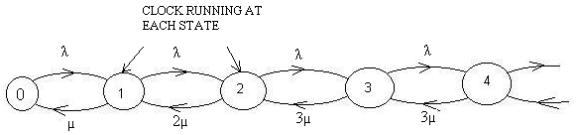
Rate Diagram (3
services exp(µ))
S = min  where
where  are time by 1st,
2nd and 3rd station
are time by 1st,
2nd and 3rd station
P(S≥S)=P(
Min of
exponentials is again exponential f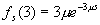
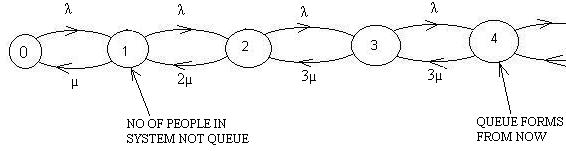
For m/m/3
e.g, m/c shop with N m/cs and each m/c breakdown with rate λ and repair with rate µ(one repair in one)

when two breakdown has already ocurred .next machine will fail in min of time of breakdowns that are N-2 and exponentially distributed.
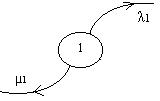
At each state 2 clocks are working one at  and other at
To study all of these models we define a general framework, which is as follows:
Birth one jump up and death one down (multi-jumps are not allowed)

Arriving at state n at time t Pn(t)
when probability becomes constant it is steady state
ie.,  (independent
of time)
(independent
of time)
(e,g. in initial period data may be biased but as time becomes large probability becomes constant with time.)
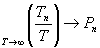 (constant)
expected no of people in the system