Forecasting Contd.
The graph below shows a series of
points plotted on the graph of Demand Di vs. the general parameter Xi .
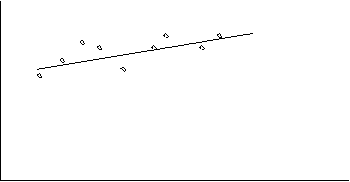
Di
Xi
Di = f (Xi)
where Di is the dependent and
Xi is the independent variable.
The demand being a function of Xi
which can be any variable, shows an approximate trend of some sort when looked
at. So on the basis of our intuition we select a
family of curves and find out the parameters from the data given minimizing the
mean-square error.
This general approach has yield many
positive results and many standard procedures have been devised in order to
study the relationships.
Below we try different functions that
can be used as an estimate of f(X) under different conditions:
1) Let f(x) = a; a constant function
that describes the trend of the observations,
then the deviation of the function from
the actual graph is given by the following ‘Error’ expression:
Error
= å(Dti – a)2
We choose the
parameter ‘a’ such that it minimizes the error function. For finding out the
minimum, differentiate the error function with respect to the parameter and
equating it to
zero.
Þ (d E/ d a) = 0
Þ a^ = å Dti
/ n
2) Let f(X) = a + bX,
a linear function with ‘a’ and ‘b’ as the parameters that gives the line of
best fit. Going by the above approach of minimizing the error function, we get
the error as:
Error = å(Dti – a - bX)2
Thus we minimize the error term by taking the partial
differentials of f(X) w.r.t. ‘a’ and ‘b’ respectively
and equating to zero.
(dE / da) = 0 = (dE / db)
performing the above function on the error
function we get the following values of ‘a’ and ‘b’ :

 a = D - b t


 b = å(Dti
ti – n D t)2
b = å(Dti
ti – n D t)2
å ti2 – n ( t )2
We say that the real function
describing the distribution of data points is given by the following function:
D = a + bX
+ e
Where the term ‘e’ indicates the random
variation of data above and below the function. We find that the term ‘e’ is
distributed normally with the distribution function N(0,s2).
The value of s for the function D is given by

 s = Ö 1/(n-2)å(Dti – D)2
This implies that as n Þ
¥, the function D is also normally distributed with N (
a + bX, s2).
In case Demand is a function of 2
variables then it can be expressed as,
D = a + bX + cY
where a, b and c are constants to be
evaluated.
AGGREGATE PLANNING AND PRODUCTION
There is a variation in demand as D1,
D2,…….,D12. There is a need for developing a strategy
in order to counter these variations. In an industry decision making is
required at all levels (the scope of decisions being different). Decisions
taken in an organization are broadly divided into the following 3 categories:
1. Strategic Planning Decisions:
These comprise of decisions that include the vision and plans of the company
for the next few years. Generally involving the top management, they require a
large amount of investment and change in the long term. Some of the typical
decisions taken by the top management are the following:
·
Location
and sizing of new plants
·
Acquisition
of new equipment
·
Design
of logistics system
2. Tactical Planning Decisions
3. Operational Planning Decisions
(Details about the points 2 and 3 are
given in the next lecture)