|
Lecture on 8th Nov 2002 |
Puneet Bhargava
Akshiv Singhla |
Queuing and Simulation
(continued)
The inter arrival times A1,
A2, A3 … are assumed to be independent of
each other.
Although we may argue that
each next A tells something about the distribution. Each new A
would be helping in better defining the model i.e. the probability distribution
of A. But once the model has been defined i.e. the probability
distribution is fixed, these A are independent of each other (within the
model).
Therefore we will assume
that the inter arrival times are independent of each other (once the model is
fixed).
In the previous lecture, we
had said,
Waiting time for the (n+1)th
customer,
Wn+1 = [Wn + Bn
–An+1]+ = Max (0, Wn + Bn –An+1)
This is valid only under the
assumption of FCFS (first come first serve)
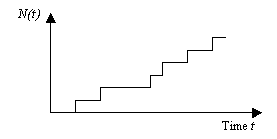
The function N(t)
is defined as the total no of arrivals till time t (includes people already
served and those in the queue) defined for t ≥ 0. It is
non-negative, integer and increasing function of t. A graph of increasing
function, N(t) with time is shown below.
Note
that if (N(t):t ≥ 0) is known and then so are (A1, A2,
A3 …) and vice versa. This can be easily seen through the
graph.
We now
discuss a popular process for modeling arrivals to the queue i.e. Poisson
Process.
Poisson process
The integer valued arrival
process {N(t)} is said to be a Poisson process with rate λ, λ
≥ 0, if:
i)
N(0)
= 0 i.e. there is no arrival in the interval of length beginning at t = 0,
which is intuitively reasonable.
ii)
Process has independent increments
No of events in any time interval are independent of the past
i.e.
{N(t+s) – N(t)} is
independent of {N(u) u ≤ t} for all s and t.
Note:- In an internet traffic, this assumption is not valid since the data is
coming in bursts. So if data is detected then there is high probability that
there will be more data coming in the next unit of time. This holds true even
for the idle periods of time.
iii) No of events in any interval
of length t is Poisson distributed with mean λt which means
that
 for n = 0, 1,
2 …
for n = 0, 1,
2 …
for any s and t.
It therefore follows that,
E(N(t))
= λt
i.e. N(t) is a Poisson process with mean λt
The following definition is
used to characterize negligible terms in an analysis so that these terms do not
get undue attention.
Definition: A function f
is o(h) when:
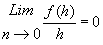
e.g. h2 + h3,
etc. So here we are interested only in the order of magnitude.
So by this definition the
negligible terms can be easily left and only the significant terms are allowed
in the analysis.
The Poisson process can be characterized in an alternate and equivalent
form which is intuitively more appealing.
The counting process {N(t)}
is said to be Poisson process with rate λ, λ ≥ 0,
if:
i)
N(0)
= 0
ii) Process has stationary and independent
increments
N(t+s) – N(t)
has a distribution dependent only on s
Here
stationary depicts that the behavior of the process does not depend on
time, but only on the length of the interval.
i.e.
P(s,s+t) = P(0,t)
and
independent means that the increments of the process do not depend on
other increments. The increments of a process are independent of the past, no
matter what happens in the past. So the probability distribution of an event
remains same irrespective of the how many events have occurred before that
interval. For e.g. persons coming to a barber shop. This event of arriving at
the barber shop is independent of the previous event, but whether he chooses to
remain there or not after seeing the line is a different issue.
iii) P(N(h) = 1) = λh
+ o(h), i.e. probability of arrival in a small interval h is
proportional to length the of interval h.
iv) P(N(h) ≥
2) = o(h), i.e. probability of having two or more events in the
interval h is negligible. It follows that
P(N(h) = 0)
= 1 - λh
+ o(h).
Violations to this in real
life: people arriving in batches at places such as airports etc. So if we count
the number of persons, many events are occurring in a small interval h i.e. the
probability of more than two intervals in small interval h is not negligible. The
assumption would still be valid if we considered no of batches. An event occurs
if a batch enters and hence the same analysis can be done on it.
Relationship between N(t) and (A1, A2, A3 ….)
A relationship between N(t) and (A1, A2, A3 ….) is derived, to show that the inter-arrival times
are IID’s.(independent identically distributed function)
Let A1, A2,
… be a sequence of inter arrival times of a Poisson process. Note that
P(A1 > t)
<=> P(N(t) = 0)
If the first event occurs
after time t then there can be no arrivals from time 0 to t.
N(t) is a Poisson
process, therefore it is given by:
P(N(t) = 0) = e-λt
The cumulative distribution
function(CDF) of the number of arrivals is given by:
P(A1
≤ t) = 1 – P(A1 > t)
= 1 – P(N(t)
= 0)
= 1 – e-λ t
After
differentiating the CDF, PDF is given by:  λe-λt for t ≥
0
λe-λt for t ≥
0
We still have not shown that
Ai’s are IID (independent identically distributed)
P(A2 > t
| A1 = s) = P(no
event in (s, s+t) | A1 = s)
=
P(no event in (s, s+t) (assuming independent increments)
= P(no
event in (0, t)) (because of stationarity) = e-λt
By alternate argument,
P(A2 > t
| A1 = s) = P(N(s+t) – N(s) = 0 | N(u)
= 0, u<s, N(s) = 1 )
= P(N(s+t) – N(s) = 0 ) (by assumption
of independent increments)
= P(N(t) = 0) (by assumption of stationary increments)
= e-λt
Similarly by the method of induction, it can be shown for all the
Ai‘s that all of them follow the same distribution.
Hence all Ai’s
are IIDs.