Date 5th August
2002-Monday Lecture –2
Forecasting Techniques:
Characteristics
of forecast:
- Usually they are wrong!
- A good forecast should
include a range
- Aggregate forecasts
tend to be more accurate as errors cancel out
Var (x1+x2+…+xN / N) = 1 *
Var X
E (x1+x2+…xN / N) n EX
- Larger the forecasting
horizon, less accurate the forecast.
- Forecasting techniques
are not to be used in exclusion of known information
Types
of forecast:
- Subjective forecast:
e.g. asking car dealers to give numbers for future car sales
- Prone to errors since
bias may come in
- The dealer may have an
incentive to give wrong numbers if his pay is linked to his meeting the
target sales
Surveys:
·
It
is easy to introduce bias
- Difficult to get
representative sample
- Jury of executive
authority
Delphi Method:
·
Send
questionnaire to experts
·
Collate
responses and when strong conflicts are encountered the process is again
repeated until a consensus is obtained.
- Quantitative forecast:
using numerical techniques to do forecasting
·
Causal
method
·
Extrapolative
or time series based methods
Examples of business decisions that rely on forecasting:
1.
Inventory
control
2.
Upgrade
capacity
3.
Cash
flow management
4.
Cost
and revenue forecasting – tax planning
5.
Shop
floor activity planning
Classification based on the time period of forecast:
1.
Short
term forecast: (daily – weekly)
·
High
level of detail needed
·
Due
to high frequency of use, method should be relatively inexpensive
·
Large
number of items to be forecasted (e.g. for production of cars – the various
subparts needed) therefore method should be such that it requires only small
amount of data, so that the data as a aggregate is manageable.
2.
Medium
term forecast: (monthly – bi-monthly)
·
Forecasts
are typically aggregated by product type
·
Details
not needed
·
Extra
cost and effort can be employed
3.
Long
term forecasts:
·
Forecasts
inherently have greater uncertainty – low accuracy
·
Subjective
expert inputs needed i.e. advice of experts is to be sought
Quantitative techniques:
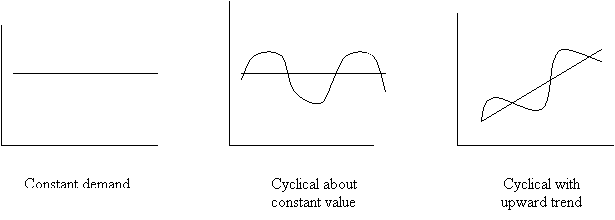
Common forecasting situations one might encounter:



Mat = Dt+Dt-1+….+Dt-m
m
Ft+1(forecast
for time t+1) = Mat (average demand)
Another option could be to give weights to demand
from different periods. ∑ wi =1
Another method is to start with an initial guess and to keep updating the initial guesses using actual demand to improve the forecasting
St = St-1 + α*(Dt
– St-1)
St = αDt +
α(1-α)(Dt-1 ) + α(1-α)2 +…….
How to compare two forecasting techniques?
Consider 2 methods for forecasting, F1and F2 given the actual data D at times 1…n
- (Dt,F1) 1 ≤
t ≤n
- (Dt,F2) 1 ≤
t ≤n
Compare mean square errors: 1 ∑ et2 where et = Dt- Ft
here larger errors are penalized
n more
Compare mean of errors: 1 ∑ et here the sum may be zero hence this method
of
n comparison but the advantage is that if sum> or< zero it tells the side on which more errors tend to occur
Compare mean of modulus of error: 1 ∑ |et| x 100 mean absolute % error
n