Production Planning Control
Lecture Notes
Dated: 4/10/2002
Notes
Prepared by: Vikrant Gangwal & Saurabh Singh Rohilla
Model with Deterministic Time Varying
Demand
Let (r1,
r2, r3 …. rn) be the known requirement for a single product over
the next n periods. Where rn represent
the demand of the nth period. Period are defined as times of replenishment. Let (Y1,
Y2… Yn) denotes order sizes placed in these periods.
Wagner-Whiten Model
1. Shortage are not permitted
2. Starting inventory is zero
3. Only linear costs of holding & fixed order costs are
present
Concave function: If we take any two points
on the function and join the line the line always remains below the function.
Its double derivative is non-positive.
Inventory
at the end of the period t is given by
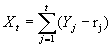 " j = 1 to t where t = 1 to n.
Initial Inventory can be assumed to be zero.
Let
ht(x) denotes the holding cost incurred in period t, and Ct(Yt)
be the order cost .
Note:
More generally, the holding cost is a concave function of the ending inventory
in each period and ordering cost is a concave function of the order quality in
each period.
Optimal
policy is obtained as a solution to the following problem:
Minimize å (Ct * Yt + ht* Xt )
With the constraints:
Xt = å (Yj - rj)
Xt ≥ 0 t =1,2,…..n
Xo=0
Common
form of the cost function is:
Ct(Yt) =Kδ(Yt) + CYt Where δ(Yt) = 1
if Yt > 0
= 0 otherwise
ht(xt) = hxt
Results:
An optimal ordering policy has the property
Yt*Xt-1
= 0 t =1,2,…..n
We
assume that production is made such that it fulfills complete demand, this
implies Yt = 0, rt , rt + rt+1
,…….. ,rt + rt+1 +….+rn are the only permissible values.
NETWORK FLOW PROBLEM
Optimal
policy may be found by finding shortest path through an acyclic network with
the nodes labeled 1,2,…..n and arcs connecting all pairs of the nodes with i < j.
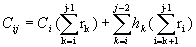
Length of the arc connecting the
nodes i and j ,Cij , is the cost of ordering in the period i to
satisfy requirements through period j-1,where i < j ≤ n+1, plus the inventory cost .
Thus
j-1
Example: 4 period problem
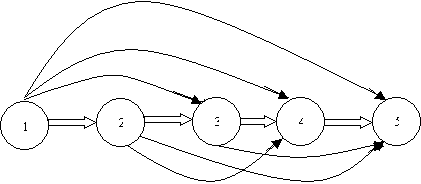
The
objective is to find the shortest path when cost of each path is known. This is
analogous to find the minimum cost of the ordering plan.
Solution: The network flow problem comes under Dynamic Programming.
Where we find the shortest path between any two (A, B) points by first finding the shortest path between the ‘B’ point and a point near its vicinity and then reaching gradually to the ‘A’ point.
Any
path from (1-5) [see above fig.] is a feasible
plan of action (order).
C24 (2 to 4) = C2 (r2+r3) + h2*r3
C25 (2 to 5) = C2 (r2+ r3+ r4)
+ h2(r3 + r4) + h3* r4
Let
fi denote the cost of optimal policy at the i th period.
Then
fn-1 = 0
fi = min ( Cij + fj ) for i
= 1,2, ….n
j >
i
Let’s
have: r = (52, 82, 23, 56)
Ct(Y) = 75 if y > 0
= 0 otherwise
ht(X) = x
Then
f5 =0
f4 = C45 + f5 =75 at j=5
f3 = min(C35+f5,C34+f4)
=min(131,150)
=131 at j=5
f2 = min(C25+f5,C24+f4,
C23+f3)
=min(75+23+2*56,75+23+75,75+151)
=173 at
j=4
f1 =
min(75+87+2*23+3*56,75+87+2*23+75,75+87+131,75+173)
=
248 at j =2
Y1
= 52 ,Y2 =110,Y3=0,Y4=56
Random Demand Ordering Plan
Probability
Distribution Function is assumed for this random demand.
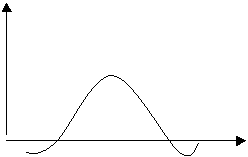
f(x)
xà
This can be best understood from the problem of a newspaper boy.
There is some cost which can be recovered by selling extra newspaper (if any) as junk (raddi).
There is some cost incurred if he doesn’t meet the demand
There is some cost incurred if he buys newspapers in excess
So
objective is how many newspapers should he buy to sell them in order to
minimize the total cost incurred, where the demand for the newspaper is for
that day only (obviously!).
Cost
price C = 25p
Selling
price S = 75p
Unsold
(raddi) return = 10p
Suppose
demand is D and he orders X. Total cost incurred
C (X, D) = 15(X-D)+ + 50(D-X)+
Where
Over-ordering cost = (Cost price - unsold return) = (25-10) = 15
Under-ordering
cost = (Selling price – Cost price) = (75-25) = 50
So
assigning some expected value to the cost incurred E(C (X, D)).

We
would like to the value of X that minimizes the expected cost C(X). 
= CoF(X) –Cu(1- F(Q))
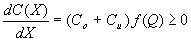 for all Q
  0
0
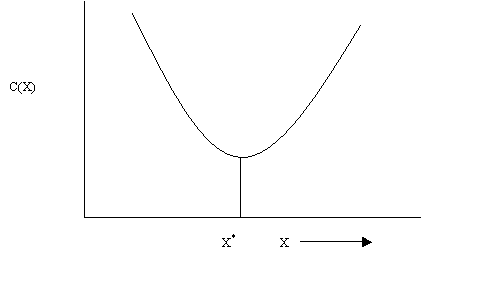
Because the second derivative is non negative, the function
C(X) is said to be a convex.
Lets X* is the optimal solution, where first
derivative of C(X) is equal to zero. That
is,
C’(X*)
= (Co+ Cu) F(X*) - Cu
From
above equation we get
F(x)
= Cu / (Cu + Co)
This
F (X) represents the probability that the demand is less than ‘X’.