Lecture Notes 4/9/02
Author: Akshay Dua
Aggregate
Production Planning
Objectives
1. Minimize costs
a. Cost of inventory handling
b. Unsatisfied demand or delayed
demand satisfaction
c. Regular production costs
d. Costs of alternate production
methods
2. Maximize profits
Issues involved
1. Time unit-
-Least count of time on the basis of which
decisions are made.
-This depends on the demand
forecasts. A larger time unit implies lower accuracy, whereas a smaller time needs larger computational
complexity.
-It is typically ranges from a week
to a month.
2. Time Horizon -
-Determines how far we plan for. We only plan for the time within the
time horizon and not beyond it.
-It is decided by the reliability of the forecast at various times. Time
horizon can be set up till the forecast is reliable.
-Seasonality must also be kept in mind. Complete seasonal variation must be
captured so that a lean period after a high demand period and vice-versa is not
neglected.
3. Level of
Aggregation -
- Plan for both product and
resources needed for production.
- Greater aggregation generally will give more reliable data; also there
will be less computational complexity.
- High aggregation can be used as a guideline. develop
detailed plans from these using past experience.
4. Frequency of
replanning
- Plan is revised regularly after a
fixed period of time.
- High costs involved
- Also difficult to implement
changes in plan
Characteristics
of a good plan
1. Plan should map
the forecasted demand as closely as possible. This property must hold through
the forecasted period. For example considering two plans where both eventually
meet the demand at the end of the period. The plan that maps the forecast closer
through the time horizon is a better plan as it reduces inventory quantities to
be maintained.
2. Plan should be as
monotonic as possible. More rise and falls in the plan implies greater hire and
fire.
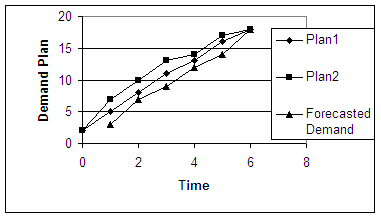
In this case Plan 1 better than Plan 2 in both
respects