 Formula
One™ racing's team catering and hospitality has come a long way since the
days when the race truck would tow a small caravan to the Grands Prix to
give the drivers somewhere to get changed.
Formula
One™ racing's team catering and hospitality has come a long way since the
days when the race truck would tow a small caravan to the Grands Prix to
give the drivers somewhere to get changed.
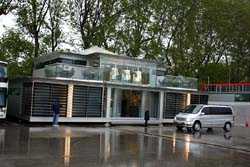
This year, McLaren took the paddock facility concept to a different level, with the arrival of their Team Communication Centre. In simple terms, it has moved away from the idea of being based on any sort of vehicle. Instead, it is a purpose built structure, assembled and dismantled at every event.
Almost four months on since the Centre's debut at the San Marino Grand Prix, various members of the McLaren team have described how the new facility has impacted their lives during the course of a race weekend.
McLaren team principal, Ron Dennis: "The conception of the Communications Centre was really the result of a moment that I suddenly realised, looking at the three separate motorhomes the team operated previously, that some single element which could create a bigger, airier, lighter, weatherproof area, which was almost a large office, would make our grand prix team function better.
"This project was not about trying to have a shinier environment than anyone else. It had to fulfil a function and act as a business tool and that's exactly what it is."
Driver, David Coulthard: "The feeling that the partners and sponsors get when they walk into the Communications Centre is important, as they are important to our continued success. I feel that, in terms of creating a team environment, this is absolutely the right thing."
Ron Dennis: "One of the interesting challenges was addressing the area of demographics. Who was going to occupy the Communications Centre? In essence we tried to accommodate everybody. You should ask the people who use the facility, because most people seem to leave with a smile on their face!"
Photographer, Jurgen Tap: "If someone was to ask me what I think of the place I would say, it's an unreal perfect place to work in and I feel totally privileged to be a part of this. It is a fantastic facility. From here we send out pictures all over the world, to agencies, newspapers, magazines, internet. We have ISDN lines, normal modem lines to send out images of the McLaren Mercedes."
Head of the Team Communications Centre catering, Lyndy Redding: "Through traffic during the day has got so busy, because it's got a real buzz as it is open plan and people like to be here. In terms of numbers, we are probably serving 100 for breakfast, 200 for lunch and about 100 in the evening.
"We have changed the way we look after people at a grand prix. We operate very much like a restaurant. The main feel when you come into the Communications Centre is that it is an entertainment space. The atrium is used for the press and team together, while the two side areas are more for the VIPs and for meetings. It works very well."
Ron Dennis: "The design of the Communications Centre, especially in terms of the ergonomics of the building has required a great deal of thought. One of the elements of the facility is to have this feeling of spaciousness. We wanted to have a sense that wherever you are inside it, there is a feeling of being part of a whole. All the doors are, to a degree, transparent. That allows you to have a quiet environment so that you can concentrate and work, while allowing your peripheral vision picks up on the rest of the team."
David Coulthard: "When you had three separate motorhomes, you would have the Mercedes people in theirs, the West group in theirs and VIPs in the McLaren section. Now, everyone is mixed together."
Head of Race Engineering, Steve Hallam: "The engineers' room represents a step forward in terms of what we had before. It is a trackside office to enable us to debrief the drivers. It is a bigger office, laid out in a more user friendly manner. It means we can bring a few more engineers into the debrief and that makes for better communication and understanding.
"The race engineers and the two drivers sit at the same table facing one another, so everything is on the table for discussion. This enables them to sift through the data together, exchange ideas in one environment. We are in communication with the factory here, via ISDN links."
Ron Dennis: "I think the fascination of this is the challenge it represented. We spent a lot of time at the planning stage, but nevertheless, we did not know if it was going to work. I am not just talking about its functions, but also whether it can be put up and dismantled in a sensible amount of time."
Team Communications Centre Technical Manager, Alan Field: "It is very hard to describe the Communications Centre, because it is a one-off facility. It comes on six articulated vehicles and it is built up over a period of two days, one week before the grand prix. There are a lot of early mornings, making sure everything is up and ready on time.
"We take a lot of time over laying down the first pod, as that is the critical one. You are talking about accurate in terms of millimetres. Imagine if we are out with the first section, by the time I get to the other end of the sixteen and a half metres length, I can be at least 30 centimetres out. McLaren has always insisted on precision, from the race team to the hospitality."
Ron Dennis: "I first started in Formula One in 1966, which is a fair old number of years! Facilities like this are part of Formula One's progress. It is a very dynamic creation. It sets us apart from the other teams. Inevitably, when you make an investment, and it is an investment, into a facility such as this, you are going to have your critics. But its operational cost is, if anything, slightly less. So from a cost perspective we now have something more cohesive."
Alan Field: "The pyramid roof is the crowning glory! It is the last element to be lifted on by crane to the top of the facility. In man hours, it takes 30 hours to set up the Communications Centre; roughly working from seven in the morning until the sun goes down."
Trainer and physio to Kimi Raikkonen, Mark Arnall: "In the set up we had before, there was only one room for the drivers, which they had to share. In this set up, both drivers have their own room, which gives them space, where they can relax before qualifying and the race, have a massage or fall asleep. The Communications Centre is generally quite busy and this gives them a place to escape. It's a very big improvement."
Ron Dennis: "Everyone who works for the company should feel proud of it. Having said that, it is very hard work, because we offer a service which spans 14 hours in a day and that involves a very tiring, never ending stream of service."
Lyndy Redding: "The main feedback we have had is that everyone feels welcome."
Alan Field: "There is a lot of hard work put in from all the team to assemble it in time for the Wednesday before the rest of the team arrives. And yes, I do take a lot of pride in it."
Ron Dennis: "Traditionally, McLaren has been seen as a little grey; a behind the scenes organisation with not too many smiles and without much humour. But McLaren is really not like that at all. This Communications Centre gives people from the outside an insight into what McLaren is: dynamic, focussed, dedicated group who want to achieve their objectives. I am pleased with the outcome. It has served its purpose, it has achieved an objective and apart from anything else, I think it is a great facility to use."