let the Spirit and the Bride say come
Our precious first amendment
Dr. Nudow has guaranteed himself a footnote in history through his lawsuits to remove the words "under God" from the pledge of allegiance. It was the Knights of Columbus who provided the crucial impetus of the grass roots campaign which resulted in that phrase being added. Now, however, there is a fear, perhaps partly justified, of a "theocracy" replacing freedom of conscience, as though a fanatical "God Squad" is about to win the support of an overbearing majority and push aside the rights of religious minorities and individuals. The concern is surely in part justified. As a people we have been, in Noah Feldman's phrase, Divided By God.
America's religious history is indeed filled with the concern that Nudow and others restate in today's language, but also valid is the alternative yearning that an individual's legitimate spiritual exercise and expression never be prohibited. Sometimes these two divergent strands intertwine, and sometimes they conflict. See Perez Zagorin article : religious intolerance versus Biblical freedom.Honor Minorities
Respect Dissent
Jefferson: freedom of religion
Thomas Jefferson's strong and consistent advocacy of freedom of conscience is well known. Following in the intellectual lineage that includes Spinoza (the excommunicated Jew),as well as Milton (the maverick Puritan man of letters), as well as Roger Williams (the great puritan Baptist philosopher and divine), Jefferson was a believer in a secularism in the political realm, and freedom of conscience, in the spiritual realm. Nevertheless, Jefferson's attitudes on the church vs. state issue are more nuanced than what some ideologues on either extreme would have us believe.
The part of Jefferson's statement so often quoted is part of a letter to a friend where he praises Amendment One of the Bill of Rights of 1791. "The First Amendment has erected a wall of separation between church and state...." However, what is ignored is the rest of Jefferson's comment, to wit: "but that wall is a one-directional wall. It keeps the government from running the church but makes sure that Christian principles will always stay in government."
Minority of One
"Jefferson borrowed phraseology from the learned Baptist minister Roger Williams (called the first American political philosopher, the morningstar of American liberties,) who said, '...the hedge or wall of separation between the garden of the church and the wilderness of the world, God hath broke down the wall...."' [America's God and Country Encyclopedia of Quotations ]
Jefferson went on to say: 'Believing with you that religion is a matter which lies solely between man and his God, that he owes account to none other for faith or his worship, that the legislative powers of government reach actions only, and not opinions, I contemplate with solemn reverence that act of the whole American people which declared that their legislature should "make no law respecting an establishment of religion or prohibiting the free exercise thereof," thus building a wall of separation between Church and State.'
Jefferson lambasted Christianity, yet loved Jesus:
"I abuse the priests, indeed, who have so much abused the pure and holy doctrines of their Master, and who have laid me under no obligations of reticence as to the tricks of their trade. The genuine system of Jesus, and the artificial structures they have erected, to make them the instruments of wealth, power, and preeminence to themselves, are as distinct things in my view as light and darkness; and while I have classed them with soothsayers and necromancers, I place Him among the greatest reformers of morals, and scourges of priest-craft that have ever existed. They felt Him as such, and never rested until they had silenced Him by death."
Separation of church and state
William James (retrospectively) was profoundly supportive of what Jefferson, Madison, and the founders had done. James also feared excessive religious influence in both government and education and endorsed a complete separation, perhaps even more than the early Baptists and Quakers and deists (like James Madison and Benjamin Rush and Patrick Henry) who rankled under the thumb of established churches like the Puritan in Boston, as well as, to some extent, the Anglican in the southern colonies.
Thomas Jefferson, six years after his letter to the Danbury Baptists, wrote (in a letter to Samuel Miller, Jan 23, 1808): "I consider the government of the United States as interdicted by the Constitution from intermeddling with religious institutions, their doctrines, discipline, or exercises. This results not only from the provision of law that shall be made respecting the establishment or free exercise of religion, but from that also which reserves to the states the powers not delegated to the U S government [10th Amendment]. Certainly no power to prescribe any religious exercise, or to assume authority in religious discipline, has been delegated to the general government. It must then rest with the states as far as it can be in any human authority."
Minority denominations were worried
Too much power, centralized in the hands of too few people, represents a recipe for tyranny. In no realm did the founding fathers fear such tyranny, in those days, as in the realm of faith. Tom Paine said: "For myself, I fully and conscientiously believe that it is the will of the Almighty that there should be a diversity of religious opinions among us." [Common Sense] And no one was more sensitized to the dangers of an overpowerful religion, or the prospect of a pernicious alliance of church and state, than the tiny religions which lacked clout or an aegis of tax-support and government backing. Among these minority faiths were the Quakers .... and the Baptists.
Madison wrote to his friend / neighbor Monroe that he could count on the Baptists (at that time, like Quakers and others, an 'outsider' faith) as allies, "standing firmly by their avowed principle of complete separation of church and state." (Armstrong 12) The Baptist position on religious liberty could be summarized thus:In their demands for a Bill of Rights, the anti-federalists were led, in point of time, by the Baptist John Leland of Virginia. To Madison he made this firm request: "Let freedom of religion lead all the rest in the Bill of Rights." More on John Leland How ironic that some Baptists of our day and age militate for state-backed religion, a muscular and conformist (totalitarian) Christianity under the control of a supposed moral majority (meaning themselves). How ironic that some Baptists of today behave as if intoxicated by the temptations of power, as if blinded by might, and forgetful of the courageous idealism and lofty liberal values of their lowly predecessor Baptists who helped give us the First Amendment.
- First, there must be complete freedom of conscience. No one must be subject to penalties by any civil, military, ecclesiastical authority because of religious belief or non-belief.
- Second, there must be complete freedom to practice religious beliefs and activities, including the propagation of the faith at home and abroad, so long as they conform to respect for the person and the laws of human decency and safety.
- Third, there must be effective separation of church and state, specifically: (a) no taxation in any amount for any church, religious activity, or establishment. (b) No control of any religious organization by an agency of the government. (c) No favoritism by the government toward any religious organization, whether by extending diplomatic relations or concessions to its ministers, leaders, or programs.
Faith and values are important nevertheless
But was the intent behind Amendment One in any way to destroy or nullify the legitimacy of true religion, or to detract from the value thereof? Assuredly not. If anything, most founders were convinced of the indispensable need for the core values of biblical faith. Thus, Cecil Roth would write: "It was Hebrew mortar (to quote a famous phrase) that cemented the foundations of the Republic; and not without reason did the first seal it adopted depict the overthrow of Pharaoh in the Red Sea, with the motto: "Rebellion to Tyrants is Obedience to God' . . . ." This seal, right out of the Passover narrative, was Jefferson's design.
In the twentieth century, Erich Fromm reiterated the connection conceptually, saying, "God's authority ... guarantees man's independence from human authority." That is, from despotic or exploitative power.
Not only did he design the proposed Exodus-themed seal, but Thomas Jefferson once declared: "Of all the systems of morality, ancient or modern, which have come under my observation, none appears to me so pure as that of Jesus."
James Madison, the Founding Father most responsible for the Constitution, said the whole future of America's civilization is not taken on the power of government but rather "upon the capacity of each and every one of us to govern ourselves according to the 10 Commandments of God." True discipline is ultimately self-discipline.
Even Tom Paine invokes ethics and morals
Thomas Paine said he had not even "the most distant disrespect" for the real character of Jesus Christ.... "The morality that he preached and practiced was of the most benevolent kind; and though similar systems of morality had been preached by Confucius, and by some of the Greek philosophers, many years before; by the Quakers since; and by a good many men in all ages, it has not been exceeded by any."
Paine said that Jesus Christ "preached most excellent morality and the equality of man; but he preached also against the corruptions and avarice of the Jewish priests, and this brought upon him the hatred and vengeance of the whole order of priesthood." [Veritas odium parit]
Benjamin Franklin, so often witty or wry in his teasing of our human tendencies, turned more serious when he wrote that "Whoever will introduce into public affairs the principles of Christianity will change the face of the world." See Ben Franklin (friend of evangelist George Whitefield). Patrick Henry said, "It cannot be emphasized too strongly or too often that this great nation was founded not by religionists but by Christians. Not all religions, but on the gospel of Jesus Christ." (Evidence from Columbus.)
Walt Whitman, hardly conventional in his own struggle for a faith he could embrace, nevertheless asserted: "I say the real and permanent grandeur of these states must be their religion." Yet how permanent? If the salt loses it savor, it is good only to be trampled underfoot. If we lose the spirit of our ancestors as they overcame obstacles and contended with hardships, how can we hope to fulfill the rainbow promise of their ancient faith and human dreams?
George Washington warned, "Don't let anyone claim to be a true American. Don't let them claim the tribute of American patriotism if they ever attempt to remove religion from politics." [see Washington]
John Adams wrote:
"We have no government armed in power capable of contending with human passions unbridled by morality and religion. Our Constitution was made only for a moral and religious people. It is wholly inadequate for the government of any other."
Adams at another time said, "Statesmen, my dear Sir, may plan and speculate for liberty, but it is religion and morality alone, which can establish the principles upon which freedom can securely stand. Only foundation of a free Constitution is pure and virtue, and if this cannot be inspired into our People in a greater Measure than they have it now, they may change their rulers and the forms of government, but they will not obtain a lasting liberty."
John Jay, the First Chief Justice of the U. S. Supreme Court, and a committed Christian of old Huguenot heritage, said, "Providence has given to our people the choice of their rulers, and it is the duty as well as the privilege and interest of our Christian nation to select and prefer Christians for their rulers."
John Quincy Adams said, "The highest glory of the American Revolution was this: That it connected in one dissoluble bond the principles of Christianity with the principles of civil government."
Both the Massachusetts settlements were founded upon versions of Christian faith, and other colonies were likewise established by Christian sects using biblical principles to establish self-government. Indeed, if it hadn't been for the intellectual and spiritual leadership of the churches, the American Revolution may never have been fought. Cornwallis, during his surrender at Yorktown, acknowledged the overriding importance of America's churches in the Revolution, when he threatened that England would ultimately take back the colonies through subversion of the American churchesThe crucial importance of family and values
Lenin, said: "Destroy the family, you destroy the country." Is that what happened to Russia under the czars, then again under Lenin and his communists? Indeed, what is needed, I believe, is the cohesion of intimacy without the dominance of androcracy. Riane Eisler has pointed the way to a "return" by way of the gentleness of an inner balance, a kind of gylanic mutuality and an authentic conciliation -- or reconciliation. It may mean a modest humbling, of sorts, for the hard thinking of some dogmas and ideologies. See The Chalice and the Blade (1988). ISBN: 0441007023
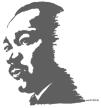
Martin Luther King, Jr. was very appreciative, intellectually, of some of the insights of Buber, the Jewish theologian. Uprooted modern man more than ever stands in need of the relational dimension, the I-thou immediacy of some of the older forms. If the curse of American evangelicalism has been its suspicion of learning and knowledge, its strength may be the transforming personalism of an energetic biblical heritage.
For Christians, this means NOT demanding that government become a coercive power to enforce matters of faith that are forever the real province of the lonely believer, reaching out in simplicity and personal faith. As Dr. King declared: "We [Christians] need to recapture the gospel glow of the early Christians, who were nonconformists in the truest sense of the word."
Court ruling on school prayer
In 1962 and 1963 the highest court in the land handed down their decisions banning school prayer and Bible reading. They insisted that government must not make any law "respecting the establishment of religion," as our founders declared in Amendment One. On the other hand, just how dangerous was the rabbi's prayer in Rhode Island that our Supreme Court felt compelled to strike down? Here it is:
"We give thanks to you, Lord, for keeping us alive, sustaining us and allowing us to reach this happy occasion." What will the Supreme Court outlaw next? How about the Declaration of Independence? It mentions God four times."
We acknowledge that the mere mouthing of the deity's name does not in any way take the place of simple justice and decency. Actions speak louder than words, and that kind of "letting one's light shine" is surely the wisdom nobody can gainsay or resist. If intoning God's name were enough to make us righteous, history would tell a vastly different story than it tells. The shame on Christianity is the sordid record of violence and cruelty inflicted on those whose main crime was being different, or sometimes just "handy" for those with a penchant to do diabolical deeds. In the end, the message for us all is that God's law must be written on our hearts, enshrined in our deeds, and not entrusted to the realm of statist coercion, or totalitarian imposition.
It is a paradox, no doubt. America, founded on religious faith, became the first nation to attempt a fundamental guarantee of freedom of conscience. America, with its first amendment, became a trailblazer in the sphere of separating church and state (something Espinoza had proposed a century earlier). Thus, having secularized in 1792 (at the federal level), religious belief coninued unabated. If anything, the less government favors the churches received, the stronger the public's regard for them. Interestingly, the same thing happened (by and large) when Mexico "secularized" in 1921.
Their heart is far from me
The Bible says: This people draweth nigh to me with their lips, but their heart is far from me. How often such has been the case in our own (socalled "Christian") history. So often it is the "religious" people who are most dangerous, as the Bible verse alluded to. Yet while acknowledging the negative, there also has been a very positive side. Just an example. The social gospel movement that gave birth to the evangelical outreaches of the Salvation Army and Dwight L. Moody, soon saw a powerful confirmation in the counterpart movement of the Catholics. Rerum Novarum and Pope Leo XIII represented a thunderous endorsement to the compassionate biblical outreaches among the poor.
James Q. Wilson notes that by the beginning of this century the growing Sunday school movement included 60 percent of young people, so a majority of the young were receiving an hour or two of religious instruction every weekend. That this coincided with a steep decline in crime is surely more a matter of causation than coincidence.
"Our laws and our institutions must necessarily be based upon and embody the teachings of the Redeemer of mankind. It is impossible that it should be otherwise; and in this sense and to this extent, our civilization and our institutions are emphatically Christian." The U.S. Supreme Court, 1892, Church of Holy Trinity v. United States.
Balance and an Open heart
"Our founders learned -- and taught -- a twofold language. The language of reason and the language of biblical faith. They did not think that these two languages � at least as regards principles of liberty--were in contradiction. These two languages form a union. The Creator spoke both languages, and so can we." [Michael Novak]
America's history has been deeply imbued with religious faith, much of it of a warm, populist sort. Yet this fervently religious nation became the first nation to enact protection for freedom of conscience. America, with its first amendment, became a trailblazer in the sphere of separating church and state. Having thus secularized in 1792 (Amendment One), religious belief coninued unabated, and in fact spread rapidly throughout the hinterland. The Great Awakenings of the colonial and revolutionary periods (we think of Jonathan Edwards and George Whitefield) were followed by the revivalistic ("evangelical orgies") of pietistic and holiness sort, the camp meeting, slave revival, brush arbor (fire baptised) variety.
The supreme paradox is that it has been against this deeply religious background that America has created an official policy of secularism and religious neutrality. Somehow our leaders have sensed the importance of a deliberate and pains-taking restraint in religious matters. While always modelling due reverence for a generalized (traditional) faith, our leaders at the same time have also resisted the temptation to be drawn into religious tangles over particulars. (Generally they have tried to).
The Pledge of Allegiance
These days, who knows of Bellamy, famous for the Pledge of allegiance , or a harbinger of the Progressive Era? History tells of Bellamy the committed and vocal evangelical Christian socialist, but are we talking split personalities here? For there is a second chapter of the pledge story. The words "under God" were added in 1954 after a campaign instigated by a group of laymen, the Knights of Columbus. Their grassroots effort must have been the right idea, at the right time, for it caught the imagination of the public, swept across the nation, and in short order became law.
See The Lustre of Our Country - America's shining contribution to history.
"Movements for social justice and efforts to aid the disenfranchised, the weak, and the poor have owed much to the work of Christians motivated by Biblical exhortation and example:
"The prophet's cry for justice and Jesus' relationship to the poor and outcast. Plans differ and strategies conflict, but the motive underlying it all is right out of God's Holy Word, the Bible. The gospel is a social message, solemn and overpowering in its force; it is the proclamation of solidarity and brotherliness, in favor of the poor." [ Gabriel Sivan. The Bible and Civilization. ]
Will we Christians be unsettled by the words of Barbara Ehrenreich, who as an atheist, nevertheless has nothing but praise for the lofty and socially liberal idealism of Jesus of Galilee: "As a social activist I have come to know and respect many religious traditions and many religious people. I like the fierce old prophets of the Old Testament, railing against the rich and the mighty. I admire the transcendent philosophy of Buddhism, which, I should point out, is completely nontheistic. And I'm a great fan of that inveterate troublemaker, permanent vagrant, and socialist revolutionary, Jesus Christ."
Ehrenreich continues: "In fact, sometimes I think it would be great if the United States were a "Christian nation," assuming anyone could remember what Christianity originally meant. Originally, it was not a program for persecuting gays, poor people, abortionists, and teachers of evolution. It was a program for the abolition of militarism and for the radical redistribution of wealth."
John Bartholomew Gough wrote:
What is a minority? The chosen heroes of this earth have been in a minority. There is not a social, political, or religious privilege that you enjoy that was not bought for you by the blood and tears and patient suffering of the minority. It is the minority that have stood in the van of every moral conflict, and achieved all that is noble in the history of the world.A Role Remains
Henri Bergson said, "Humanity really understands the new only when it inherits much of the old." We must not forget our heritage, either to honor that side which is noble, even sacred, or those parts which we must expose to censure, and vow never to repeat.
A reporter asked Rose Kennedy if she had but one thing to leave her children, what would it be?
She answered, "Certainly it wouldn't be money or estate, or any other material thing, nor even success, could I guarantee it. Faith! It's the most important, the one legacy I would choose to pass on."
"When we have faith we are happy, because God is directing our lives, our work, our play. You know," she paused, only a flicker, "we need a sense of direction, a purpose to life. Faith gives us confidence." See Rose Fitzgerald Kennedy