we will be moving to a new location hosted at
the faith (or lack thereof) of Abraham Lincoln
Peter Cartwright
confronting the infidel Lincoln
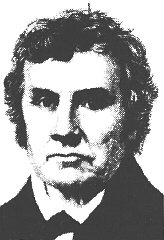
Peter Cartwright, the powerful Methodist circuit rider who in
1846 ran for Congress against a tall lawyer named Lincoln. During
his life, Cartwright preached nearly 15,000 sermons throughout the
rugged frontier, and he could deal with ruffians if the need arose.
This circuit-riding Methodist minister opposed Abraham Lincoln in his campaign for the United States Congress in 1846. Cartwright moved westward to Illinois after a childhood in Kentucky and served two terms in the Illinois State Legislature. There, despite his religious orientation, he remained an opponent of reform movements. Unlike Lincoln, another Kentucky youth, Cartwright did not advocate education and refinement. Rather, he remained an advocate of the fire and brimstone religion of camp meetings, shorn of the message of progress and civilization that became the core of the Whig political ideology. In the campaign of 1846 Cartwright attacked Lincoln on the question of his religious beliefs, in response to persistent rumors that Lincoln was a deist or unbeliever. (Running strongly in a predominantly Whig district, Lincoln deftly parried Cartwright's blunt attack.)
Mark Noll writes:
Abraham Lincoln ran for Congress in 1846, and he faced a formidable opponent: Peter Cartwright. Cartwright, a raw-boned, circuit-riding Methodist preacher, was known throughout Illinois. During his sixty-five years of riding the circuit, he would baptize nearly ten thousand converts.
During the intense 1846 Congressional campaign, some of Cartwright's followers accused Lincoln of being an "infidel." In response, Lincoln decided to meet Cartwright on his own ground and attend one of his evangelistic rallies.
Carl Sandburg, in Abraham Lincoln: The Prairie Years, tells the story this way:
In due time Cartwright said, "All who desire to lead a new life, to give their hearts to God, and go to heaven, will stand," and a sprinkling of men, women, and children stood up. Then the preacher exhorted, "All who do not wish to go to hell will stand." All stood up�except Lincoln. Then said Cartwright in his gravest voice, "I observe that many responded to the first invitation to give their hearts to God and go to heaven. And I further observe that all of you save one indicated that you did not desire to go to hell. The sole exception is Mr. Lincoln, who did not respond to either invitation. May I inquire of you, Mr. Lincoln, where are you going?"
And Lincoln slowly rose and slowly spoke. "I came here as a respectful listener. I did not know that I was to be singled out by Brother Cartwright. I believe in treating religious matters with due solemnity. I admit that the questions propounded by Brother Cartwright are of great importance. I did not feel called upon to answer as the rest did. Brother Cartwright asks me directly where I am going. I desire to reply with equal directness: I am going to Congress."
He went.
beloved rail-splitter
The Infidel Lincoln?
Mark Noll considers the 'faith' of Lincoln
A brief look at the debate over Lincoln's religion, and at the circumstances of his life, can at least provide hints regarding the faith of Lincoln.
Puzzling, unconventional religion
Confusion about Lincoln's religion arises from the multiple ambiguities of his life. On the one hand, Lincoln was, in the words of biographers James Randall and Richard Current, "a man of more intense religiosity than any other President the United States has ever had." On the other hand, Lincoln's faith was not conventional.
As a young man in Illinois, he eagerly read free thinkers like Tom Paine. At the same time, he was a kind of "frontier spiritualist" who believed that signs, dreams, and portents foretold the future. He had no use for Christian creeds or statements of faith, and little use for formal theology. At least early on, Lincoln was probably also a Universalist who believed in the eventual salvation of all people.
He spoke of God often and in many different ways � William J. Wolf counted thirty-three different expressions, like "Almighty Being" or "Father of Mercies," in Lincoln's Collected Works. Yet Lincoln rarely referred to Jesus. [except in the numerous brief impromptu exhortations he gave to groups of "freedmen" -- former slaves emancipated either through war or by proclamation.]
After the death of his 4-year-old son, Edward, in 1850, he regularly attended Presbyterian churches in Springfield and Washington, pastored by doctrinal conservatives. Yet he never became a member of any congregation.
Making religion a political issue
An incident early in his political career highlights the unconventional character of Lincoln's faith. In 1846 he stood for election to Congress from Illinois's Seventh Congressional District.
The rumor began to spread that Lincoln mocked Christianity and scoffed at religious practice. This amounted to a vital issue since Lincoln's opponent was a Methodist circuit-riding preacher, Peter Cartwright.
To quiet the alarm, Lincoln published a broadside on his religion that denied any wrongdoing. Significantly, however, it made little claim to anything positive. Here is the key passage of the circular:
"That I am not a member of any Christian Church, is true; but I have never denied the truth of the Scriptures; and I have never spoken with intentional disrespect of religion in general, or of any denomination of Christians in particular. � I do not think I could, myself, be brought to support a man for office whom I knew to be an open enemy of, and scoffer at, religion. Leaving the higher matter of eternal consequences between him and his Maker, I still do not think any man has the right thus to insult the feelings, and injure the morals, of the community in which he may live � "
Even as Lincoln recognized the importance of religious propriety for public officials, he made clear that his religion was his own business.
Long-standing debate
Lincoln's manifest trust in God alongside his unconventional piety confounded his contemporaries. A popular early biography by Joseph Gilbert Holland, published in 1866, described Lincoln as a model evangelical gentleman. This greatly upset Lincoln's law partner in Springfield, Illinois, William Herndon, who thought he knew what Lincoln was really like. The portrait in Herndon's biography was much saltier. Lincoln was depicted as a prairie "infidel" who got along very well without the church; an ambitious, even scheming, politician; a man more fond of the bawdy than the Bible, more given to introspective melancholy than to Christian holiness.
Modern studies continue the contrast. In G. Frederick Owen's Abraham Lincoln: The Man and His Faith (published in 1976 and reprinted several times), Lincoln appears as a Christian prophet who sustained evangelical convictions throughout his life. By contrast, in Gore Vidal's historical novel Lincoln (1984), Christianity is a superfluous veneer that Lincoln occasionally parades for political purposes.
The greatest difficulty in coming to a clearer picture of Lincoln's faith is the fact that his religion does not fit into modern categories. He was not an orthodox, evangelical, "born-again" Christian striving toward the "higher life" (as these terms have been used since the 1870s). But neither was he a skeptical "modernist" with a prejudice against the supernatural and an aversion to the Bible.
Consequently, many conflicting stories about Lincoln lack concrete historical verification. In one, for example, Lincoln made a definite profession of faith; in another he was voicing agnostic opinions to the end of his days in the White House.
How did you find us?
Did you find us from
(none).
So glad you found us.