![]() |
| McGRINGO's SCORPIONS |
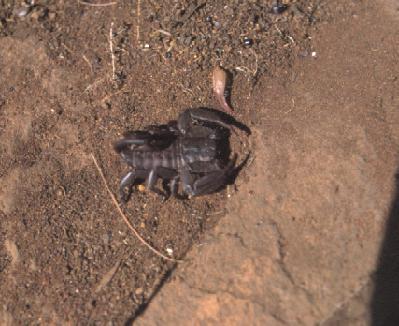
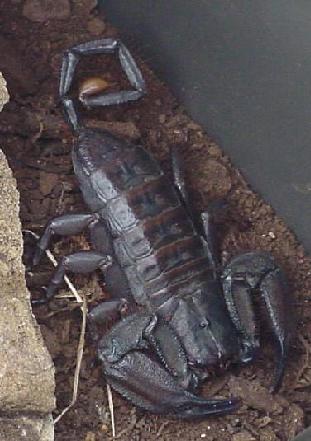
| Found: Gauteng, South Africa. Date: 1981 Length: Approx. 7cm Terrain: Rocky hillside, "Pelindaba" rock Comments: An adolescent specimen. Short tail identifies it as female. The scattered remnants of other arthropods are typical - Hadogenes are reportedly very sedentary, spending up to years in the same crack in a rock, waiting for prey to pass within grabbing range. NOTE: Details are sketchy, this slide was taken when I was about 16 years old! |
| ROCK AROUND THE CLOCK! |
| The world's longest scorpions (up to 210mm) are among the Rock scorpions (Family: Ischnuridae) although this distinction is due to the extremely long, thin tails that distinguish the males from short-tailed females in most of the species. They are distinguished by flattened bodies and powerful, elongated chelae. Their venom is mild and they appear reluctant to sting, even when provoked. They are found exclusively on rocky outcrops, living in the cracks between rocks. Jonathan Leeming reports that some attain a lifespan of up to 30 years, remarkable longevity for any animal! Hadogenes are very sedentary - they will stay in the same crack for up to years at a time, simply grabbing prey that wanders past This can be helpful when searching for them - over time the remnants of prey accumulate into tell-tale "trash" heaps. Due to their long lifespan, they are sensitive to disturbance and some species are threatened due to destruction of habitat. In his informal study of the Scorpions of the Pilanesburg, Leeming observes that they are so restricted to distinct rocky outcrops and mountains that even narrow valleys between populations create an insurmountable barrier that prohibits gene flow (Newlands 1985). This inability to relocate explains why they are still found in undisturbed rocky outcrops in the middle of urban areas. |
| Hadogenes sp. |
![]() |
| Hadogenes gunningi |
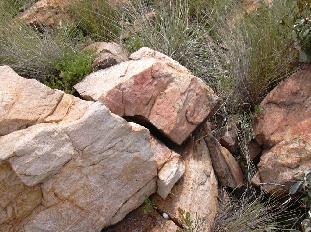
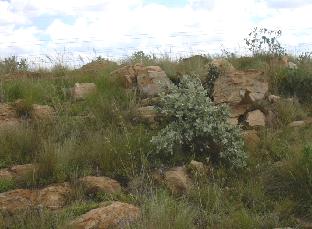
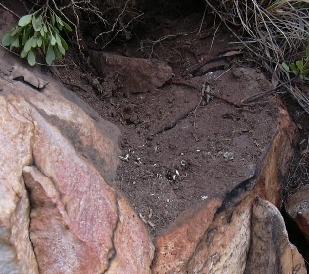
| Found: In a rock crevice on a rockyridge atop a koppie. Date: 15 Feb 03 Length: Approx. 12cm Comments: A fine adult female specimen. Short tail identifies the sex. A few small remnants of past meals in a sheltered niche alerted me to her hideaway, deep in a crack in the rock (A). When opened, the inside of the crevice was full of similar remnants (B). When I uncovered her lair, I couldn't believe it appeared empty, it was so obviously well lived-in - then my friend Louret spotted her half-buried in the fine sand (C) that had settled in the crack over time, apparently unconcerned about an entire colony of small black ants crawling all over her. |
![]() |
![]() |
| A |
| B |
| C |
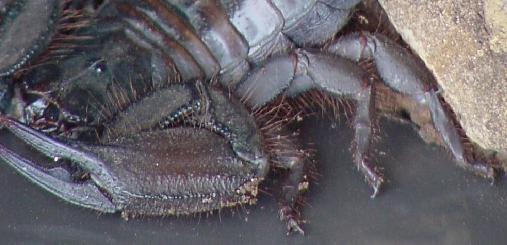
| Very curved tarsi (claws) provide excellent grip on vertical surfaces and upside down on rocks. Elongated pedipalps ideal for probing cracks. |
![]() |
![]() |