| McGRINGO's SCORPIONS |
| TELLING TAILS |
| This section comprises my observations and anecdotes, together with my own opinions and theories (which I hope you will feel free to comment on or correct). They are arranged in no particular order. It is my hope that these snippets may provide further insight, whether valuable or trivial, into the fascinating and relatively secret world of scorpions. It may be that a seemingly innocuous observation provides a missing piece to a greater puzzle - I certainly hope so! |
| When I collect grasshoppers for food, I usually throw in some greenery to keep them alive. When I dropped a few grasshoppers into the tank of Henrietta (my big O.pugnax female from Hennops River), a few broad blades of grass fell in with them. The next day, having wolfed down both grasshoppers, she was evidently still hungry. The blades of grass had since dried out and were folded "shut" like pages of a book. I was fascinated to see her holding a blade firmly with one pincer while methodically and delicately feeling along the inside fold with the other. Once the entire length had been investigated, she then picked up another piece of similarly folded grass and repeated the operation. Pretty smart for an invertebrate! |
| You gotta hand it to Henrietta |
| Attack of the killer prawn |
| In Johannesburg and much of Gauteng, one of the most reviled insects is the notorious Parktown Prawn (named after the suburb where they first appeared in large numbers). They are Corn or King Crickets - large, red and orange monsters with ferocious looking oversized mandibles and a disturbing tendency to hiss, excrete foul smelling black gunk and hop drunkenly at you. They are pests, burrowing into lawns and flowerbeds and eating plant roots from below. Although they're allegedly vegetarian, I have personally witnessed them clustered around dogs' bones, audibly nibbling on the residual meat. Nearly everyone has a horror story to tell - they are virtually indestructible, like the psycho in Halloween, the "body" keeps on getting up and coming back for more! Anyway, in December 2002 I was stuck for food for a medium sized O. pugnax I had captured, so I popped out from my desk at work and went into an adjacent field. All I could turn up was a medium sized "Prawn." With much distaste, I took it home and put it in the scorpion's tank. For two days it was a Mexican standoff. Then on Day 3 I was shocked to look into the tank and see the Prawn standing over the scorpion, gnawing away at the base of the scorpion's tail! I quickly separated them, but it was too late - the Prawn had already eaten away about one half of the first caudal segment, to the extent that the tail flopped uselessly. Within an hour, with its watertight exoskeleton so extensively breached, the scorpion was dead (I suspect through dehydration). I have since been assured that the scorpion must have been sick in the first place to succumb to the Prawn's attack, but that's small consolation - needless to say, my revulsion for these nightmarish insects has only increased. |
| Drunk Scorpion Syndrome |
| This is a deadly malaise I have observed in scorpions. The scorpions typically "stilt" like a female giving birth. Their movements become increasingly uncoordinated - jerky and stiff, with their tails flailing around (hence my name for the sickness). They also become hypersensitive to the slightest vibration - just opening a container lid will send an afflicted scorpion into extreme agitation, as will any attempt to introduce food. Unfortunately no-one has been able to tell me what causes it or how to cure it. I first observed it in my little female Opistacanthus validus (see pic of her with babies on this site), after I had repatriated the scorplings. She showed the symptoms for about a month, but then appeared to get better and that was the end of it. Not so lucky was my female Hadogenes gunningi, who succumbed in July 2003 after a 4-month battle against the sickness. Failure to eat during this period left her exceedingly dehydrated, her tergites literally concertinaed over each other. I even tried force-feeding her a roach puree (crushed cockroach and water) but she would not ingest the solution I dabbed on her chelicerae. Since then I also lost a male Opistophthalmus austerus and a female O. glabrifrons in adjacent tanks. This led Ian Engelbrecht to speculate that the sickness was being spread airborne in the fine mist resulting from spraying the tanks. I have subsequently taken care to uncover only one tank at a time when spraying and - touch wood - all the rest of the animals appear fine. If anyone can shed any light on this topic, I would be most grateful. |
| Keep 'Em Separated! |
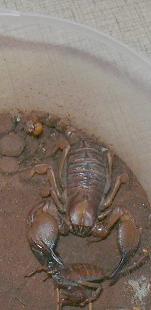
| Talk about learning the hard way! When sorting out my scorpions, I absent-mindedly left a large Opistophthalmus glabrifrons in a tub adjacent to a tub containing a young O. austerus - with the lids off both! By standing on her tail, the big female could scale the side of the container with ease... The picture shows the gory sight that met me when I returned half an hour later, evidently just seconds too late. The juvenile's carapace was already fatally crushed, so all I could do was stand by and let the raider devour her prize. A stern reminder folks - always make sure that a scorpion's container is deeper than the length of the scorp from sting to outstretched pincer! |
 |