
A story involving conflict or contrast of character, esp. one intented to be acted on the stage.
(Dictionary.com Unabridged)
1963-1964
1950s
1960-present
1564-1616
1898-1956
4th Century B.C.

No or NOH Theatre developed in Japan
Italian Commedia dell'arte theatre styles established
Restoration Theatre (comedy)
Melodrama emerges
Royal Shakespeare Company forms
Steven Berkoff and the Modern Stage

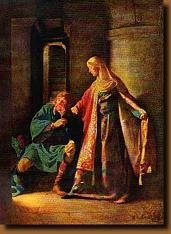
The language of Shakespeare is commonly misinterpreted. Many times the reader does not obtain the full meaning of his dramas on account of the inability to understand his words. In Macbeth he consistently boggles the reader's mind causing them to decipher his text in order to follow the plot and appreciate the overall work. For instance, there is a passage in Act II, Scene II (pg. 59) where Lady Macbeth is tending to her husband after he has just killed King Duncan. Macbeth returned to his wife to inform her that the deed had in fact been taken care of but he has gone tender in which he endures a slight breakdown and minor setback of the mind. His wife, on the other hand, is resolute and determined not to fall short of their dream nor let her husband fail.
To wear a heart so white.
I hear a knocking
At the south entry. Retire we to our chamber.
A little wter clears us of this deed.
How easy is it, then! Your constancy
Hath left you unattended.
Hark, more knocking.
Get on your nightgown, lest occasion call us
And show us to be watchers. Be not lost
So poorly in your thoughts."
Deciphering such a passage enlightens the reader on a lot that Shakespeare conveys through Lady Macbeth. First it showers some perspective on the relationship of the husband and wife, "My hands are of your color." Most of the drama they seem to have a hard and rough, loveless marriage but this excerpt shows different; she comforts her husband during his time of need. This identifies the intensity and depth of their connection, establishing it as real and beyond just an agreement type matrimony. This is also important for the reader to make note of so they can understand why Lady is assisting him and be assured of her loyalty, "A little water clears us of this deed. How easy is it, then!" It goes beyond her own personal greed, for she wants the best for her husband and is willing to do anything for him while by his side. Next it develops Lady's character illustrating her as a strong-willed and determined woman, "I shame to wear a heart so white." At this very moment she is the only thing to hold Macbeth together, keeping him from breaking and giving up, "Be not lost so poorly in your thoughts." Overall her unyielding attitude helps drive the plot of the drama and this is seen even in this small selection. Last, not only does this passage tell us about Lady, it also gives us insight into Macbeth. Here we see Macbeth vulnerable and slightly exposed, "Your constancy hath left you unattended." Her words make clear to the reader his state of mind, or lack there of rather, The overall insight of Macbeth from the passage is undoubtedly key to figuring out Macbeth and how he feels about the deed he has performed and those to come as well as comprehending his reactions to unexpected occurrences that befall him. The uncertainty on his part gives the reader a sense of questioning as far as Macbeth's motives in addition to adding sought suspense.
Follow these links!
Cabell, James, B. "Restoration Theatre." Theatre History. 2002. Henry Hlt and Company. 18 May 2007.
"Drama." Dictionary.com Unabridged (v 1.1). Random House, Inc. <Dictionary.com http://dictionary.reference.com/browse/drama>
Hooker, Richard. "Greek Drama." World Civilizations. 6 June 1999
<http://wsu.edu/~dee/GREECE/DRAMA.HTM>.
Kerry, comp. "Theatre Timeline." MSN Groups. 2004. 16 May 2007
<http://groups.msn.com/Performingzone/theatretimeline.msnw>.
Morka, Anna. 2000. Quad C Theatre. Macbeth. 17 May 2007.
"Russian Realism." Early 20th Century Russian Theatre. Northwestern University. 21 May 2007. <http://faculty-web.at.northwestern.edu/slavic/theater>.
The English Language. University of Tronto. 17 May 2007.
Trumbell, Eric W. "Melodrama" Oct 2002. Northern Virginia Community College. 18 May 2007.