How chemistry evolved �the Dimply�
Over the years, golf has gone through countless equipment advances, which have changed the game dramatically over the years. The clubs used today and larger in size and are hit farther than ever before. In response to this, golf courses have lengthened to accommodate these long hitters. The golf ball, though it looks almost exactly the same as it did when golf first started in the 19th century, has gone through drastic changes too, inside the ball.
Credit for the advances in golf balls generally goes to the physics field. However, it is actually chemistry that allows the ball to jump off a club face, fade or draw in the air, and stop dead on the green. The earliest golf balls were made of hardwoods, and later moved onto leather pouches filled with boiled feathers. In the mid 18th century, balls were made from gutta-percha, which is a coagulated latex, which was basically sap from sapodilla trees. When heated, it can be formed into a sphere shape, and is virtually indestructible.
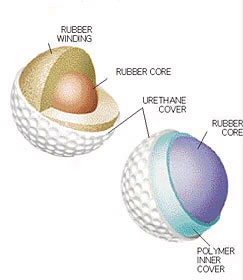
1898 brought a new era in golf ball technology. B.F. Goodrich introduced the first ball that had rubber threads wound tightly around a rubber core. After many tests, they came up with a design that replaced the gutta-percha with balata, a natural rubber found in South America. This revolutionized the golf ball for pros and amateurs alike.
In the 1950�s, a chemist from DuPont, Richard Rees, created a material that would change the game of golf for amateurs forever. He copolymerized ethylene and acrylic acid and took a sample from it and converted it to its sodium salt, thus creating a very hard substance known as ionomer resin. It was brought to the market in 1964 under the name of Surlyn and was a huge hit among amateur golfers.
Around the same time, a Massachusetts chemical engineer named Robert Molitor came up with the first alternative to a wound ball. The two-piece ball had a polyurethane cover and rubber core. The ball replaced Surlyn and other ionomer resin balls and became known as the �distance ball�.
Golf balls flying further than ever before, but there was still one problem with the balls back then. Balls then were as hard as a rock and it is very uncomfortable to hit a hard object with a metal stick, trust me. So, Bob Weiss, a chemical engineer professor at UConn, came up with �soft ionomers�. They were terpolymers of ethylene, methacrylic or acrylic acid, and a third component, usually an acrylate to soften the feel of the ball when hit.
Since then, everything has changed. The call for more distance was heard clearly by golf ball developers. Top-Flite introduced the first ever multilayer balls, bridging the gap between wound and solid core balls with a hard �mantle� between the solid core and the soft terpolymer covering. In 2000, many players switched to the Titleist Pro V1 (my ball of choice) because of its added distance. Weiss explains that polyurethane is the hottest material out there right now, and it is used by many companies such as Titleist. The trick for manufacturers is to put an extremely this layer of the polyurethane over an ionomer mantle to eliminate the dampening effect polyurethane has so the ball can go further.
As you can see, the golf ball has gone through multiple interior changes to better feel and more distance. However, the golf ball has maintained its form for hundreds of years now. It just goes to show you, it what�s inside that counts.