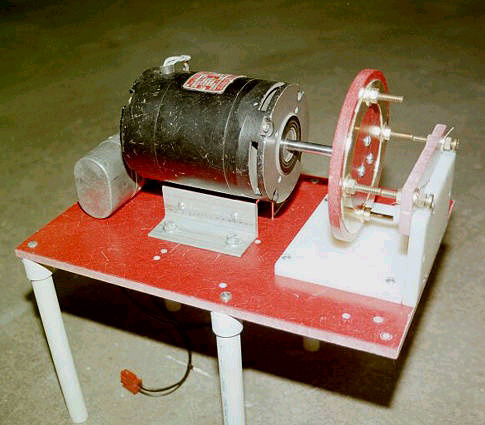
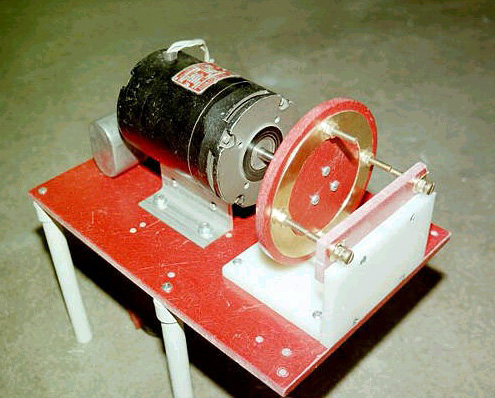
I wanted to try a rotary spark gap, which are noted for their superior peformance. I obtained a 120-volt synchoronous motor rated at 1800 RPM from a surplus store. I have no idea what it was used for previously and not even sure if it even spins at its stated rpm. I did not take the time to strobe it out to determine its actual speed. But after cleaning it up and lubing the bearings, I got it to run with a 4uf start capacitor. It takes about 10 seconds to come up to speed and runs smoothly after that.
The disk had to be made from a heat-resistant material as the contact points generate alot of heat in use, and would melt or warp any lighter material. I found a sheet of 1/2" fiberglass board that was quite dense and would work well. This material was difficult to cut and drill. I am no machinist, I rough-cut a 6" circle and attached a 2" gear to its center. I did this by drilling and tapping 3 holes in the gear and secured it via 3 screws through the disk. The gear had a collar and setscrew which provided a nice way to attach it to the motor shaft. Using another general purpose motor I had clamped to a table, I attached the disk to its shaft and got it spinning. With a file and sanding block, I was able to eventually get a perfect circle by holding them firmly against the spinning disk.
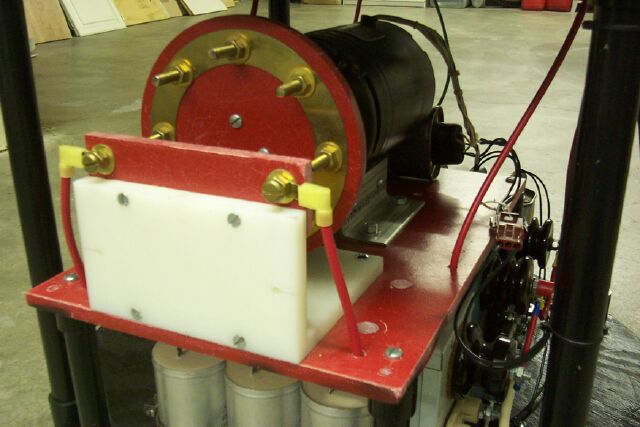
I cut a 5-1/2" x 3/4" dia ring out of brass sheet and attached it to the disk with four 1-1/2" x 1/4" brass bolts, nuts, and washers. The motor was mounted to a sheet of fiberglass board with L-brackets and the electrodes
to a strip of fiberglass board supported by 1/2" thick nylon panels. |