|
The
Convent Route
Umán, Muna, Ticul, Oxkutzcab,
Maní, Teabo, Mama, Tekit, Tecoh, and Acanceh. Texts refer only the respective
site’s colonial architecture. Site’s listed in order of their proximity to
Mérida. |
|
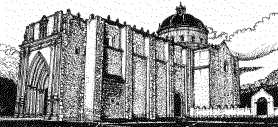
UMAN: A Franciscan foundation established in 1576,
becoming a residential mission in 1583. Part of the open chapel of the original
building survives in the Chapel of St. Peter and St Paul which stands on north
side of the church. The present-day church is relatively late, built in the
1790s. Fortress-like exterior with flying buttresses shows typical Yucatecan
stonework; gothic-inspired façade with renaissance niche, 16 stained-glass
windows. |
 |
|
MUNA: Muna guarded the northern approaches to Xiu
territory in preconquest times. The Franciscan mission overlooks the main square
and stands squarely on a former Mayan temple. The immense church dates to the
mid-1600s. Watch for dedication plaques above the west door, in the choir arch,
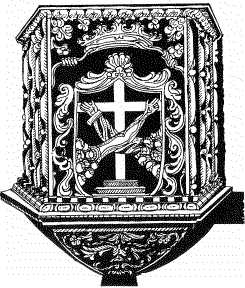
above the side entrances and high on the façade. The pulpit is carved with the
Franciscan crossed arms. |
 |
|
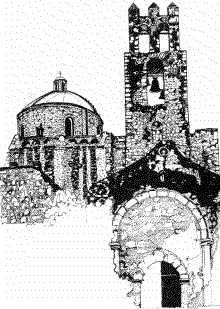
TICUL:A pottery and leather town par excellence and
filled with workshops called talleres. There was a Franciscan mission in
Ticul since 1555 and by 1591 it had attained the rank of cabecera or head
mission and construction on the great church and convento began not to be
finished until the 1640s. The mark of the Franciscans is seen throughout the
church—symbols of the Order, knotted cord frames around the doorways. |
 |
|
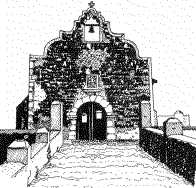
OXCUTZCAB: A market town for the Maya living in the
surrounding countryside (Annual Fair, Aug 10-16th worth seeing). The
Franciscan mission stands beside the town square. The original mission was
founded in 1547 but failed due to a clash with the Maya. The second was begun in
1580, though architecturally speaking it never amounted to much. The complex
there today was built from 1640-1693. The magnificent retablo or altarpiec is
the finest work of art at the site: four tiers of carved panels and sculptured
saints. Don’t miss the hillstop hermitage of the Virgen de
Pilar. |
 |
|
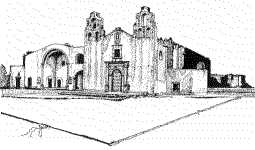
MANI: Historic and tragic Maní was the Xiu capital
prior to the conquest and the site of Bishop Landa’s infamous auto-da-fé (1562)
during which hundreds of Mayan documents were burned. Then, during the Caste
Wars, 200 people who had taken refuge in the church were killed by Maya rebels.
The church is a true monument with a rare, sculpted atrio cross and a collection
of altarpieces that are among the finest in Mexico. |
 |
|
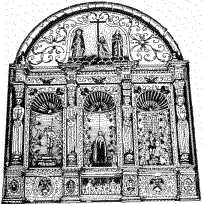
TEABO: The Franciscan mission is located at the
center of town, built over the original Mayan temple. A relief of the Five
Wounds (a reference to the stigmata of St. Francis) appear with the Franciscan
Crossed Arms and a dedicatory plaque with 1650. An inscribed date of 1696
appears on the façade. Best bet here is the altarpiece, perhaps done by the same
artist that did those of Maní. |
 |
|
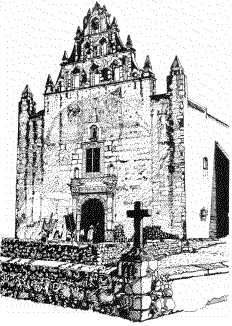
MAMA: The area is full of cenotes and associated
with female deities, both Christian and pagan. The well in the plaza behind the
monastery is the focus of the community; the well house one of only two such
structures in the Yucatan (the other is at San Bernardino, in Valladolid). The
mission was expanded in the 17th century and further altered in the |
 |
|
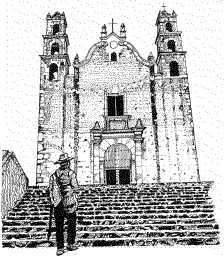
TECOH: Another huge mission (1600s), located just 10
km up the road from Mayapan (the last great city of the Yucatecan Maya, active
at the time of the conquest). There are wooden balconies in the nave and late
baroque altarpieces that were once gilded. The altarpieces are rare and unusual
for they contain paintings, rather then relief sculptures ( John the Baptist and
three archangels). |
 |
|
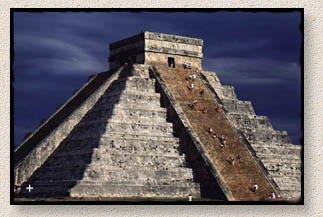
ACANCEH: The town sits in the middle of an ancient
Maya ceremonial center. Pyramids share pride of place with colonial churches and
modern buildings. Maya structures here really more interesting than the
18th century church. |
 |
