|
Chinese Naive
Art
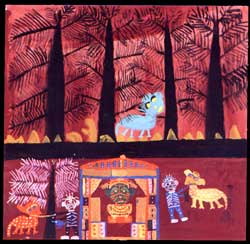
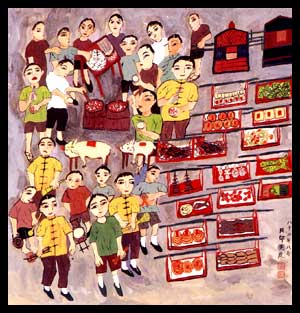
Peasant paintings first became popular in
China in the late 1950s, during a nationwide peasant painting movement
that began during China�s Great Leap Forward. Chairman Mao Zedong was a
proponent of artistic expression among his people proclaiming. Everyone
may participate in artistic creation. Peasants, you may paint.
Today, painting continues to be an important
means of expression for Chinese peasants. Most of the artists work the
agricultural farms during daylight and paint at night. Predominant in many
art collectors' collections are paintings that originated in Jinshan
County, a farm community near Shanghai. Other paintings come from Huxxian
County, a rural area several hours outside of the city of Xian. These are
the primary peasant art colonies in Mainland China.
The Huxxian County art colony preceded the
one in Jinshan County, organized shortly after the Cultural Revolution.
Jinshan County's colony was created a decade later. While the media of
gouche on paper are common between the two colonies, the composition and
style of the Huxxian County paintings differ dramatically from the art
created in Jinshan County. Also, paintings created in Huxxian County tend
to be one-of-a-kind, meaning that there is no copying or printing done of
these images. In contrast, paintings in Jinshan County tend to be
recreated by the artist on multiple occasions, so that multiple versions
of essentially the same paintings are created. Each painting, however,
differs due to the evolution of the artists' vision of the painting.
|