Dasain at Muktinath
"The sun has risen in the east, the
warmth-giving sun is shining,
The sun's rays are shining down on this
holy site.
Here upon the right-hand lotus is the
Great Sacred Place of the One Hundred and Eight Springs;
If you offer sacred water here you will
travel safely in the aftrer world."
The Great Sacred Place of the One-Hundred and Eight Springs celebrated in this song is the name by which Muktinath is known to the Tibetan-speaking inhabitants of Mustang. Muktinath is one of the most important places of pilgrimage in the Hindu World, and its sacred srings and other sources of vital power draw visitors from far beyond the boundaries of Nepal.
Pilgrims visit Muktinath in any season of the year, but, if it's possible, they will make their journeys at a time when the spiritual benefits are most abundant. One of these moments is the great Hindu festival of Dasain, which extends over ten days in the month of October.
The demands of devotion transcend comfort. At around 12,000 feet, Muktinath is cold in autumn. Some of the pilgrims are lean, well-travelled ascetics who spend their lives walking great distances from one south Asian shrine to anothere, but others may never have been much above sea level or experienced comparable cold. Many are elderly or infirm, unacustomed to walking, and quite unprepared for the temperature and altitude of a high Himalayan Dasain. Just occasionally, pilgrims do succumb to the conditions; but for the faithful, there is no finer way to leave the world.
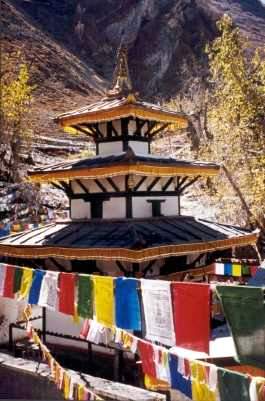
Arrival brings little respite to the tired travellers. They rise early to bathe in the icy waters of the hundred and eight springs, then go barefoot and shivering to receive the blessing of a tika, a mixture of vermilion powder and rice placed on the forehead by the priest of the main shrine. The sense of fulfillment on the devotees' faces at this moment is a reminder that this is what makes all the hardship worthwhile: the blessing of Vishnu, the Lord of Liberation, Mukti Nath. His shrine is a tier-roofted temple that seems to have been magically transported from the Kathmandu Valley onto a setting of flat-roofed highland architecture. Vishnu, the preserver, is represented inside his temple by a black ammonite. These spiral fossils, which rose with the Himalaya millions of years ago from the bed of the Tethys Sea, are regarded as manifestations of the god, one of whose attributes is the sacred disc, or chakra.
Dasain at Muktinath does not feature the large numbers of sacrifices that mark the occasion in Kathmandu, for here it is centered on Vishnu the preserver, who does not delight in blood offerings. Beside, animal sacrifice is antithetical to the religious principles of the ethnically Tibetan Budhists inhabiting the Muktinath Valley.
For the Buddhists, the most important shrine is the site knonw as Fire Burning on Earth, Stone and Water. The Hindu pilgrims also venerate this phenomenon of natural fire as a manifestation of Brahma, the creator. The blue flames can be seen by anyone who draws aside the rough curtain in front of the stone altar while observing the respectful convention of covering his or her face to shield the fire from impure human breath.
It is not only the Hindu and Buddhists who revere the sacred complex of Muktinath. In an adjacent valley lies the little settlement of Lubra, whose inhabitants are followers of Bon Bonpos regard their religion as the prodecessor of Buddhism in Tibet. They, too are frequent visitors to Muktinath. Inside the temple called Gompa Sampa, below the main Vishnu shrine, the visitor is confronted with a huge carved wooden screen. If a villager of Lubra also happens to be present, he may point out that half the auspicious swastikas are carved counter-clockwise, in the Bonpo manner. The reason is that the screen was worked long ago by a craftman of Lubra, who wished to emphasize that the place is sacred not only to Buddhists and Hindus, but to Bonpos as well.
The complex abounds in minor sites believed to be the legacies of semi-divine visitors. There are rocks bearing the footprints of magi such as Padmasambhava; inside a small alcove can be heard the grindstone of a goddess' subterranean water mill; the poplars that shade the trail sprouted from the staffs of visiting saints. Almost every stone seems to have its own story.
Although many pilgrims experience hardship while reaching their destination, they are abundantly rewarded by the benediction of Vishnu, the companionship of their fellow-travellers, and, not least, the sweeping Himalayan landscape of Muktichetra, the Field of Liberation.
