The Voyage of Milagros:A Serial Adventure of the High Seas
Chapter Two: Captain Carlo
return to Chapter One
I was not anxious; when it came to making way, I knew both the proverbial and literal ropes. The essential tasks roll easily from my tongue or to the page, whichever vehicle is necessary to line out every member of a respectable crew, from the first mate to the cabin boy. I made my way to the bow and squinted at the sun for the hour of the day. The text and figures of Seaman's Secrets returned to fore from the far reaches of my memory, available when needed, yet not cluttering the mind when not.
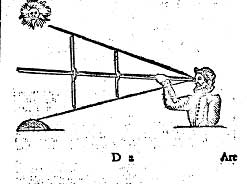 "First, Consider whether the Sun be comming towards the Equinoctial, or going from him: That being known, consider the time wherein you seek the Declination, then look for the Suns Declination in your Regiment for that day, and also seek his Declination for the next day, subtract the lessor out of the greater, and the remainder is the whole declination which the Sun declineth in 24 hours, or in his moving through all points of the Compass, from which number you may by the Rule of Proportion find his Declination upon every point of the Compass for every hour of the day�"
It was 5:43 in the afternoon. An excellent time to find a ship's captain in his quarters preparing for the evening mess. I had never set foot on Milagros before this day, but I new the way to the captain's quarters as if I had built the vessel by hand myself. My new shipmates bustled around the deck offering friendly greetings as I made my way. "Aye ye skalliwag," and "Ahoy scoundrel!" My gay response a cheerful "Call me Ishmael!"
I rapped three times on Captain Carlo's door. The porthole darkened in front of me has his slowly moving shadow blocked the amber light coming from the lantern swaying on the back wall of his quarters.
The door swung open suddenly. Milagros gave a deep-throated groan and started a hard portside list that threw the young captain against the cabin door toward me. His bulky frame bore down on mine as I braced myself against some rigging and pushed toward him with all my strength, keeping us both erect as the ship continued to roll, port to starboard.
Having gained our balance, Carlo and I made our way as fast as a rocking boat would allow to the starboard rail just behind the captain's quarters. The smell of spent gunpowder was starting to fill the air. Sea gulls, Terns, Cormorants, and any other creature capable of a screech, squawk, or squeal were in full chorus as were the men aboard Milagros. You could see men on shore moving in every direction, trying to get a better look; those not mindful of what had happened stopped dead in their tracks and looked with blank stares towards the harbor's edge.
In an instant we realized the enormity of the situation. The muffled explosion and painful groan that came from Milagros told us all we needed to know. A caisson stored below deck well beneath the water line of a ship off our starboard side had exploded.
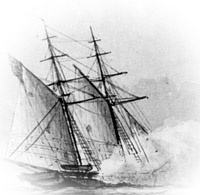 As Carlo called for the first mate, I pushed past him along rail toward the exterior ladder. My climb was halting, both from the sway of the ship and the fresh pain that was my gift from Emilio, now reopened. Upon reaching the upper deck, I took in a scene of near total chaos: The ship's crew, some of them mere boys on first sojourns from home, scrambled in varying states of panic across the rolling funhouse that was once their stable vessel. And worse! A riot of black smoke belched from the galley portal and several of the starboard vents. We were afire.
When my feet reached the deck, I heard the first of the screaming. Some of the voices below still carried the force of reason, barking short but intelligible instructions to invisible others. Water was ordered from the mess, blankets from the crew quarters and persons directed to get topside in all haste. But beneath these more sensible exhortations, and yet somehow above them also, came unmistakable arias of agony. These are the sounds men make in spite of themselves. They are our oldest and most telling utterances, sounds made by men in the jaws of lions, women dying in the act of giving birth, and I feared now by blinded seamen in searing heat.
I leaped for the galley door. As pulled it open I was blown backward by a great force; I flew headlong into the portside railing, fracturing it like a greenstick and nearly falling into the dark chop below. Everything was silent, I could hear nothing. But woefully, I could see: sailors strewn everywhere, bodies arranged in bizarre acute angles, appearing like crumpled up lengths of carbon steel randomly scattered around a blacksmith's scrap yard. Most were not moving, but several groveled slowly around the deck, screaming in silence. Groggily, I remembered that Milagros's galley was located adjacent to the armory. The heat was blinding, but there was no fire. Erect as ever she stood, spars, masts, even sails unconsumed - everything in place, but everything blackened, charred.
And then the thing began to move towards me, slowly at first, then with greater speed. Its form still unrecognizable through the thick smoke made even thicker from the accumulated dust and other fine debris dislodged by the explosion. When I realized what it was I could scarcely believe my eyes, yet there it was, moving past me now with full speed. The sum weight of all it contained had to exceed the weight of two full-grown horses. You could see the decking of Milagros contort beneath its mass, and had the ringing in my ears been a dull roar rather than a thunderous one I am sure I would have herd the snapping sounds that comes form such a heavy load on wooden planks as worn as those that covered the decks of Milagros.
If I were to tell others who don't know me what was taking place before me they would think me crazy as a mad hatter, a teller of tall tales. For an instant I thought maybe I was going crazy, that my mind had some how displaced reality with a dream, but what I was seeing and now feeling was real. Not a prettier sight could be imaged.
After catching the arm of the first mate Captain Carlo must have summoned as many men as he could as he ran for a small dory temporarily stored near the stern of Milagros. I remember seeing the small craft as I made my way up to the captain's quarters just moments ago. It was sitting atop a number of large oak water barrels that had recently been filled.
Captain Carol had the crew place the water-laden barrels into the dory, and smash them open, until the small craft was filled to its gunnels with water. He then grabbed the bow and lifted as he instructed others to grab its rail and do the same. I was awed by the shear physical strength of Captain Carol and his crew as this mass of men and water moved toward me. Obviously these men were willing to give there all for this captain and he for them.
As this bulk of humanity moved past me I could see Captain Carlo barking out orders as he instructed the men to lift and tip the dory in one sweeping motion towards the galley door. Pieces of oak barrel that hadn't been splashed out of the dory on the way were now thrown through the small doorway as a wall of water flooded the galley.
I was much amazed. Nowhere had I seen nor read of such a tactic; it was wondrous invention or a stroke of mad genius, but in either case it served. A huge volume of steam arose from the galley door. Captain Carlo's men staggered back lest they be flayed or blinded by the Vulcan vent they had created. Carlo himself stood his ground, turning only slightly aside to escape the worst of the wet heat. When the cloud dissipated, it came to no one's surprise that our captain was gone, the first to breach the blackened portal and face what horror had become of his men and his ship.
In short order came more chaos. But now it was a welcome sort: a swarm of soldiers, sailors and apparent passers-by boarding the ship en masse to tend the injured or cover the dead. My pleasure doubled with the sight of a lovely young nurse, an angel in fact, whose cool hand was quick to my forehead. Her pale face, surrounded in ethereal shimmer, seemed to float above me like a full equatorial moon. No man could do better than lose his wits beneath her glow; O Sweet Lunacy!
�Then to the crowded hawk markets of Basra: bright sunlight, deep shade and an equivocal din of staccato Arabic tongues all speaking at once. I was adrift in a dream, half-remembered and now half-lived again in my stupor of shock upon the deck of Milagros.
It was the day I met young Carlo; he was no captain then.
I held the post of Secretary to Lord Chesterfield, commandant of the Second Brigade of the Southern Dragoons (a notorious band of drinkers and brawlers as ever was birthed by the British East India Company). Chesterfield was an affable sort, "landed" of course as were all those able to purchase commissions of command, yet no mere British boor pining for Mother England and the posh pleasures of the gentry. I felt he rather liked the Foreign Service, and he showed more than a little aptitude for its particular style of life.
Indeed, Chesterfield was a keen (nay, an incorrigible) falconer, a trait that much endeared him to the local Ameers within his region of authority. It was in service to my Lord's addiction for sport that I found myself surrounded by hawks, hawkers and hordes of the unwashed in this ancient Persian port city.
"Fetch me a goshawk, Ishmael, a big one. Money is no object."
This was Chesterfield's first official order. He followed quickly with a few more:
"Three Bashas: all of good size. Do you know the Basha, my boy? She's the same as our little English sparrowhawk. You'll recognize her. I'll need hoods, too, both the proper kind and the soft ones the locals use, about twenty of each I should think. And bells, boy! Buy me all the bells you can find!"
I was not entirely bereft of falconry lore. I flew merlins as a younger man on the Salisbury Plain, following my father's long-time summer holiday penchant for lark hawking. It was in fact mostly because of this early experience that I had gained my post in India: Evidently I was the only qualified applicant who could answer Lord Chesterfield's rather unconventional interview questions, most of them relating to the aristocratic pastimes.
But now cast down among the native masses, jostling more or less aimlessly in the crowd, I dared admit to myself that I had a rather sketchy image indeed of "our little English sparrowhawk," and I doubted whether I would in fact recognize her easily.
Enter Carlo, my unexpected guide to all things Persian and ceaseless raconteur.
"You'll lose your job with that one, Friend."
"I beg your pardon?" I turned, annoyed at the interruption of what was surely the best bargain on a cast of Bashas in all the Gulf.
"I said you'll lose your job if you seal a deal for those sorry Shikras! Ol' Chesterfield will have your hide for bringing him hawks better suited to barn sparrows than the partridges he's after. Allow me�"
With that rather abrupt introduction, my new friend took me by the arm over the loud objections (curses, actually) of my would-be vendor. Who but another pale-faced sahib would now buy his battered little Shikras?
In time I would come to thank Carlo for this miraculous salvation, but at that moment I was quite unsure what fate awaited me. Carlo led me past the front rows of little shops and into the dim backrooms where the heavy smell of the Houka permeated the air like an ill marsh wind. Keenly I became aware that my pistol offered little protection, sitting as it did, beneath my undergarments in the dresser of my bungalow.
In a dark corner of the room sat Mirokai, one of the most remarkable men of his race I had ever seen. His bulk for a Microneasian was immense, but he did not look merely fat; he looked imposing, monumental. This motionless body, clad in rich stuffs, coloured silks, gold embroideries; this huge head, enfolded in a red-and-gold head-kerchief; the flat, big, round face, wrinkled, furrowed, with two semicircular heavy folds starting on each side of wide, fierce nostrils, and enclosing a thick-lipped mouth; the throat like a bull; the vast corrugated brow overhanging the staring proud eyes--made a whole that, once seen, can never be forgotten. His impassive repose (he seldom stirred a limb when once he sat down) was like a display of dignity. He was never known to raise his voice. It was a hoarse and powerful murmur, slightly veiled as if heard from a distance. When he walked, two short, sturdy young fellows, naked to the waist, in white sarongs and with black skull- caps on the backs of their heads, sustained his elbows; they would ease him down and stand behind his chair till he wanted to rise, when he would turn his head slowly, as if with difficulty, to the right and to the left, and then they would catch him under his armpits and help him up. For all that, there was nothing of a cripple about him: on the contrary, all his ponderous movements were like manifestations of a mighty deliberate force. It was generally believed he consulted his wife as to public affairs; but nobody, as far as I know, had ever heard them exchange a single word. When they sat in state by the wide opening it was in silence. They could see below them in the declining light the vast expanse of the forest country, a dark sleeping sea of sombre green undulating as far as the violet and purple range of mountains; the shining sinuosity of the river like an immense letter S of beaten silver; the brown ribbon of houses following the sweep of both banks, overtopped by the twin hills uprising above the nearer tree-tops. They were wonderfully contrasted: she, light, delicate, spare, quick, a little witch-like, with a touch of motherly fussiness in her repose; he, facing her, immense and heavy, like a figure of a man roughly fashioned of stone, with something magnanimous and ruthless in his immobility. She held the raptor, the beautiful, perfect raptor.
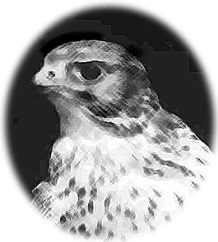 At first I guessed the beautiful creature a Lanner with its cream colored head accented with streaks of black, the most prominent an incomplete ring 3/4s round, starting at the base of the neck and extending up the back of the head in an arching fashion that turned inward at eye level and continued across the temple to the upper rear corner of the eye where it split into two divergent lines that flawlessly traced the outer circumference of each orbit, trailing off just before fashioning a complete ring. The markings reminded me of those I had seen tattooed on the face of a Maori warrior, they were very distinctive and gave the bird an air in harmony with its owners, stately and strong. However she was too large to be a Lanner. Her deck feathers were to light and her mail feathers had a faint mottling pattern more in line with a Peregrine than a Lanner. I voiced these observations aloud to myself as I examined other features seemingly unique to this extraordinary creature.
My utterances were overheard by the falcon's owner, Abali, Mirokais' wife who asked me if I wanted to take a closer look.
She said the bird was a crossbreed, a combination of Peregrine, Lanner and a Gyr. She was six years old and was given to her by a breeder from Abu Simbel, a small village in the extreme south of Egypt and on the very edge of the Western Palaearctic. She explained that the markings of the falcons from Abu Simbel are distinctly different from those in the rest of the region and they fly at a slightly higher pitch, possibly because they have a strong "African element." She assured me that she had neither seen nor heard of a falcon of any kind that could match the beauty and grace of her most cherished raptor.
To this, Carlo my self-imposed guide, and apparently now my spokesman
replied,
"Popycock!"
The room fell silent. Lips pursed on the otherwise inscrutable faces of our hosts. One of the eunuchs lowered a fat hand to the region of the hilt of his sword. I prayed (silently) that the obvious familiarity which Abali and Mirokais demonstrated with the English language did not extend quite far enough to embrace the current slang. Perhaps, I dared hope, they would take Carlos' exclamation as some sort of complimentary avian reference!
I remembered again and with no small measure of chagrin the unfortunate location of my pistol.
"Ha!" It was Mirokais himself who first replied. His laughter pealed and boomed in the tiny confines of the room, and soon was shared by all.
"You do know your hawks, young Carlo. Tell me, if you can, what sort of bird my lovely wife displays�?"
It was another challenge, delivered not without humor yet with the barest hint of steel behind it.
"Why, it is nothing but a Saker falcon from the Altai region north of the Himalaya."
"My lady," he added, with a noted softening of tone and a shift in his gaze toward the woman, "holds an exquisite specimen, to be sure. But an Altai Saker it is."
With that, the matter was settled. Carlo, having nearly killed me with a heart-clutching few moments of suspense, proved himself, for the first of many times to come, a master of the politic and a keen student of the person. His skill as a taxonomer goes without noting.
We returned to quarters that evening laden with the finest of hawking furniture at Mirokais' disposal, a huge passage goshawk and a true cast of Bashas for Lord Chesterfield's sporting pleasure. Carlo took the Saker for himself.
On to Chapter Three
|