
SPSS Conjoint: What It Is?
SPSS Conjoint is a system of three inter-related procedures for performing full-profile conjoint analysis.
Conjoint analysis is a type of experiment done by market researchers. It enables the researcher to understand consumer preferences or ratings of existing or possible products in terms of product attributes and their levels.
The purpose of conducting a conjoint experiment is to learn the relative importance of product attributes, as well as learn what the most preferred attribute levels are. When done well, conjoint analysis helps the researcher to understand the existing and desired product. The researcher can simulate market share of preference of existing or possible products, even if the particular combination of factor levels that comprises the "product" was not explicitly judged by the subjects.
A number of approaches exist for doing conjoint analysis. In full profile conjoint analysis, a product card consists of one level setting for each attribute under consideration. The set of such cards can be all possible combinations of attribute levels (one combination per card) or some fraction thereof. Often, the researcher is only interested in presenting a fraction, because all possible combinations represents too many product alternatives to judge without concern about fatigue and the reliability of the subject data.
Fractional factor designs require the aid of a computer. The ORTHOPLAN procedure can generate such designs.
The researcher often presents the choice alternatives as a set of physical cards that the subjects then sort in order of preference. The PLANCARDS procedure is a utility for generating such cards.
Full-profile conjoint data can be analyzed by way of ordinary least squares regression. The CONJOINT procedure is a specially-tailored version of regression.
An example of SPSS Conjoint's output.
Who Uses It ?
Market researchers
Those involved in new product development of products that have "hard" attributes. Example: When looking at automobiles, two door versus four door is a hard attribute choice; "Makes me feel safe" or "Makes me feel powerful" is a soft attribute.
What It Helps You Do ?
Learn what product attributes are important in the consumer's mind.
Learn what the most preferred attribute levels are.
Perform pricing studies.
Perform brand equity studies.
Do all of this BEFORE producing the product in mass amounts and possibly experiencing a failed launch. The market researcher is the friend of product development and sales. Product development is an expensive resource, and good research helps insure that their work effort is expended on products that succeed. Likewise, market research helps insure that products are developed that will sell.
How It Works ?
Think about the attributes that should be included in the study. All important attributes should be included; an omitted important attribute affects results adversely. On the other hand, don't include too many attributes.
Think about the attribute levels. Levels should be chosen with care. This is often illustrated with price. Too narrow a price range will make price unimportant in a study. Too wide a price range will make price dominate as a factor.
Think about the number of cards. Too few cards will lead to too little information in the data, while too many cards risks respondent fatigue and unreliable data.
Use Orthoplan to generate an orthogonal main effects fractional factorial plan with a suitable number of cards. These designs are not easily done without a computer.
Use Plancards to generate physical cards for the subject sort and rank task.
Use Conjoint to learn attribute importance, preferred attribute levels, and desired products.
A Classic Conjoint Analysis Example
Green and Wind present an example in
which a company is interested in marketing a new spot remover for carpets and
upholstery. The company's technical staff has developed a new product that is
designed to handle tough, stubborn spots. Management has identified five
attributes that it believes will influence consumer preference: an
applicator-type package design, brand name, price, a Good Housekeeping seal of
approval, and a money-back guarantee.
There are three package designs under
consideration, denoted package design A, B, and C.
There are three brand names under
consideration. Two are competitors' brand names already on the market, while one
is the company's present brand name choice for its new product. The names are
K2R, Glory, and Bissell.
Three alternative prices being
considered (this example is from the early 1970s) are $1.19, $1.39, and $1.59.
Good Housekeeping seal of approval is
either present or absent.
Moneyback Guarantee is either present
or absent.
In all, there are a total of 3x3x3x2x2
= 108 alternatives to be tested if the researcher were to present all possible
combinations of the five attributes. Instead, the researcher takes advantage of
a type of experimental design called an orthogonal array to present a fraction
of all possible alternatives to the respondent. In this way, the researcher can
keep down research costs as well as avoid respondent confusion and fatigue. This
fraction is chosen so that the researcher can fit a main effects general linear
model relating respondent preferences to the five factors. Other things equal,
the trials are chosen to meet statistical criteria such as efficiency,
orthogonality, and balance, though it is not always possible to perfectly
satisfy these criteria. The researcher must employ computer software to
correctly generate the experimental trials.
Green and Wind present the orthogonal
array shown in Figure 1.

Figure 1.
The SPSS user could employ either SPSS
Conjoint's Orthoplan procedure or the stand-alone Trial Run product to generate
such a design. Having arrived at the 18 trials, the researcher might proceed by
making up 18 "cards," one for each alternative to be ranked. On each
card might appear an artist's sketch of the package design along with details
regarding the other factors. SPSS Conjoint's Plancards procedure can generate
cards. Figure 2 shows a card:
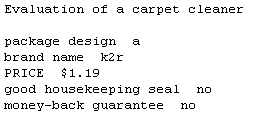
Figure 2.
The researcher might instruct the
respondent to sort the cards in order of preference from high to low. The ranks
become a dependent variable in a general linear model. Figure 3 shows the data
with the respondent's ranks, where "1" is the highest rank.

Figure 3.
Ordinarily, the researcher presents the
conjoint experiments to more than one subject, but Green and Wind only present
data for one subject.
SPSS Conjoint's Conjoint procedure can
do a general linear model analysis of the data. Conjoint prints the results
shown in Figure 4.
Figure 4.
Figure 4 has a lot of information.
The Utilities column shows a set of
scores or scale values for each attribute in the conjoint analysis. These scale
values are chosen by the conjoint estimation program so that the when they are
added together the total utility of each alternative product will correspond to
the original ranks as much as possible.
The Factor column shows a utility
function for each level of each factor. These mini-plots, or the corresponding
utilities, show that - excluding brand name -- Package design B is the most
preferred level of Package design, $1.19 is the most preferred price, and that
both the Good Housekeeping seal and the Money-back guarantee have some utility.
The Averaged Importance column shows
attribute importance. Factors ordered by importance are: Package design, Price
(almost as important), Money-back guarantee, Brand, and Good Housekeeping seal
of approval. Note that attribute importance is indicated by the relative range
of utility scores for an attribute.
Green and Wind make a number of
observations about these results. For example the utility of a product with a
price of $1.39 would be 2.83 utility points less than one with a price of $1.19.
However a money-back guarantee which involves an increment of 4.5 utility points
would more than offset the effect of the higher price. It is this type of
tradeoff comparison that makes a conjoint analysis so invaluable in new product
development.
