Kansas, That is!
return HOME
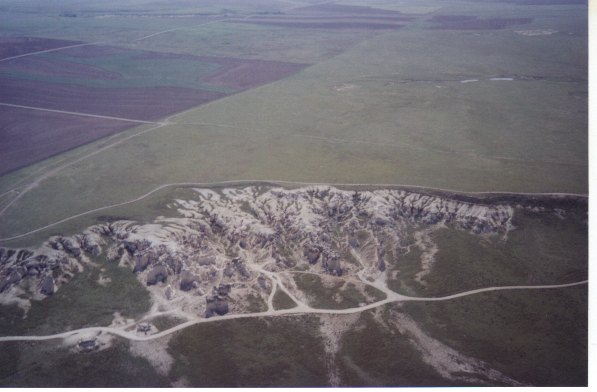
Either route you take will put you on the South side of Castle Rock. Unless somebody runs over the sign, It is a well marked entrance. Any Kansas map worth buying will have Castle Rock marked on it.
So, why is it called Castle Rock? A lot can be learned by stopping in at the DQ in Quinter. They have one of those "tourist racks" with brochures, and in that rack, you should find good stuff about Castle Rock. But to answer the question, if you go about 8 miles East, and maybe a touch South, there is a ridge that one can see the "rock" from. From this angle, it appears to be a Castle standing on the prairie. Most people believe it has to do with the "tower" standing to the North of the main outcroppings, but, sorry, that's not why.
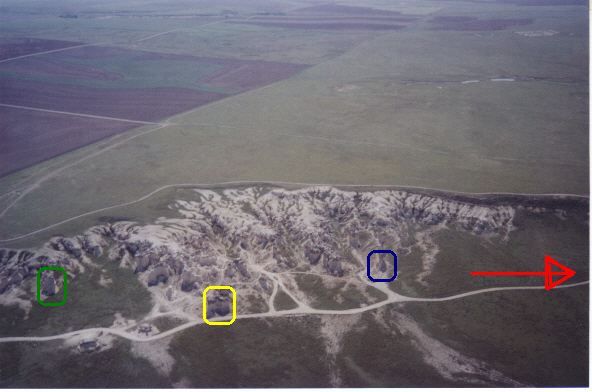
The red arrow points the way to what everyone simply calls the "Tower." Follow the road and have a looky. It used to be a great climb until the top fell off. How sad. Take a look, but not really worth climbing anymore.
The big blue square. That's where I spend most of my time climbing. I call it the "First Mesa." The route is on the East side, and I have named it "Elixir." There SHOULD be a rappell station on top, but if you climb, you know nothing is guaranteed.
The yellow square. This is called the "Road Mesa" because the road runs so close to it. There are several good routes here. My favorite is "Encomium" and is on the East end of the Mesa, the wall faces more North...don't worry, I'll get more detailed later.
The Green Square on the left? That's simply called the "Last Mesa" because it's the farthest from the Tower. There's a decent crack climb on the South face of this mesa called "Errant."
There are SO many climbs here, that I simply can't list them all. I'm just going to touch on the best, and the one's that actually NEED climbing gear. With all the canyons, slots, and rocks, every surface is climbable
First off, let's talk anchors. If you are not familiar with Kansas limestone, it is a strange rock. Cams will usually hold, I've had good luck with hexes, but nuts won't hold. They might work for an aid move, but I wouldn't want to fall on a nut at all. Pitons and long bolts do work. Long bolts means something at least 4 inches in length, and they need to be 1/2 inch diameter. My preference is 1/2 by 6 inch bolts. But the 4 inchers work, at least, I've yet to have one pull. 3/8 bolts are NOT acceptable. I HAVE pulled and bent 3/8 inch bolts. The rock is simply too soft.
And a WARNING! People WILL pull your bolts if they can free climb to them. I've seen huge chunks of rock pulled down because MORONS chained the bolts to a pickup and took off!! My advice.... get sleeved bolts that can be removed when you go. Most of the climbs here are top roped and can easily be walked off of.
Another word of caution. Don't climb after a rain. How long to wait after a rain depends on the rain. I'd say wait at least 24 hrs. The rock soaks up water and becomes very soft.
A technic I use to gain a "summit" is the "hammer throw." I tie my rock hammer to at least 50 foot of 8mm cord, spin it a few times at the end of a couple foot of cord, and release at the right moment, hopefully sending it over the wall. If done correctly, the hammer will sail over the "fin" of rock, and land on the other side. Then I pull my static line over the fin, and 2 of us ascend at the SAME time. Each person on each end of the rope. This method requires good communication, but some of these climbs are too short to safely lead. Wherever I have to use this method to gain the summit, there should be a rappell anchor on top. But I only leave anchors where "non-climbers" can not go. I have rappelled off using this method, too, but it is more difficult to descend for some reason.
Some illustration for my words....
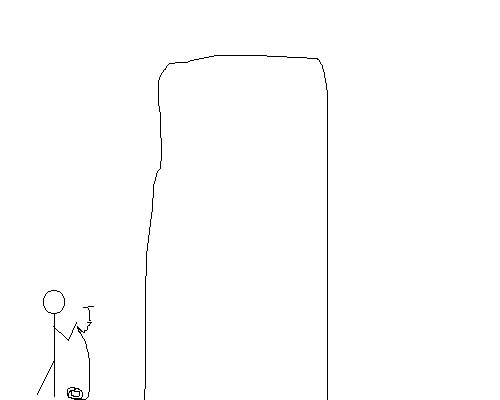
Winding up the hammer to be tossed over the fin.
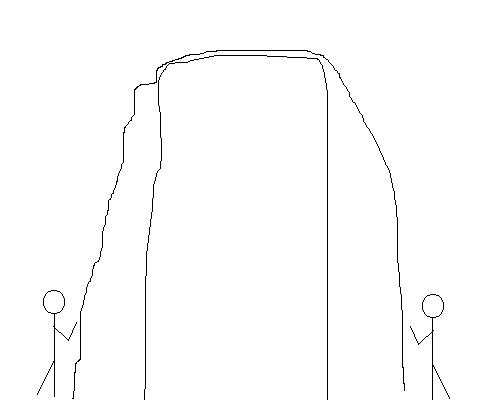
Then each one ascends each side of the fin. Just make sure you both start at the same time, and you both reach the top simultaneously. If you have not visited Castle Rock, this "fin" idea might not make sence. I believe once you are there, it will become more clear as to what to do.
A slight variation is for one to ascend while the other is clipped into the rope, acting as an anchor. Then the person on top is the anchor, or ties the rope into an anchor for the other to ascend.
Okay, on to the climbing!!
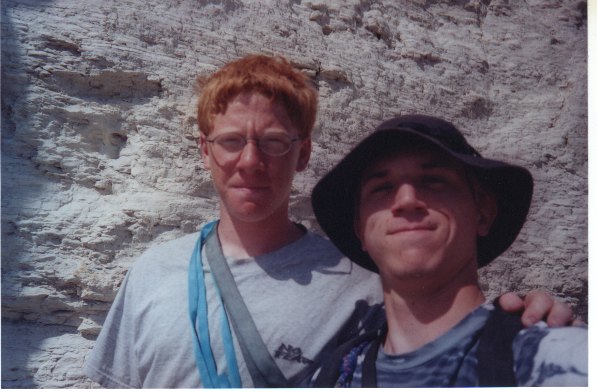
Pictured in the above photo is my friend David. (Standing behind me with red hair) This was taken in July of 1999. We climbed every climb we could that day, and were sorry when we ran out of daylight. This photo is taken at the base of the Tower. But I know you're here to get beta, not oogle my friend.
return HOME