
Viola sororia
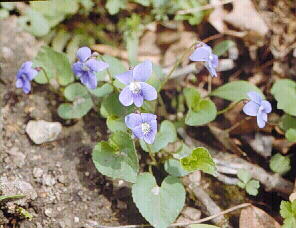
Sometimes called: dooryard, common meadow, common blue violet
Origin: native
What is it? a dainty herb of wet or moist woodlands, gardens and disturbed soils, with perky, colorful flowers. More often called the
"common blue violet," I prefer the regional Missouri name of
Meadow violet (simply because I feel it�s a prettier name).
Flower: unusual; a deep violet-to-lavender or white flowers, 1" in diameter,
each with 5 distinct petals; center of the flower white with the 3 lower
petals strongly veined; flower are often found below the leaves and
bloom on their own stalk
Height: 4-10"
Leaf: characteristically heart-shaped, scalloped teeth, hairless, each leaf
rising from the base of the plant on its own stalk
Bloom time: spring
cycle: perennial
They're beautiful! Isn't that enough? They're incredibly hardy, but daintily beautiful. The people of Illinois and New Jersey have recognized this, naming V. Sororia as their state flower. As well, the leaves are high in vitamins A & C and have been used in salads or cooked greens. The flowers can be made into candies and jellies.
Meadow violets are rather well-adapted to lawns and roadsides. Have you ever seen a
lawn that seems literally carpeted with these beautiful little flowers? It manages this not by seeding (although it does produce seeds), but reproduces mostly by underground runners (rhizomes) and hence can take over a lawn or a roadside in a hurry. Violets are relatively short-lived Spring flowers, though, and the blooms are gone within weeks.
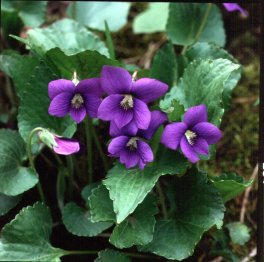
American and over 900 worldwide. The familiar garden annual, the pansy, is also a member of this same family. Meadow violet is one of the so-called "blue violets," all of which are nearly identical at first glance. Oddly enough, none of the so-called "blue violets" are actually blue, but rather display varying shades of purple, violet, or lavender. The color is so variable and the flower shapes so similar that the flower itself is of no use in distinguishing one species from another. For example, the only discernable difference between the Meadow Violet (V. sororia) and the Wooly Blue Violet (V. papilionaceae) is that the leaves of the Meadow are hairless, unlike the Wood. There does not seem to be a uniformity in classification, and four different
wildflower identification books can attribute a different name and classification to the sameflower. Because of this, actually, many botanists have begun lumping many of the blue violets together into one species (V. sororia).