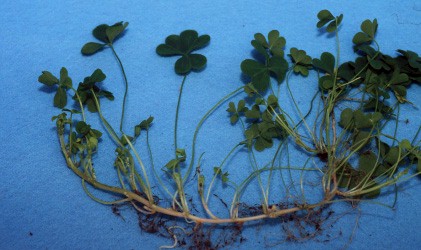
Oxalis europaea
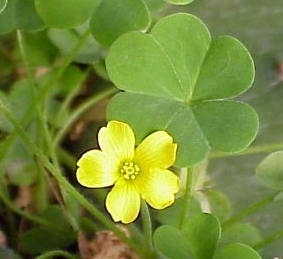
Height: 6-15"
Origin: non-native
What is it?
A dainty, yet tough native annual which forms stubborn colonies and blooms all summer long with tiny yellow buttercup-like blooms.
Flower: 1 to many bright yellow flowers, 1/2" wide, with 5 petals
Height: 6-15", but can grow much shorter if it has adapted to mowing
Leaf:
Each leaf is divided into 3 heart-shaped leaflets, resembling a compound clover leaf. Each life also has a center crease, along which the leafs can fold up
Bloom time: spring through autumn
Cycle: an annual in the North, perennial in more temperate states.
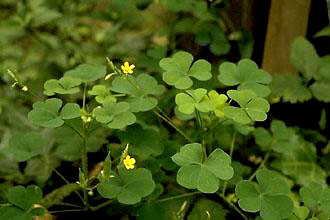
Yellow Wood Sorrel (Oxalis europaea), is an introduced North American plant which may grow either as an annual or as a perennial, depending on the harshness of the winter. This delicate-seeming plant forms colonies which arise from slender but tough underground stems (rhizomes). That's why this beauty is so hard to destroy in lawns. For protection from the elements, Wood Sorrel folds its leaves up at night and opens them again in the morning. It also folds them up when under stress, such as when growing in direct sun, or during storms. Wood sorrel prefers moist soil, and partial shade, but is also commonly found growing through the cracks in sidewalks. I've seen it growing both through and along sidewalks, alongside trails, in lawns, and in flower beds and gardens.
Wood sorrel starts blooming in mid-spring and continues to produce flowers through mid-fall. So if you're looking for attractive, easy maintenance flowers, Oxalis europaea fits the bill.
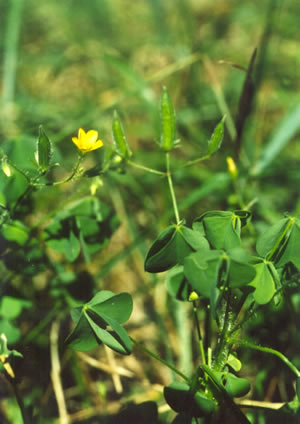
Finally, although I have never tried it, the literature says that wood sorrel is both thirst-quenching and refreshing to eat (Consult an expert before eating!). The leaves, flowers, and immature green seed pods are all edible, with a sour, lemon-like flavor (the sourness comes from oxalic acid, which can be poisonous if consumed in large amounts). It can be added to salads, used in soups (the same way as garden sorrel), used in sauces (traditionally served with fish), or used as a seasoning. A chilled, sweetened, wood sorrel tea makes a refreshing beverage along the lines of lemonade. Wood sorrel is quite high in ascorbic acid (vitamin C) and may provide other nutrients but, as with many of our common plants, the research appears scanty to non-existent.
Anyway, stay on the lookout for Yellow Woodsorrel- I'm sure you'll appreciate him as I do.