|
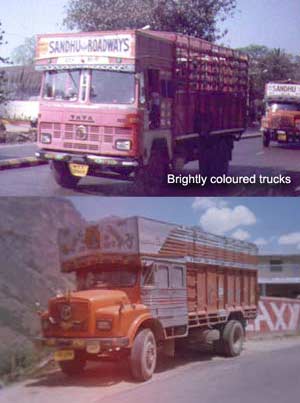
The trucks that are the lifeblood of India's freight network, all bear the name TATA. In any color you want, as long as its orange, these square heavy vehicles, lumber round India in great densities, probably outnumbering cars outside of cities. The drivers decorate them individually with their prefered slogans and pictures - you'll often see a face or a flower on the differential - but no matter how decorous the paintwork, the vehicle itself is bound to be decrepit and filthy. During my journey I saw many TATAs which gavwe the appearance of having collapsed where they stood, slumped into the road. Some seemed to have capsized off the side of the road, such that I couldn't help but wonder if the drivers were sober, and many more were parked at random roadside spots, surrounded by stones, and with a branch sticking out - this means they've broken down, and often as not, another one will have stopped to help. |
On a long road I would notice frequent TATA stopping points, where there would be loads of them parked up, chai and food being served, and most importantly, mechanics. Sometimes there would be several hundred metres of this caravanstead on the outskirts of some small town. Driving one of those things must be even slower and more prone to breakdown than an Enfield.
Indians seem such mild mannered and timid people when you confront them face to face, and as pedestrians, they're mostly harmless. But it seems when they get behind the wheel of a motorised vehicle, their sense of self importance inflates in proportion to the size of the motor, creating a highway caste system. Cyclists set the pace in built up areas by their sheer number, and because they set the pace they can occupy the whole width of the road if they please. Scooters and rickshaws need to jostle with pedestrians for passsage, whereas a larger bike can often scatter them with its extra weight and speed. A cyclist, hearing any motor behind him, will hopefully slip off the tarmac into the dust, if he doesn't wobble the other way first. All bikes much give way to cars, which with their extra wheels, weight and width, can afford to be much less cautious with the road and its bumps and other users. Then the 4 wheel drivers, radiating cool with their tinted windows keeping India out of the car, can really hurtle along, but even they have to give way to the TATA, portly kings of the road. If one TATA sees only bikes ahead he may decide to overtake another, then there's no turning back - the two of them will block the highway for as long and as far as it takes. Enfielders can eat dust. Courtesy? Forget it! Servility? Indians know their place in society and in the road using community, and they play both of these roles to the full.