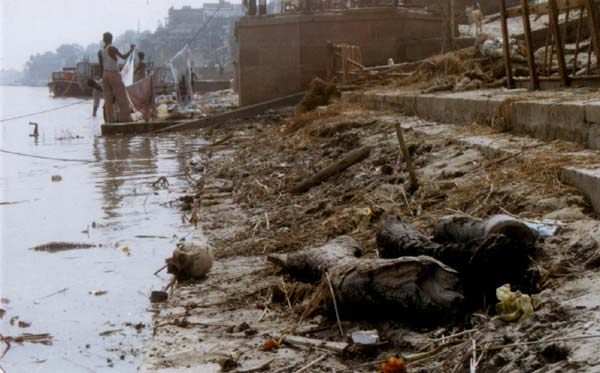
| Even apart from all you've probably heard about Indians bathing in the Ganges filth, Varanassi is a disgusting city, especially the narrow streets behind the Ghats (stone steps leading down to the river). Dead vegetable and animal matter are swept into stinking heaps. Then the cows come and eat the plastic bags of trash, and the dogs come along and shit on it. A man can piss anywhere by crouching with his legs apart. The usual sense of decay in all india is all the more evident in the shabby grandeur of some of the buildings. This temple in the picture is in good condition apart from the pile of rubble lying in front of it.Some parts of the ghats are used as human lavatories making the atmosphere in the overlooking hotel rooms a tad pungent at high noon. And the ghats are littered with effigies recovered from the water, broken bits of boats, mud from the monsoon, tattered clothing drying in the sun, recovered pyrewood. At the still water's edge between the tied up boats, all kinds of floating trash and religious leftovers can be found. Raw sewage is dumped just upstream on the same side. When Judith chanced upon a floating unburned corpse one morning, it was only metres from a group of bathers. | 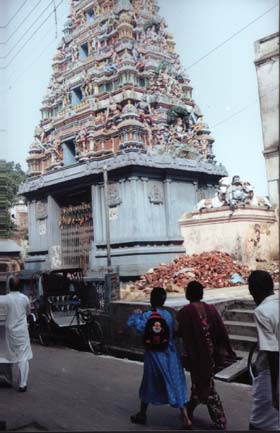 |
I shudder to watch puilgrims submerse themselves in it and scoop it up to drink from their hand, and take some home in a bottle for the spiritual benefit of the family.
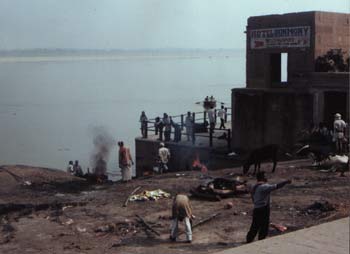 This ghat, is used for burning the less clean dead. Its not very ceremonious. On the main bruning Ghat photos are not permitted. |
The main funeral ghat burns around 250 bodies per day, and ferries purer corpses (sadhus, children, the pregnant) out to the middle for direct dumping. Murdered people are sent to a less holy ghat. Tourists are told the appaling cost of Banyan firewood, and asked to contribute: "Body burning six hours make 300 kilos wood. One kilo wood is 150 rupees that make 45000 rupees how many kilos you buy?" The jewellery of the deceased is cast into the sacred slurry stream and then sifted out by untouchables to provide for the attached hospice. Deepti said she made friends with a Sadhu here who specialised in eating bits of leftover corpses. |
| In India any activity or belief can be a path to the divine. My path these days is doing exactly what I want though I can't quantify how close to the divine this leads me. This method certainly puts the responsibility for my happiness squarely on my own shoulders though, which is where it should be. And insofar as my final goal be considered spiritual then doing exactly what I want is a spiritual path. But I don't need to tell you about prevailing philosphies of the West. Seriously, I think Indian religion is mostly primitive. I don't have a high opinion of most of the religion that goes on, but Hinduism seems still to be in the middle ages. I've noticed that religion often starts with a genuine experience, then gets written down, interpreted, and hierarchies are made and cultural accrutions accrued. Then by the time it gets to the poor and illiterate, it's just fairy stories and random superstitions which transmit absolutely nothing of the original experience of divine love, and which serve more to aggravate the differences between people than to emphasis the one-ness of Creation. Nowhere is this more true than in India, where such superstition pervades all aspects of life. | 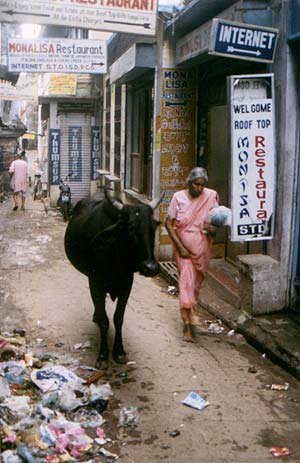 |