|
Bombay Luck |
January
2002
|
| Its been a week and I'm still where I started, in Bombay, staying with Purvi, a recently qualified interior designer, and her family. The house is a spacious apartment on 3 marble tiled floors, has a security guard at the gate, 3 servants, and a cleaner, so I'm dead lucky! In addition her father owns a construction company and runs the business from here, so with two extra office workers the house always seems very full. The computer and the shrine are both in Purvi's brother's bedroom, and I get the impression that even in this affluent household, expectations of personal space are very different to English ones. Also notable is the fact that I've smoked nothing and seen no alcohol since I arrived, though I'm sure that'll will change when I get to Goa. The servants rub a white cream into tobacco before chewing it, but I didn't fancy that one little bit. |  |
|
It's quite a privilege being waited on hand and foot;. I have merely to say coffee, and I will be presented with a sweet milky instant coffee with a glass of water on a tray. My clothes are washed and ironed, the floors are swept and wiped with a damp cloth twice a day. Meals prepared and served and washed up. And the servants themselves are no trouble. They drift around the house looking for ways to be useful then sleep out of the way on the kitchen floor under a squeaky fan. They work 9 months of the year in the house apparently with no leave, or posessions, and then go back to their lives for the other three. Purvi says there's a high turnover in this house because her mother, who's fulfills her traditional role in the family as a bonding agent, but still has a lot of time on her hands, isn't very nice to them. We've played juggling and unicycling, and I've learned a few words of Hindi, though they haven't let me eat off the kitchen floor with them yet, but prefer to jokily serve me meals at the high table and laugh at me eating with my fingers in the wrong order. The natives seem to have a certain innocence. After millennia of being largely peasants whose surplus was creamed off to make the local kings very rich, and then being ruled by muslims, then the British, then by their own educated classes I've see not a shred of resentment of the wealth of the rich even from the very poorest. Unlike in South Africa, where the black resentment of whites is fully justified, and manifest in crime levels - here there are many rich and many poor crammed into a narrow space and it seems like everyone accepts their lot with good grace. Purvi has recently graduated as an interior designer and is getting to grips with 3D modelling. There is a cable modem here (though rather disappointing as the whole city seems to be sharing one ISP) and my hard disk plugged in like a dream. So far so good. I've been walkabout a few times but concluded that the house is by far the best place to be - I'm not really interested in tourism. Since nobody indicated I should leave, and my presence adds significantly neither to the claustrophobia of the house nor the running costs, I set myself the task of convert her current project into Director 3D, where the client can view it interactively. This will look good good on both our websites.
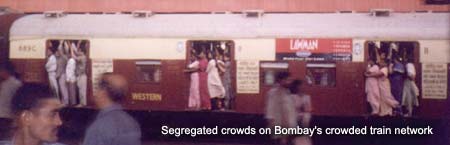
The city centre is over 20km away, and the best way there is by rail. The trains here are on a wider gauge than UK and the carriages are wider. They seem to be perpetually full to overflowing with people hanging out the doors at peak times. First class is differentiated by price only. (If its more expensive, its less crowded). In the middle of the crush sometimes a man pipes up, "tickets please!" and after everyone has reached down into their pockets and presented them, he exits with a couple of hostages. The railway lines are awash with the poorest people scavenging, cooking, sleeping, wondering about, living in the open; Sometimes even growing stuff. The whole city feels that crowded. The streets always seem full, and people live wherever they can find a quiet spot. I've seen families eating a meal on the pavement, and corrugated villages seem to grow like fungus on wasteland. Everywhere in the world, train tracks seem to run behind places, and views from trains are the most squalid of all. |
 |
Walking the streets I noticed open drains under construction everywhere. Apparently that's why there are so many mosquitoes in the house at night at the moment. Once constructed the drains are host to foetid stagnant sludge - but at least they are mostly covered in this posh street. Civic engineeering is one of those things that gets first neglected when people in responsibility start appropriating money. The newspapers talk about political corruption on every page. It was discovered recently that the transport ministers offices were being used for a scam where jobhunters paid bribes to con-artists promising them a job in the state airline. The papers are wondering how the minister could not have known that his offices were being used by unknown people! What is worse is the implication that somebody thought they could get away with it! Maybe they will yet! One popular ploy for a political candidate with shall we say a rather bad criminal record, is for his wife to stand. |
|
People who fight the system using legal means are sometimes assassinated - in Bombay, one of the more westernised cities. In the remoter parts, like Bihar, politics is totally beyond the law, its more a matter of gun battles and family grudges. With all this in mind after my trip downtown to see the gate of India, I resolved to take a trip over to New Bombay, on the mainland. The idea with planning a New Bombay was to create a nodal, organised city, to cope with the natural expansion of Old Bombay's population. After the train traversed a mucky estuary the stations suddenly became larger, cleaner, but looking further afield, I noticed that around half the buildings in this new metropolis were unfinished. Leaving a station at random and traversing an empty carpark, evidence of planning was rife. Wide streets, adventurous architecture, apartment blocks with shop units underneath - but I still got a similar impression to the Old city, in that every unused tract of land was either a building site or a rubbish dump - and everywhere breakage and decay! The place was less crowded, but the numerous shells of incomplete buildings, and the sparse population gave it an apocalyptic air. (I must have forgotten my camera that day). I was glad to stray a few hundred yards further out to a village on the estuary-side and the streets became tiny and windy and crowded with children, chickens, cows, auto rickshaws, little businesses and the thousand other things that happen on India's packed little roads. At least it felt alive! |
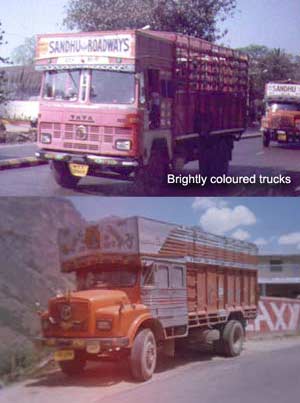 |
One of the first things I noticed about india, was the assault on my senses of bright colors, strange sounds and (usually offensive) smells - not to mention strong flavours that I already associated with India. In comparison, England is like living in a bubble by comparison. Lorries for example, are all decked out garishly and annotated with exhortions to righteousness, their windscreen idols adorned by flickering Christmas tree lights. Europeans call it kitsch, but here it's just another splash of colour in life's painting. On the tail of each truck is a clear safety message, SOUND HORN. The indians don't need to be told twice. from a hundred yards behind you, you'll hear a the racket of a vehicle approaching - then he'll give you a melody (if you're lucky) on his horn, in case you the engine, the brakes, and the judders. |
|
Auto rickshaws don't blow their horns, they rasp as if the battery is on its last legs, and when the road is narrow and traffic is stuck in both directions, you'd think whoever made the least din had to back up. Its not all offensive though. Reversing sirens range from beeped fur Elise to beeped Jingle bells. One day a strange very coarse twangy noise wafted up, like someone plucking a longbow. It turned out to be a some sort of bedmender, using his tool to advertise his passing, I mean his proximity to the house. One woman got on the train and started ullulating in a tone I've never heard before. I was too spooked to give her cash. And sometimes I've seen Tibetans, not monks, sitting outside a building, not begging, but chanting - just adding to the noise and the inevitable bustle of the street. Then there are the dogs who in certain parts of town, bark ALL night. The poorest stallholders selling from a blanket on the pavement will burn insense outside??? three sticks at a time! Perhaps the most invasive of the senses to be invaded is the sense of personal space. That's not normally considered a sense, but it is when you are being touched all the time. I was watching that Munchie didn't run under a bus the other day, when the very bus slammed into my back! But all the time the streets are so full, beggar children hang of your clothes, vehicles squeeze past at no uncertain speed with inches to spare, sometimes less. Groups of Indian boys will handle each other like homosexuality is in fashion, and they're often not afraid to put their hands on Western women! India is the most densely populated country in the world (and they still make room for Tibetans) and maybe that helps explain why Indians seem to have no concept of personal space, or quiet space. To be in the city is to be surrounded by thousands of people living their lives in public just yards from wherever you go. A family having a meal on the pavement, someone pissing into a pile of rubble, a kitchen on a pedestal selling daal and rotis, a line of homeless people asleep, and everyone rubbing shoulders with everyone else. Before I go and see Sai Baba I'm going to have a look at Goa, though I'm not really a party animal. The beach will be nice. Matthew |